Webb Sheds Light on Rare “Extreme Debris Disks”
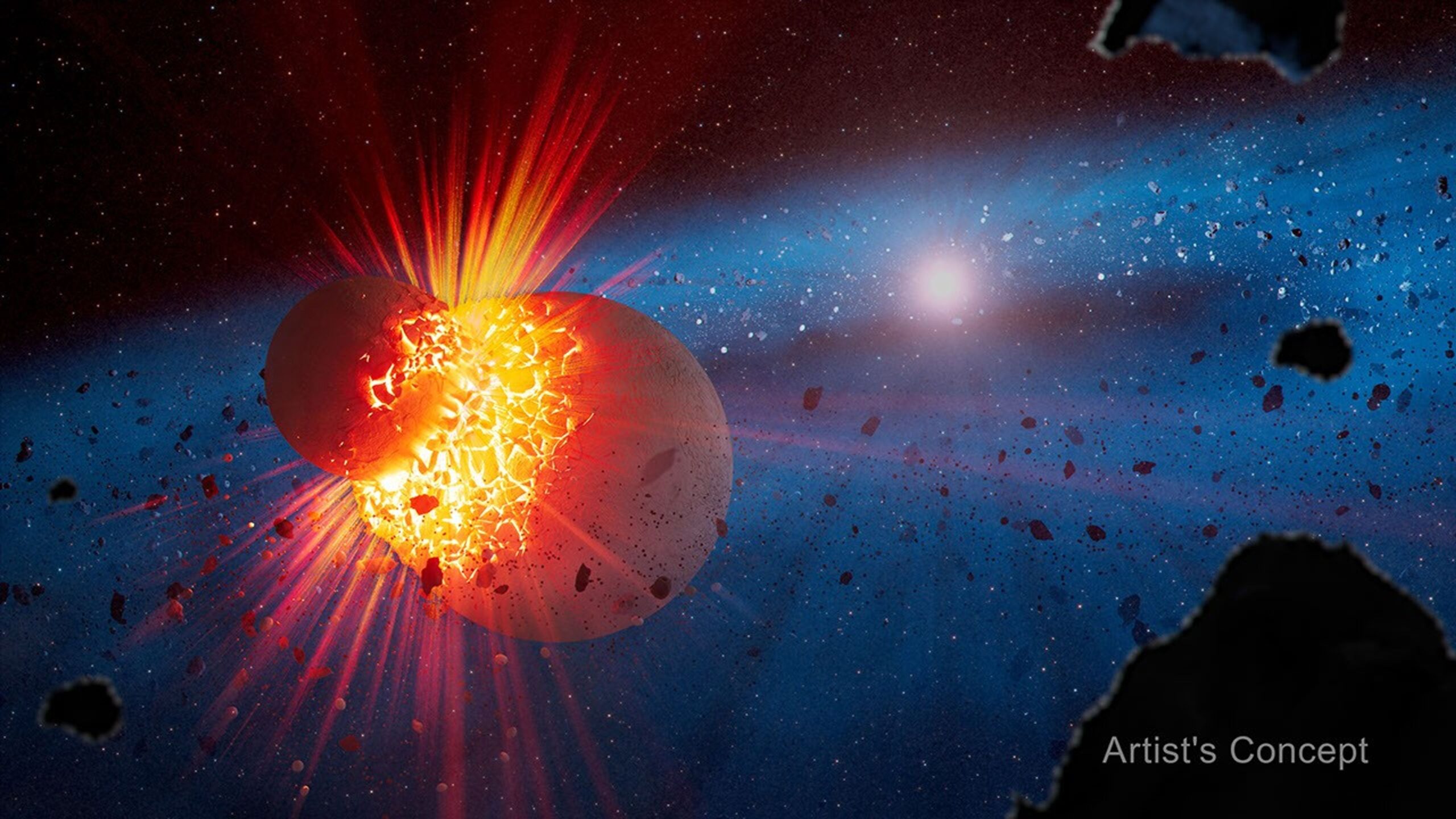
When our solar system was still in its infancy, a catastrophic collision between the proto-Earth and a Mars-sized body named Theia obliterated massive quantities of rock, ultimately giving birth to our Moon. Now, observations from NASA’s James Webb Space Telescope are shedding light on distant young stellar systems enduring the very same planet-shattering cataclysms, providing astronomers with an unprecedented look at how terrestrial worlds take shape.
As infant stars age, the dense gas surrounding them gradually dissipates, leaving behind rings of rocky fragments known as debris disks. Within these environments lies an elusive subclass called “extreme debris disks,” distinguished by immense amounts of warm dust concentrated right where terrestrial planets orbit.
Although planetary formation models predict that such environments should be abundant, observations reveal that only around 1% of young stars showcase this dramatic phase. By coupling Webb’s state-of-the-art instruments with archival data from the retired Spitzer Space Telescope, researchers compiled a benchmark catalog of 21 extreme debris disks to decode what these violent phases mean for planetary evolution.
Dust Chemistry Decodes the Violence of Cosmic Impacts
Utilizing Webb’s sharp mid-infrared spectroscopy, astronomers analyzed the mineral composition of the swirling dust. The data revealed two primary classes: silica-rich systems and silica-poor systems, each telling a very different tale of destruction.
Silica-rich disks make up about one-third of the sample and are generated by high-energy smashups between Mars-sized protoplanets that vaporize huge volumes of solid material. Notably, these intense impacts are restricted to stars younger than 300 million years. Meanwhile, silica-poor disks stem from lower-energy, grazing strikes between Moon-sized bodies and persist across a much wider span of stellar ages, showing dynamic fluctuations in infrared brightness as debris rapidly interacts.
A Direct Window Into the Early History of Our Solar System
These findings provide critical context for the timeline of our own cosmic home. The age bracket of silica-rich disks aligns closely with estimates that Earth and the Moon formed approximately 100 million years after the Sun, validating theories of high-energy planetary impacts in the inner solar system.
Additionally, the persistent dust and orbital turbulence seen in older, silica-poor systems mirror the conditions of our solar system’s Late Heavy Bombardment, during which migrating gas giants destabilized smaller rocky bodies. By capturing the fallout of these distant smashups, Webb is helping scientists assemble the broader evolutionary story of how violent construction zones ultimately transform into habitable worlds.
Reference:
NASA – NASA’s Webb Provides Crash Course on Planet-Shattering Collisions