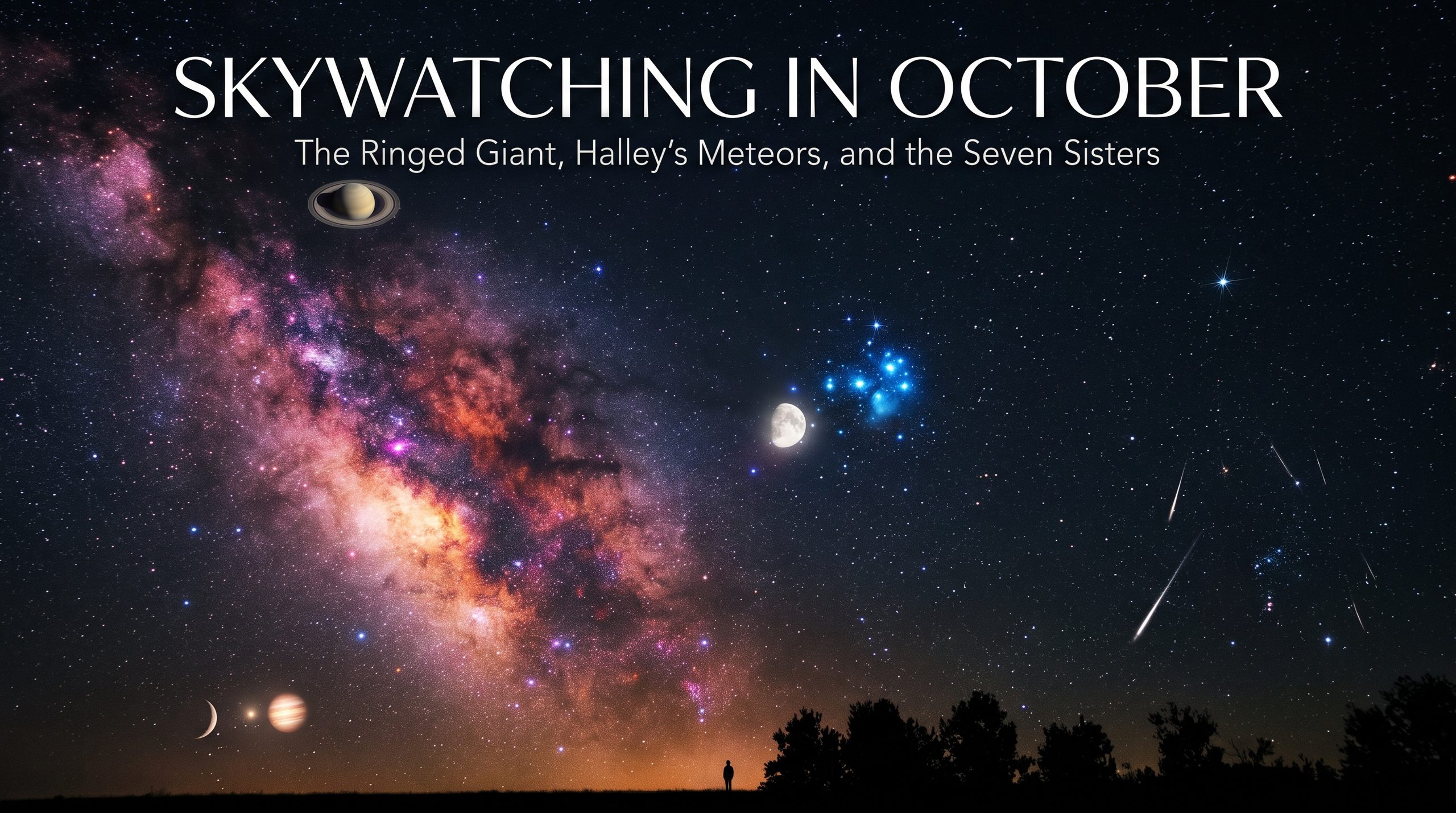
Skywatching in October 2026: The Ringed Giant, Halley’s Meteors, and the Seven Sisters
October’s cool, crisp air brings some of the clearest and most rewarding night skies of the year. Whether you’re armed with a backyard telescope, a pair of binoculars, or simply your own eyes, this month is packed with must-see cosmic events straight out of NASA’s October highlights.
Here is your essential field guide to the autumn skies.
The King of the Rings: Saturn Shines at Opposition
Kicking off the month, Saturn reaches opposition, sitting directly opposite the Sun from Earth’s vantage point.
- When to look: All night long throughout October. It rises in the east around sunset and climbs high into the midnight sky.
- Why it matters: Opposition marks Saturn’s closest approach to Earth, making it brighter and larger than at any other time this year. If you have access to a small telescope, you can easily spot its majestic ring system—and ponder the complex, shifting jet streams swirling around its poles.
Dawn Duet: A Slender Moon Meets Radiant Jupiter
If you’re an early bird, make sure to step outside just before sunrise.
- Look low toward the eastern horizon to see a whisper-thin crescent Moon hovering right beside a dazzling Jupiter.
- The contrast between the earthlit crescent and the giant planet makes for an effortless, stunning photo opportunity without any fancy gear.
Fire from Halley’s Comet: The Orionid Meteor Shower
Mark your calendars for the night of October 21 into the morning of October 22, when the Orionid meteor shower reaches its annual peak.
- The Origin: Every streak of light you see is a speck of cosmic dust shed by none other than Halley’s Comet, burning up as it slams into Earth’s atmosphere.
- Viewing Strategy: A bright moon will brighten the sky for part of the night, so the prime viewing window opens in the pre-dawn hours right after moonset. Find an open field away from city streetlights, lie back, and let your eyes drink in the dark.
A Cosmic Close Encounter: The Moon and the Pleiades
Wrap up your month on October 27–28 by watching a classic celestial pairing.
- The Moon will glide past the Pleiades (also known as the Seven Sisters or Subaru in Japan), one of the closest and most celebrated star clusters in our galaxy.
- While the cluster appears as a soft, luminous cloud of six to seven stars to the naked eye, sweeping over it with binoculars transforms it into a brilliant jewel box of vibrant blue suns.
Key Moon Phases for Your Calendar
- Last Quarter: Oct 3
- New Moon (Best for dark-sky hunting): Oct 10
- First Quarter: Oct 18
- Full Moon: Oct 25
Grab a warm jacket, brew a hot drink, and treat yourself to the wonders unfolding above us this October. Happy stargazing!