Unveiling the Red Planet: The True Story Told by MAVEN
The crimson glow of Mars in the night sky has captivated human imagination since ancient times.
Today, the planet we observe is a desolate, cold, and arid desert world.
However, compelling evidence suggests that billions of years ago, Mars was a warm planet enveloped in a thick atmosphere, with liquid water flowing across its surface.
The profound mystery of how an environment capable of nurturing life transformed so drastically is exactly what the MAVEN mission sought to unravel.
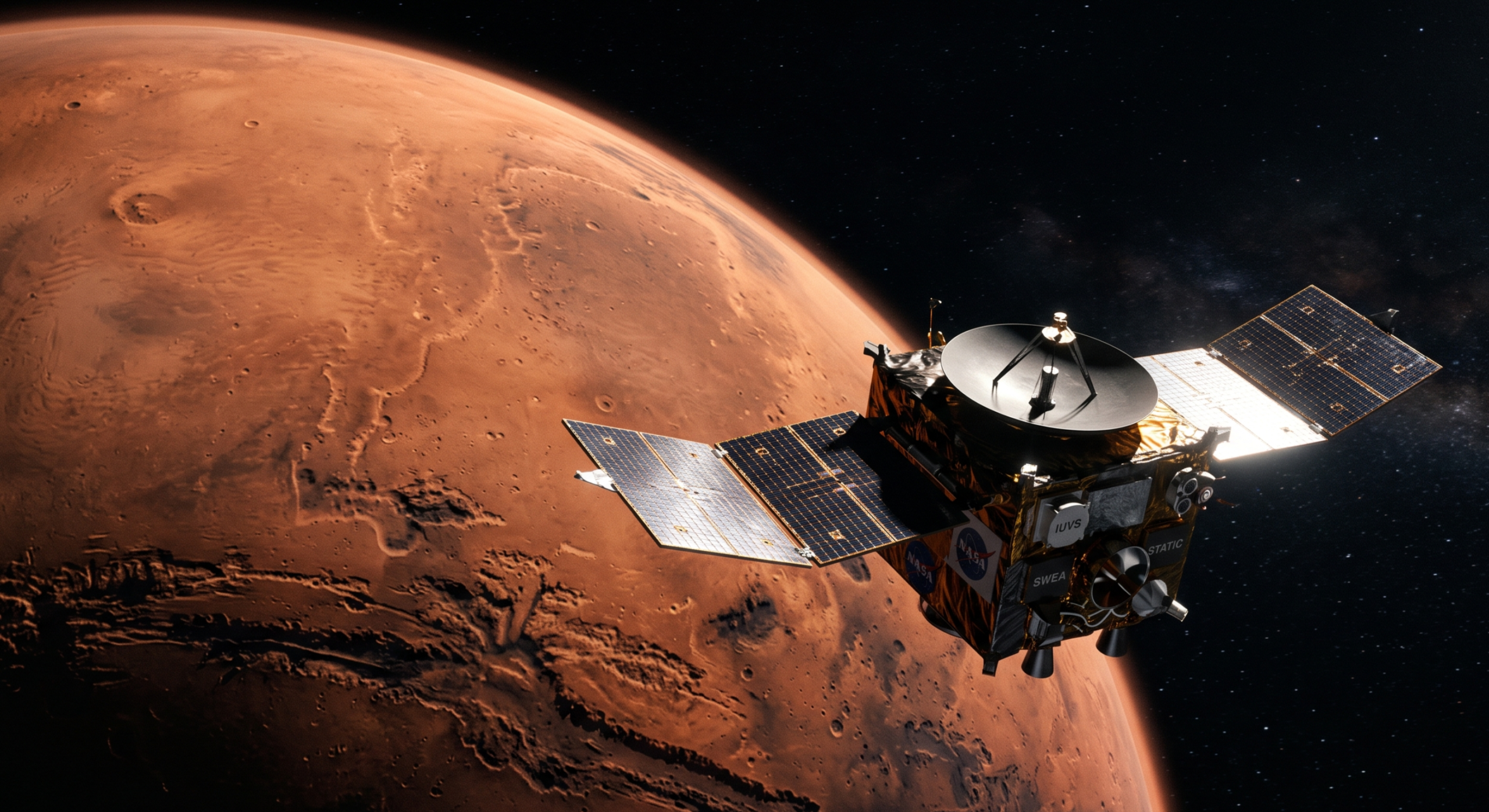
MAVEN, which stands for Mars Atmosphere and Volatile EvolutioN, was specifically designed to investigate the Martian upper atmosphere, its ionosphere, and their intricate interactions with the solar wind.
Launched from Earth in November 2013, the spacecraft successfully entered orbit around the Red Planet in September 2014.
While previous missions primarily focused on the dusty surface, MAVEN was a groundbreaking endeavor dedicated to examining the invisible veil of gas surrounding the planet.
Flying in an elliptical orbit ranging from roughly 150 kilometers to several thousand kilometers above the surface, it continuously and precisely measured atmospheric composition and escape rates.
The unprecedented data returned by this spacecraft became the decisive puzzle piece in understanding how Mars lost its atmosphere and experienced such radical climate change throughout its history.
The Solar Wind and the Mechanics of Atmospheric Escape
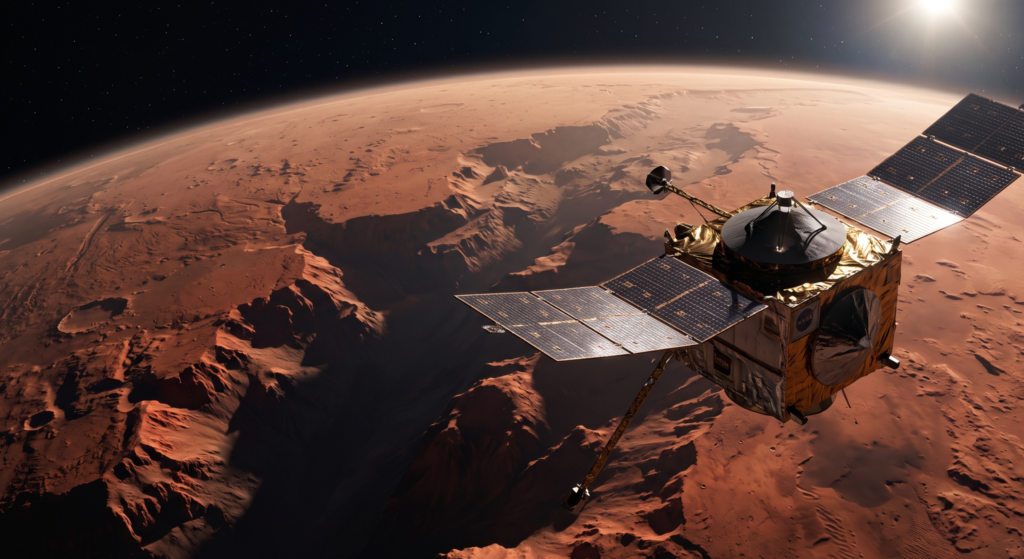
The most revolutionary discovery brought about by MAVEN’s observations was capturing the direct process of the Martian atmosphere being stripped away into the void of space.
Earth possesses a robust global magnetic field that acts as a protective shield, deflecting the solar wind, which is a continuous stream of high-energy charged particles blowing from the Sun.
Unfortunately, Mars lost its planetary magnetic field billions of years ago.
Without this crucial shield, the Martian upper atmosphere is left completely exposed to the relentless bombardment of the solar wind.
MAVEN successfully observed a phenomenon known as atmospheric sputtering in real-time for the first time on a planet other than Earth.
This occurs when high-speed ions from the solar wind crash into the Martian atmosphere, knocking gas molecules out into space much like the break in a game of billiards.
Scientists confirmed that the rate of this atmospheric escape accelerates dramatically during intense solar storms caused by solar flares and coronal mass ejections hitting the planet.
Over an unfathomable span of billions of years, the once-thick atmosphere was gradually eroded away by the constant pressure of the solar wind.
Furthermore, MAVEN revealed that massive global dust storms significantly elevate water vapor to unexpectedly high altitudes, thereby accelerating the loss of the planet’s remaining moisture into space.
The End of an Eleven-Year Watch and an Enduring Legacy
Operating well beyond its planned one-year primary mission, MAVEN completed multiple extensions and continued to beam invaluable scientific data back to Earth for over eleven years.
Beyond its own scientific pursuits, it also served as a critical communication relay infrastructure, transmitting data from surface rovers like Curiosity and Perseverance to scientists waiting back home.
Tragically, in December 2025, communication was abruptly lost as the spacecraft passed behind Mars.
Subsequent investigations determined that the probe entered an unexpected spin state, preventing its solar panels from facing the Sun and causing a rapid, fatal depletion of its batteries.
Despite months of dedicated recovery efforts by NASA, communication could not be restored, and the mission was officially declared over in June 2026.
MAVEN remains in orbit around Mars today and is predicted to maintain its trajectory for another fifty to one hundred years.
Although it has entered an eternal silence, the immense volume of data collected by this spacecraft has generated over eight hundred scientific papers and fundamentally revolutionized our understanding of Mars.
When humanity eventually embarks on crewed missions to the Red Planet, the insights MAVEN provided regarding the atmospheric and radiation environment will endure as essential knowledge for protecting astronaut lives.
Conclusion
MAVEN showed us the breathtaking story of how Mars changed, leaving us with a beautiful gift of knowledge for the future.
Even though it sleeps now, its incredible journey will always light our way to the stars.