Anatomy of a Cosmic Comet: The Cocoon Nebula and Barnard 168
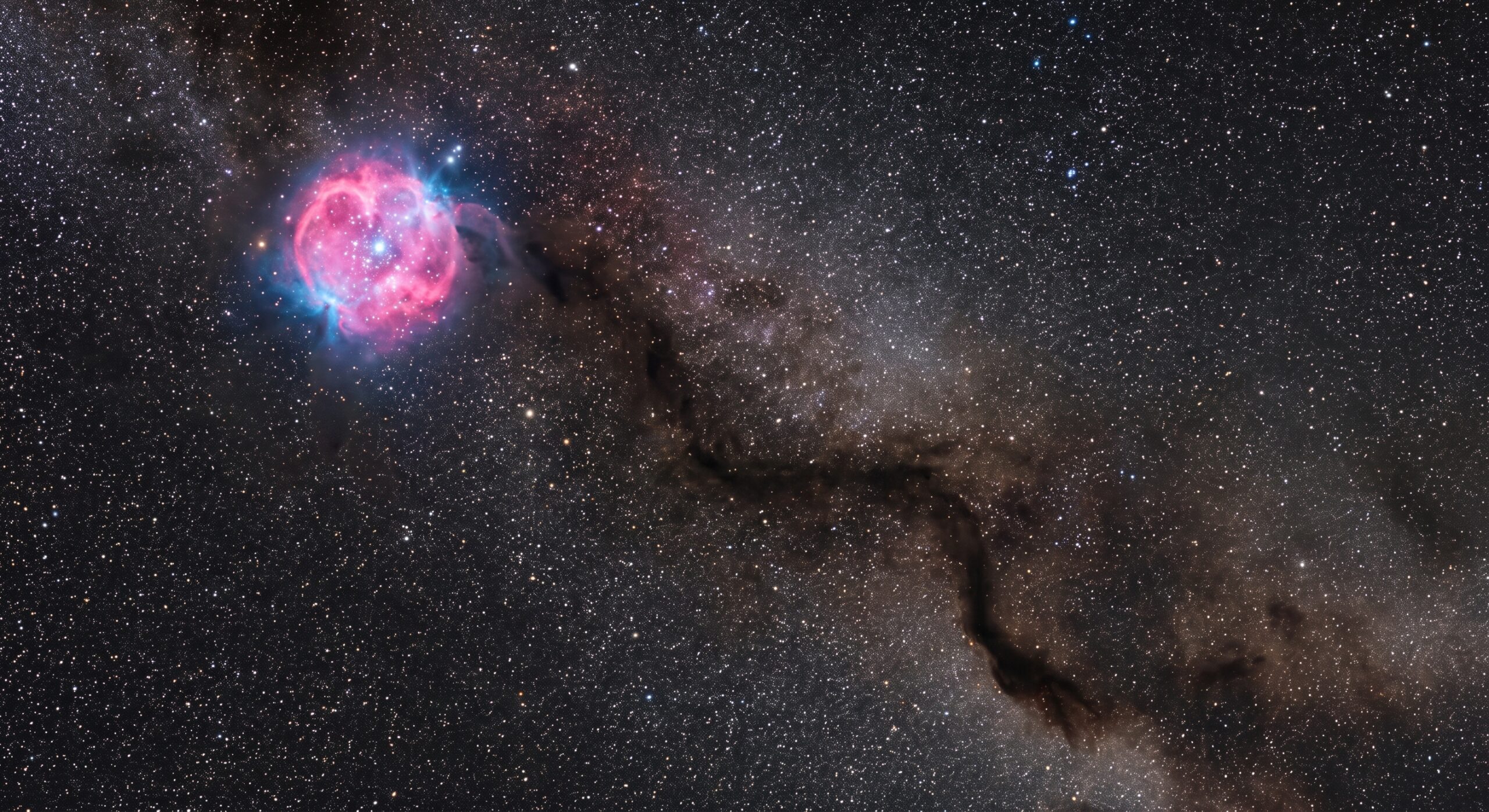
Featured on NASA’s Astronomy Picture of the Day, an expansive wide-field portrait captured across more than two degrees of the constellation Cygnus reveals the dramatic architecture of the Cocoon Nebula (IC 5146). Situated approximately 2,500 light-years away in the plane of the Milky Way, the complex presents an uncanny resemblance to a gargantuan celestial comet plunging through a dense sea of background stars.
The luminous “head” of this cosmic comet spans roughly 10 light-years in diameter, punctuating the eastern terminus of a colossal dark filament cataloged as Barnard 168. While the Cocoon blazes in vibrant color, Barnard 168 stretches westward across nearly 100 light-years of interstellar space. Far from an empty void, this dark absorption tail is an ultra-dense molecular cloud composed of sub-micron carbonaceous and silicate grains. The dense dust completely extinguishes visible optical starlight from background stars, functioning as an active stellar pipeline where gravity is quietly compressing cold gas cores into the next generation of protostars.
Interstellar Dust Energetics: Emission, Reflection, and Cavity Carving
What makes the Cocoon Nebula a premier laboratory for interstellar physics is its hybrid composition: it simultaneously exhibits the properties of an emission, reflection, and dark nebula. At the center of the glowing sphere lies a massive, luminous young star designated BD +46° 3474, estimated to be only a few hundred thousand years old.
This massive B-type star powers the entire complex. Its blistering ultraviolet photon flux ionizes surrounding neutral hydrogen gas, producing the vibrant reddish-pink glow characteristic of hydrogen-alpha recombination. Concurrently, finer dust grains in the outer envelope scatter the star’s blue optical light, creating a delicate azure reflection halo that rims the ionized core. High-velocity stellar winds and radiation pressure from the central star have excavated a expanding cavity within the natal molecular cloud, demonstrating how newborn stars actively disperse their birth cocoons and inject kinetic energy into the interstellar medium.
Gravitational Lensing Mid-Construction: Webb Resolves MACS J0553.4-3342
Expanding our view from local galactic gas filaments to the largest bound structures in the universe, new deep-field observations from the James Webb Space Telescope (JWST) examine the galaxy cluster MACS J0553.4-3342. Located in the constellation Columba at a redshift of $z = 0.412$, Webb captures this gargantuan cluster as it appeared 4.4 billion years ago, caught in the violent process of assembly.
MACS J0553.4-3342 represents a cosmic collision where two massive sub-clusters are actively merging along dark matter filaments. The immense gravitational potential of this combined mass acts as a powerful natural cosmic telescope through gravitational lensing. NIRCam imagery reveals dramatic arcs, rings, and distorted streaks of light encircling the cluster core—the magnified images of ancient, infant galaxies located billions of light-years behind the cluster. By mapping these gravitational distortions, cosmologists can trace the invisible dark matter scaffolding that funnels galaxies together, providing empirical tests for structure formation across cosmic time.