Unveiling the Cosmic Tapestry: Webb’s Breathtaking Panorama of Star Formation in IC 348
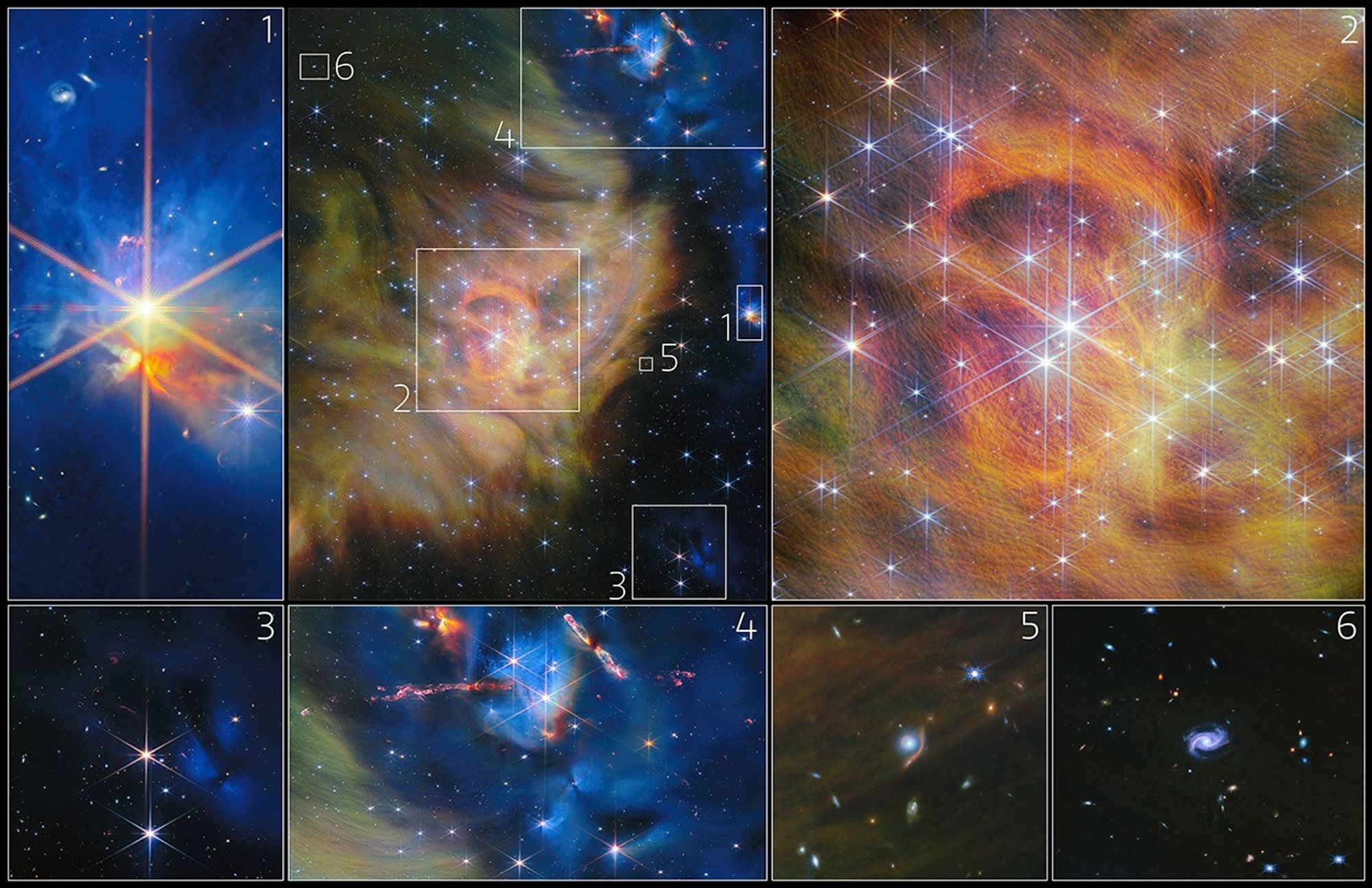
The James Webb Space Telescope has captured an unprecedented, sprawling panorama of the star-forming region IC 348, located in the Perseus molecular cloud just about 1,000 light-years away from our cosmic doorstep.
This region acts as a dynamic cosmic nursery, where frigid clouds of gas and dust collapse under their own gravity to ignite the brilliant birth of new stars.
While numerous telescopes have previously turned their gaze toward this celestial neighborhood, Webb’s highly sensitive Near-Infrared Camera effortlessly pierced through the dense veils of obscuring dust to reveal the hidden moments of stellar creation with breathtaking clarity.
The newly released mosaic stands as one of the largest images of a star-forming region ever captured by Webb, showcasing an intricate web of glowing gaseous filaments and fiercely bright infant stars that illuminate their surroundings like a masterful piece of cosmic art.
Beyond its sheer visual majesty, this vast panorama is packed with a wealth of scientific data crucial for understanding the earliest stages of the stellar lifecycle, revealing exactly how nascent stars gather material from their natal clouds to grow and evolve.
By observing such an extensive area with unparalleled high resolution, astronomers can now conduct detailed statistical analyses of how stars of all sizes—from the most massive giants to the smallest stellar embers—are distributed and how they interact within the exact same environment.
The profound secrets detailing how the stars we see in our night sky were forged in such harsh yet beautiful conditions billions of years ago are deeply embedded within this extraordinary panoramic image, providing us with vital clues to unravel the origins of our universe.
Planets or Stars? The Discovery of Jupiter-Sized Brown Dwarfs Challenges Astronomy
One of the most astonishing discoveries to emerge from this observation is the identification of peculiar celestial objects known as brown dwarfs hiding deep within the IC 348 region.
Brown dwarfs are often referred to as failed stars, acting as an intermediate class of objects that lack sufficient mass to sustain continuous nuclear fusion of hydrogen in their cores like normal main-sequence stars.
Leveraging Webb’s unmatched infrared capabilities, the research team successfully pinpointed several of the smallest brown dwarfs ever discovered, with masses only a few times that of our own Jupiter.
Historically, astronomers believed that objects this small could only form as planets within the swirling protoplanetary disks of gas and dust that orbit around a central host star.
However, these newly discovered diminutive brown dwarfs do not appear to orbit any parent star, suggesting instead that they formed in isolation through the direct gravitational collapse of a giant gas cloud—exactly the same process that births full-fledged stars.
This groundbreaking finding challenges one of the most fundamental questions in astrophysics: What is the absolute minimum mass required for a star to form, and is there a definitive boundary separating a star born from a collapsing cloud and a giant gas planet born within a disk?
If a clump of matter as small as Jupiter can autonomously ignite into a standalone brown dwarf, our galaxy might be teeming with countless numbers of these invisible, free-floating tiny celestial bodies far beyond what we ever imagined.
Because the atmospheres of brown dwarfs can harbor complex molecules like methane and water vapor, studying these ultra-low-mass objects in greater detail is an essential step not only for refining stellar formation theories but also for unlocking the evolutionary mysteries of giant gas planets.
Twin Jets: The Screams of Newborn Stars and Their Impact on the Cosmic Environment
In addition to the groundbreaking discovery of tiny brown dwarfs, this expansive stellar panorama clearly captures another vital astrophysical phenomenon known as bipolar twin jets.
As newborn stars aggressively accrete material from their surrounding disks, their rapid rotation and powerful magnetic fields propel high-velocity jets of ionized plasma outward from both their north and south poles.
Webb’s infrared vision vividly illuminates these twin jets as they violently slam into the surrounding frigid interstellar medium, creating glowing, bow-shaped shockwaves that blaze brightly in the dark void of space.
What is particularly striking about this observation is the sheer scale at which multiple young stars are seen firing these powerful jets, seemingly slicing through the fabric of space and significantly churning up the expansive gas clouds around them.
These energetic jets are far more than just a dramatic byproduct of stellar growth; they play a decisive role in dictating the evolutionary fate of the entire molecular cloud from which the stars are born.
As the jets collide with the surrounding material and transfer massive amounts of kinetic energy, they heat the gas and generate turbulence, which acts as a negative feedback mechanism that can effectively halt the formation of future stars.
Conversely, the immense pressure from these shockwaves can also locally compress pockets of gas, triggering a positive feedback loop that actively promotes the birth of a new generation of stars nearby.
The countless scars left by these jets across the IC 348 panorama serve as a powerful reminder that stellar birth is not merely the creation of an isolated object, but a violently dynamic process that actively reshapes the entire cosmic landscape.
Summary
Witnessing tiny stars and powerful jets emerge so vibrantly from cosmic dust feels like feeling the very heartbeat of the universe, and it is truly a magnificent sight to behold.