Cosmic Cotton Candy: The Discovery of the Puffiest Exoplanets Ever Found
The boundless universe continually shatters our expectations by revealing worlds stranger than fiction.
Recent processing of data from NASA’s Transiting Exoplanet Survey Satellite (TESS) has revealed two new “super-puff” planets with densities so incredibly low they are comparable to cotton candy.
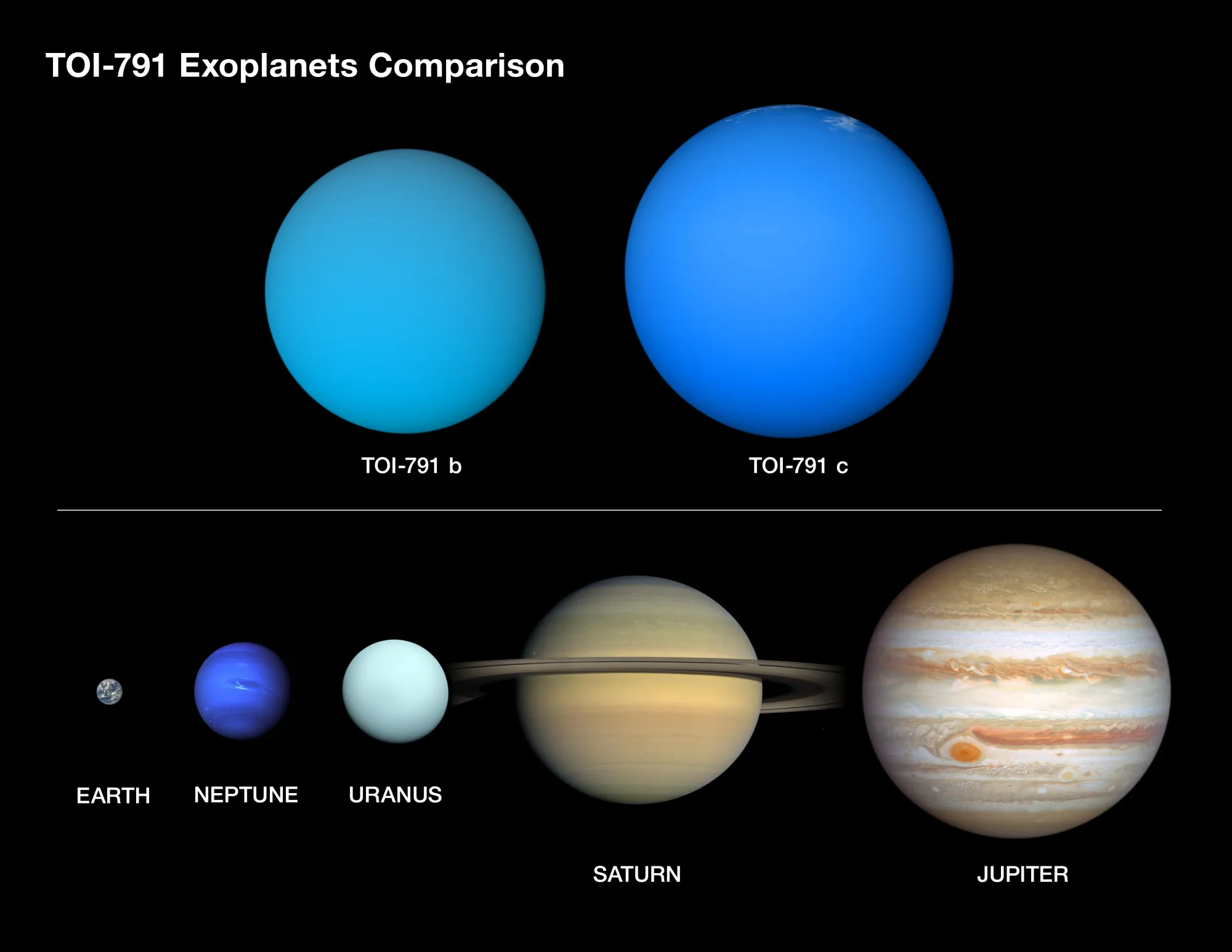
Orbiting a Sun-like star designated TOI-791, located approximately 1,113 light-years from Earth, these newly confirmed gas giants—TOI-791 b and TOI-791 c—represent the most inflated worlds ever recorded in cosmic history.
What makes them a profound scientific puzzle is the extreme disparity between their immense physical volume and their minuscule gravitational mass.
The inner world, TOI-791 b, is nearly identical in size to Jupiter but possesses a mere 3.0% of Jupiter’s mass, while its outer sibling, TOI-791 c, is physically larger than Jupiter yet contains only 5.9% of its mass.
Finding such massive, balloon-like structures challenges our core understanding of planet formation, offering astronomers a rare laboratory to study how giant planets retain such ultra-light atmospheres.
Seven Years of Celestial Monitoring and a Gravitational Waltz
Discovering super-puffs with such extended orbits is an exceptionally rare feat in modern astrophysics, requiring long-term observational endurance.
TOI-791 b takes 139 days to complete a single orbit around its host star, while TOI-791 c requires 232 days—long cycles that make catching their faint transit shadows highly difficult.
From its high Earth orbit, TESS monitored this system across a seven-year span, gathering 1,122 days of high-fidelity data to definitively map the architecture of this planetary system.
The study revealed that the two giant worlds are locked in a rhythmic orbital pattern, allowing them to exert a gravitational tug-of-war on one another as they circulate.
This mutual pull creates distinct variations in the timing of their transits across the face of the host star, which allowed researchers to mathematically calculate their precise, featherweight masses.
Finding a single super-puff is uncommon, but finding a pair orbiting the same star provides invaluable insights into how planetary migration shapes the evolution of distant solar systems.
Summary
The newly discovered giant worlds TOI-791 b and TOI-791 c boast Jupiter-like dimensions but hold only a tiny fraction of its mass, redefining our understanding of cosmic structures.
Envisioning these two massive, feather-light worlds performing a delicate gravitational dance around their star serves as a beautiful reminder of the endless wonders hidden within the galaxy.
References:
https://science.nasa.gov/missions/tess/nasas-tess-mission-reveals-the-puffiest-planets-ever-found/