Piercing the Dust: Webb Resolves Millions of Stars in the Cigar Galaxy
Infrared Vision Shatters the Cosmic Curtains of Messier 82
Located approximately 12 million light-years away, the edge-on spiral galaxy Messier 82 (M82)—famously known as the Cigar Galaxy due to its elongated shape—has long been a target of profound astronomical curiosity.
Classified as a “starburst galaxy,” M82 is undergoing an intense frenzy of stellar birth, creating new stars at a rate roughly 10 times faster than our Milky Way.
However, this violent reproductive burst has historically blanketed the galactic core in an impenetrable shroud of cosmic dust, limiting the resolution of previous visible-light observations.
To unlock its hidden secrets, astronomers utilized NASA’s James Webb Space Telescope for an extensive 65-hour imaging survey using its cutting-edge Near-Infrared Camera (NIRCam).
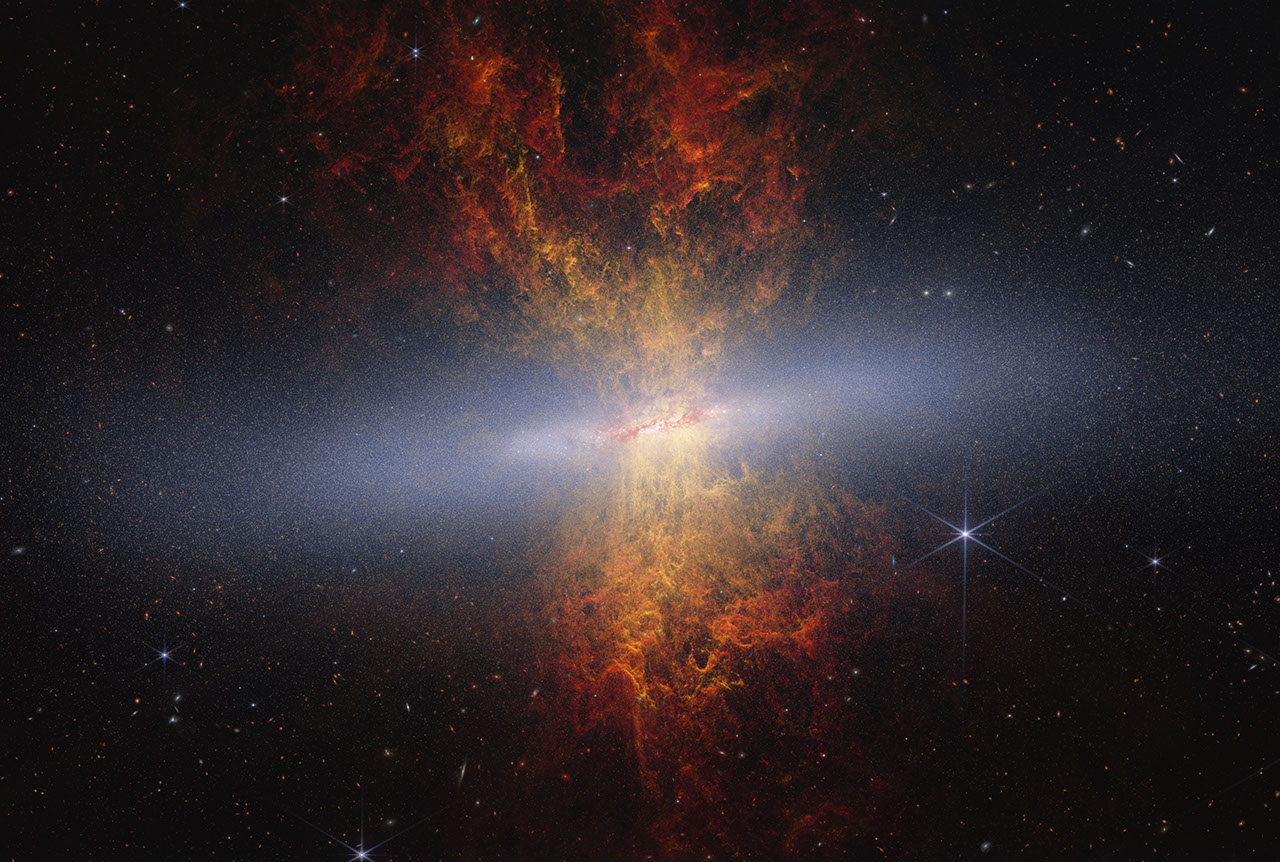
Webb’s unparalleled infrared sensitivity successfully pierced through the dense interstellar dust lanes, meticulously resolving approximately 16.5 million individual stars scattered across the galactic disk.
Appearing as luminous blue granules, these individual stars provide astronomers with a comprehensive fossil record, offering an unprecedented look into the structural evolution and foundational layout of this unique galactic habitat.
A Beautiful Mess: Galaxies as Complex, Dynamic Ecosystems
The high-resolution imagery provided by Webb reveals a delightfully complex and distorted galactic disk, characterized by an asymmetrical shape where the radius on one side differs significantly from the other.
This structural warp strongly implies that M82’s frantic starburst phase was originally triggered by a violent gravitational encounter or merger with a neighboring galaxy in the relatively recent past.
Yet, this magnificent cosmic baby boom is fundamentally self-limiting and estimated to last only a few hundred million years.
The immense collective energy generated by stellar winds and successive supernova explosions is actively driving colossal, hourglass-shaped plumes of gas and dust out of the galactic center.
By marrying Webb’s infrared dataset with the visible-light imagery of the Hubble Space Telescope, scientists mapped a layered, bipolar outflow extending far above and below the disk.
The golden tendrils closest to the galactic core represent glowing, ionized hydrogen gas, while the expanding crimson plumes further out map tiny dust grains known as polycyclic aromatic hydrocarbons.
Analyzing these interconnected datasets allows scientists to treat M82 as an intricate celestial laboratory, fundamentally reshaping our understanding of how cosmic matter circulates and evolves within the universe.
Summary
NASA’s James Webb Space Telescope has penetrated the thick dust of the Cigar Galaxy, revealing 16.5 million individual stars and the structured, violent outflows shaping its evolution.
Combining the unique strengths of multiple space observatories paints a beautifully complete picture of galactic life, showing us just how interconnected and energetic the cosmos truly is.
References:
https://science.nasa.gov/missions/webb/nasas-webb-pinpoints-millions-of-stars-within-cigar-galaxy/