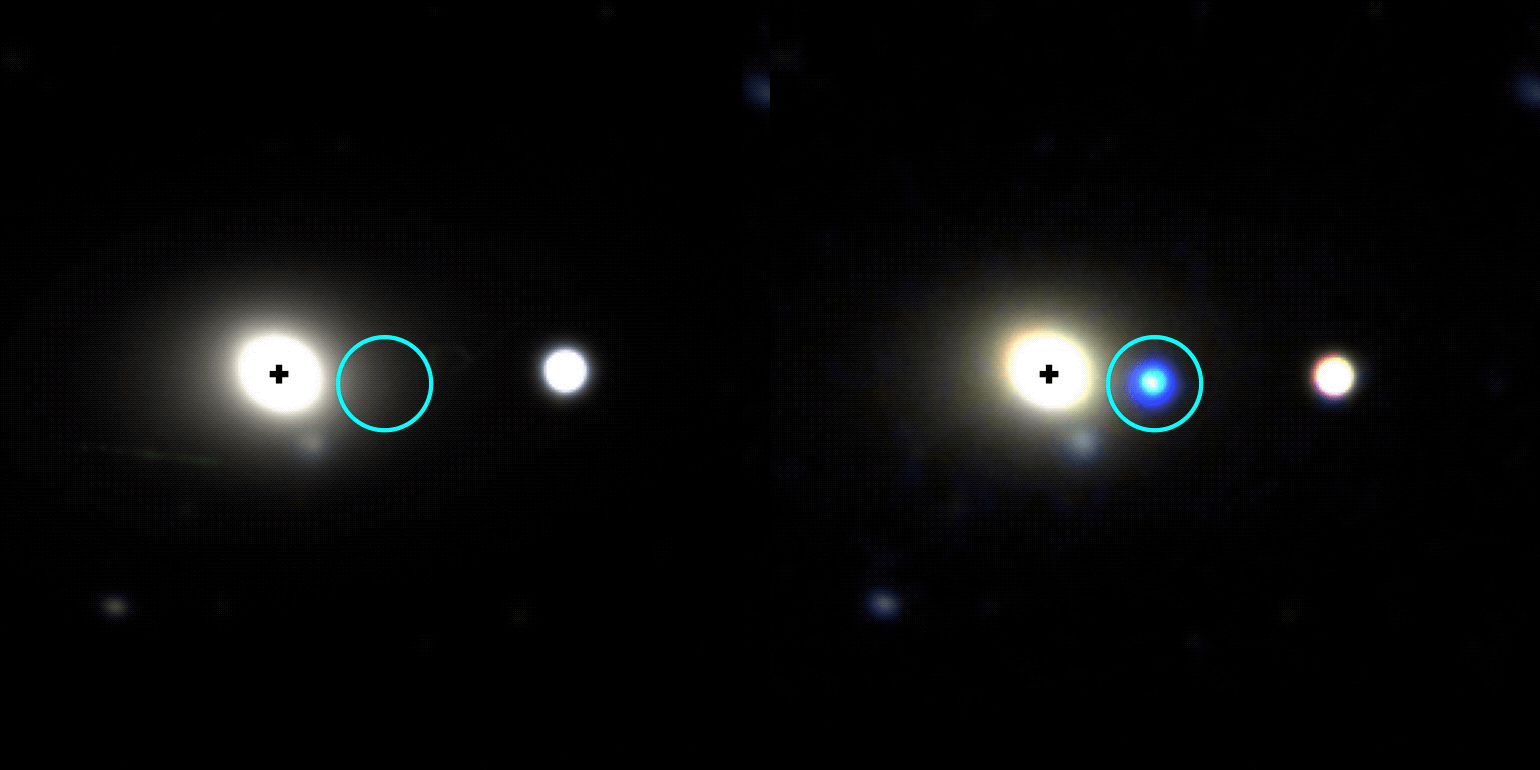
An Isolated Supermassive Black Hole Devouring a Star on the Galactic Fringe
While observations of black holes consuming stars are not entirely new to astronomical history, this recent discovery represents a highly intriguing case that challenges conventional wisdom in astronomy. Typically, supermassive black holes are thought to reside firmly at the center of their host galaxies. However, the phenomenon observed this time occurred in the “fringe,” approximately 30,000 light-years away from the galactic core.
This discovery holds the potential to act as decisive evidence supporting the existence of “orphan” supermassive black holes wandering through the cosmos. The event where a star is captured and torn apart by the immense gravitational pull of a black hole is known as a Tidal Disruption Event (TDE). The intense flash emitted by this TDE has revealed the presence of an otherwise invisible wanderer.
This dramatic celestial display, which took place roughly 750 million light-years away, was triggered by a black hole with a mass about one million times that of our Sun. Black holes themselves do not emit light, but the immense energy generated during the pulverization of a star produces a brilliant flash, accompanied by intense ultraviolet radiation that temporarily outshines the entire host galaxy.
A Tidal Disruption Event in an Unusual Location
The first hint of this rare phenomenon came from observational data gathered by the Zwicky Transient Facility (ZTF) at the Palomar Observatory in California. From data encompassing millions of flashes detected each night, an artificial intelligence algorithm automatically identified a flare exhibiting the characteristic signatures of a TDE.
However, its location was not the galactic center, but far out in the periphery. In response to this anomaly, astronomers immediately initiated follow-up observations. Spectral analysis conducted by the SOAR telescope in Chile strengthened the likelihood of it being a TDE. Furthermore, observations using the Ultraviolet/Optical Telescope (UVOT) aboard the Neil Gehrels Swift Observatory confirmed the flare was exceedingly hot, measuring around 30,000 degrees Celsius (54,000 degrees Fahrenheit).
The coordinated multi-wavelength observations by both ground-based and space-based telescopes confidently ruled out alternative explanations, confirming beyond doubt that this was a TDE occurring on the outskirts of a galaxy. Previously, TDEs had only been found in galactic cores, but this may simply be because we were only looking for them where we assumed they should be.
Where Did the Wandering Black Hole Come From?
So, why is this massive black hole wandering the outer edges of a galaxy? The most prominent theory points to the consequences of galactic collisions and mergers. The scenario suggests that when the currently observed galaxy swallowed a smaller galaxy in the past, the supermassive black hole originally at the center of that smaller galaxy was left behind in its current position.
Alternatively, during a complex merger involving three or more galaxies, a gravitational tug-of-war between their central supermassive black holes might have occurred. This could have resulted in the lightest black hole being flung outwards to the galactic edge. The fact that this black hole is currently consuming a star means it simply encountered an unlucky victim during its exile.
Just how many of these “wandering black holes” exist in the universe remains one of the major mysteries in modern astronomy. As wider-field and more sensitive observations progress, the true nature of these invisible monsters lurking throughout the cosmos will likely be revealed one after another.
Unveiling the Cosmic Depths with New Observation Networks
This discovery is a groundbreaking achievement brought about by the utilization of new observational techniques and artificial intelligence. The novel approach of searching for “off-center TDEs,” which had been previously overlooked, has the potential to induce a significant paradigm shift in future black hole research.
Although the Swift Observatory is temporarily suspending observations for an orbit boost, it is expected to resume its crucial role in the search for these wandering black holes once operations restart. Furthermore, with the impending full-scale operation of the Vera C. Rubin Observatory in Chile and the future launch of the Nancy Grace Roman Space Telescope, the scope of exploration will expand exponentially.
The combination of the Rubin Observatory’s wide and deep survey capabilities and the Roman Space Telescope’s ability to peer back through 9 billion years of cosmic history brings us steadily closer to realizing a comprehensive census of the universe’s behemoth black holes. The evolution of technologies that make the invisible visible continues to unravel the hidden history of the universe.
Summary
The dramatic moment a supermassive black hole wandering the galactic fringes tears a star apart speaks volumes about the dynamic evolution of the universe. Starting with this discovery, it will be exciting to see the mysteries of these invisible wanderers progressively unraveled.