The True Face of the Lion Nebula Revealed by the James Webb Space Telescope
An astonishing structure lurking in the depths of space has been brought into unprecedented focus by the infrared observations of the James Webb Space Telescope (JWST).
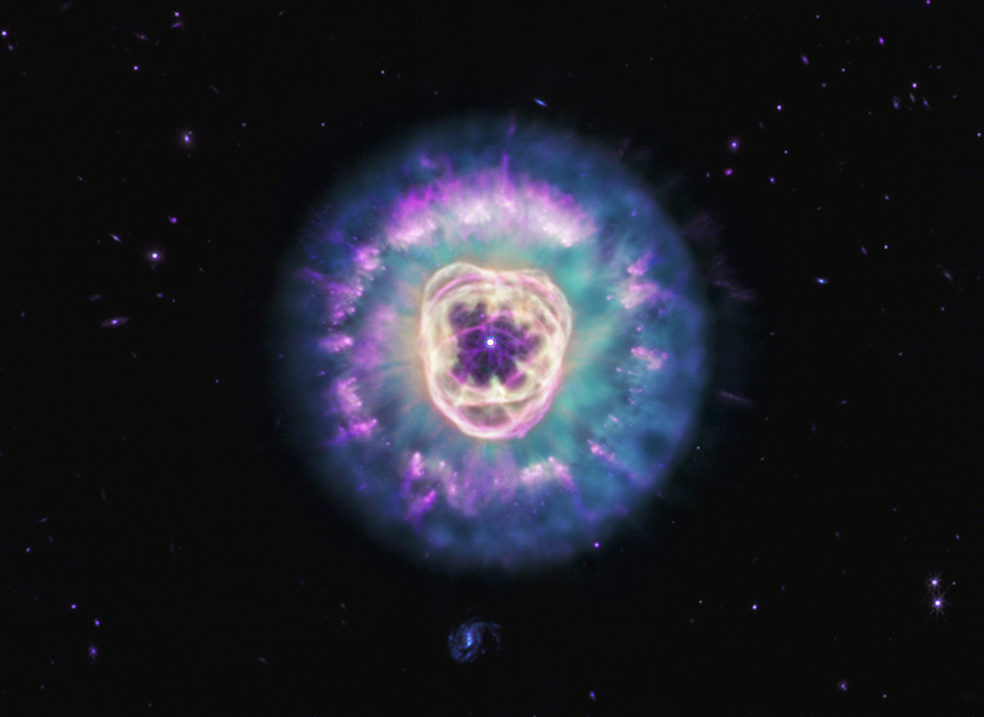
The target of this observation is the planetary nebula NGC 2392, commonly known as the Lion Nebula, located thousands of light-years away from Earth.
While the Hubble Space Telescope previously captured its fantastical shape, resembling a lion’s face and mane, in visible light back in 2000, the Webb Telescope has unveiled the truths hidden even deeper within.
High-resolution images, utilizing both the Near Infrared Camera (NIRCam) and the Mid Infrared Instrument (MIRI), capture the breathtaking details of the ionized gas bubble forming the lion’s face and the clumps of dust spreading out like a mane.
It has taken an immense span of thousands of years for this nebula to reach its current form, and even at this very moment, its shape continues to evolve.
A Cosmic Masterpiece Sculpted by a Dying Star
The driving force behind the Lion Nebula’s unique shape is the remnant of a “dying star” situated at its very center.
While extremely massive stars end their lives in dramatic supernova explosions, the star that formed NGC 2392 was a relatively lower-mass star, much like our own Sun.
When such a star can no longer sustain nuclear fusion in its core, it becomes unstable and sheds its outer layers of gas and dust into space.
This is the true nature of a planetary nebula, and a significant portion of the observable dust in the universe is produced during these stellar end-stages.
Intense energy and radiation from the extremely hot stellar core (white dwarf) left behind “cook” the surrounding material from the inside out, creating bubbles of ionized gas while destroying surrounding dust, or leaving behind surviving clumps that resemble cometary tails, forging an incredibly complex and bizarre structure.
These dynamic changes are expected to come to an end in roughly 10,000 years, at which point the lion’s form will dissipate into the vastness of space.
Summary
The Webb Telescope has brilliantly captured how the dying star at the heart of the Lion Nebula is actively shaping the gas and dust around it. We are truly fortunate to witness this cosmic masterpiece now, as it will fade away in just about 10,000 years.
https://science.nasa.gov/missions/webb/lion-nebula-roars-to-life-with-nasas-webb/?utm_source=newsletter&utm_medium=email&utm_campaign=nn202632