ALMA Observes Real-Time Assembly of a Massive Binary Star System
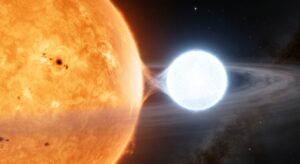
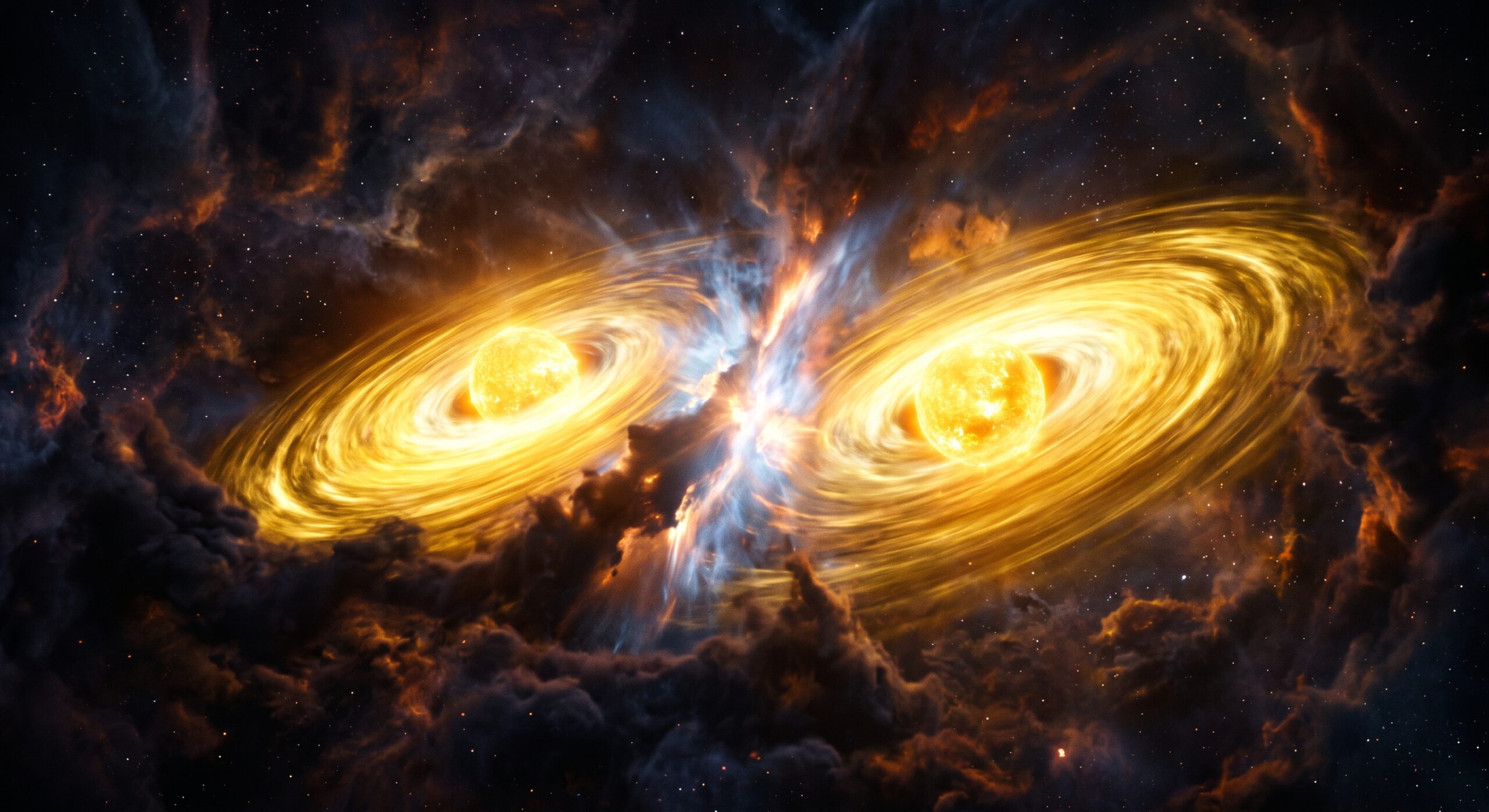
In a milestone observation announced by the Atacama Large Millimeter/submillimeter Array (ALMA), an international research team led by astronomers Yichen Zhang and Jonathan C. Tan has captured a young, massive binary star system assembling in real time. Historically, astrophysicists have debated whether massive binary stars—which eventually detonate as supernovae and form binary neutron stars or black holes—originate from the symmetric fragmentation of a single protostellar disk or through dynamic gravitational capture within crowded stellar nurseries.
ALMA’s submillimeter interferometry revealed that the two massive protostars experienced their closest gravitational approach only about 60 years prior to the observation—an instantaneous event on cosmic timescales. Remarkably, individual circumstellar accretion disks around both protostars survived the intense gravitational interaction intact, retaining well-defined Keplerian rotation profiles. These observations demonstrate that close, chaotic stellar flybys can successfully dissipate kinetic energy and bind massive stars together, establishing dynamic capture as a primary evolutionary channel for massive binary systems across our galaxy.
Webb’s Mid-Infrared Vision Penetrates the Dusty Heart of Centaurus A
Turning to extragalactic astrophysics, newly processed mid-infrared imaging from the James Webb Space Telescope (JWST) has unlocked the obscured galactic nucleus of Centaurus A (NGC 5128). Located roughly 12 million light-years away, Centaurus A is famous for its thick, opaque equatorial dust band resulting from an ancient galactic merger, which historically concealed its inner core from visible-light observatories.
Combining data from Webb’s Mid-Infrared Instrument (MIRI) and Near-Infrared Camera (NIRCam), the observatory resolved millions of evolved red giant stars through the dust lanes for the first time. The infrared data maps the detailed boundary where the central supermassive black hole’s relativistic plasma jet collides with dense molecular clouds. By probing the spatial distribution of polycyclic aromatic hydrocarbons and warm silicates, Webb provides fresh insights into how active galactic nucleus (AGN) feedback regulates interstellar gas cooling and star formation in post-merger elliptical galaxies.
Atmospheric Rossby Waves: Modeling Saturn’s Polar Decagon and Hexagon
Featured on NASA’s Astronomy Picture of the Day, atmospheric scientists analyzing Hubble Space Telescope planetary monitoring data have detailed the fluid dynamics underpinning Saturn’s newly observed south polar decagon. While Saturn’s north pole has long exhibited a stable hexagonal jet stream, Hubble’s long-term astrometric tracking confirmed that the southern circumpolar vortex has structured itself into a regular ten-sided geometric pattern.
Planetary fluid dynamicists model these geometric vortex structures as non-linear, standing Rossby waves organized by intense azimuthal wind shears and latitudinal temperature gradients. Because Saturn experiences prolonged 15-year seasonal cycles, variable solar radiative heating combined with internal convective heat flux alters the stability criteria of circumpolar jets. Mapping both the northern hexagon and the southern decagon provides a universal empirical framework for testing atmospheric circulation models on gas giants within our solar system and across directly imaged exoplanets.