Artemis III Core Stage Rollout Marks a Major Milestone
On April 20, 2026, a truly momentous event occurred in the ongoing journey of next-generation space exploration.
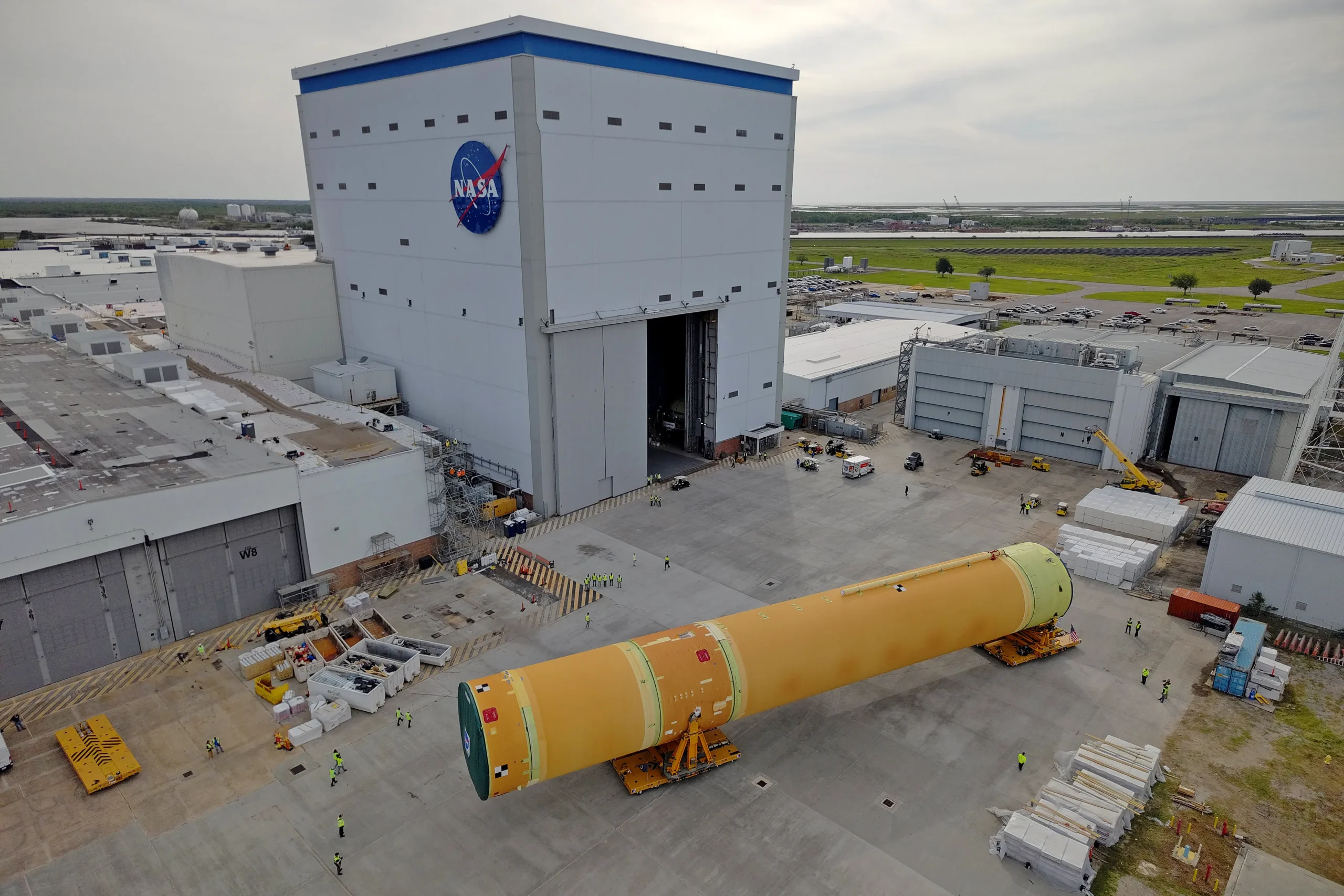
The core stage of the Space Launch System (SLS) rocket, designated for the crewed Artemis III mission, successfully rolled out from the Michoud Assembly Facility in New Orleans.
Using highly specialized transporters, this enormous piece of hardware was carefully loaded onto the Pegasus barge.
Its destination is the Kennedy Space Center in Florida, where final outfitting and vertical integration will take place.
Following the recent success of the Artemis II lunar flyby, this rollout represents tangible progress toward humanity’s highly anticipated return to the Moon.
As the structural backbone of Artemis III, this stage will soon undergo critical capability tests necessary for lunar landings and beyond.
Witnessing such massive hardware physically moving toward the launchpad deeply reinforces the reality that a new era of space exploration is unfolding right before our eyes.
The Beating Heart and Massive Thrust of the SLS
The section transported in this rollout constitutes the top four-fifths of the core stage, which will stand a towering 212 feet tall once completed.
This specific segment houses the heavily insulated liquid hydrogen and liquid oxygen tanks, along with the intertank and forward skirt.
Together, these massive cryogenic tanks will hold more than 733,000 gallons of super-chilled liquid propellant.
This incredibly vast fuel supply is the absolute lifeblood required to power the four RS-25 engines that will be attached to the base.
During launch and the initial flight phase, this fully integrated stage will operate continuously for over eight minutes, generating an astonishing two million pounds of thrust.
It is exactly this overwhelming power that will propel the Orion spacecraft and its astronaut crew out of Earth’s gravitational grip and into their designated orbit.
The design and manufacturing of these components represent a brilliant collaboration, with Boeing handling the core stage assembly and L3Harris Technologies providing the RS-25 engines.
Paving the Way for Lunar Landings and Beyond
The Artemis III mission, officially scheduled for 2027, is designed to launch astronauts into Earth orbit aboard the Orion spacecraft.
This critical flight will serve as a rigorous testbed for the rendezvous and docking capabilities between Orion and commercial spacecraft.
Perfecting these complex orbital maneuvers is an absolute prerequisite for landing astronauts on the lunar surface during the Artemis IV mission in 2028.
Currently, the SLS remains the only launch vehicle on the planet capable of sending Orion, its crew, and necessary supplies to the Moon in a single launch.
As highlighted by recent strategic updates, efforts to standardize the SLS configuration and optimize production are rapidly accelerating the entire Artemis timeline.
We are undeniably living in a golden age of scientific innovation and deep space exploration.
Establishing an enduring human presence on the Moon will unlock incredible scientific discoveries and ultimately serve as the essential stepping stone for our first crewed voyages to Mars.
Conclusion
The successful rollout of the Artemis III core stage brings us one step closer to making lunar landings a reality once again.
Let’s continue to watch this exciting journey unfold with hope and wonder as we reach for the stars.
Reference Link:
https://www.nasa.gov/news-release/nasa-rolls-out-artemis-iii-moon-rocket-core-stage/