Red, White, and Blue: How Chandra Unveils the Energetic Cosmos
The cosmos stretching beyond our atmosphere is far richer than what human eyes can perceive through visible light alone. NASA’s Chandra X-ray Observatory has spent decades probing the high-energy universe, exposing phenomena that remain invisible to optical telescopes. By combining X-ray data with optical, infrared, and radio emissions, astronomers composite images that resemble cosmic masterpieces.
Among these composite images, compositions rendered in vivid shades of red, white, and blue offer more than visual wonder. They illustrate how extreme physical environments achieve a harmonious balance across vast spatial scales. X-rays are generated in environments reaching millions of degrees, such as the infernos surrounding supernova remnants, supermassive black holes, and scorching intergalactic gas.
When these blue and white X-ray highlights are layered over the warm red hues of optical starlight, the dynamic architecture of the universe emerges in full relief. Multiwavelength astronomy is not merely an aesthetic endeavor; it serves as a critical diagnostic tool for tracing the flow of energy and the life cycles of celestial structures. Behind these vibrant colors lies the violent yet creative force that drives the evolution of the cosmos.
NGC 3603: The Energetic Cradle of Massive Stars
Located in the constellation Carina, NGC 3603 is one of the most massive and active star-forming regions in the Milky Way galaxy. It harbors a dense cluster of young, giant stars, each tens of times more massive than our Sun. These celestial heavyweights emit blistering ultraviolet radiation and drive powerful stellar winds that sculpt the surrounding ISM.
Chandra’s X-ray observations capture the scorching gas generated by these relentless stellar winds, mapping it as intense blue emissions. When merged with optical and infrared images showing red and green clouds of dust and cooler hydrogen, the chaotic nursery of stars is exposed in breathtaking detail.
The fierce winds from these massive stars carve vast cavities into the surrounding material, clearing away gas while simultaneously compressing adjacent clouds. This compression triggers a cascading effect, forcing new generations of stars to coalesce from the collapsing material. Though these cosmic winds appear destructive, they are essential for cycling heavy elements back into the galaxy. The brilliant contrast of blue and red in NGC 3603 stands as a testament to the raw power accompanying the birth of new suns.
NGC 4736: A Dramatic Ring of Starbirth and Cosmic Explosions
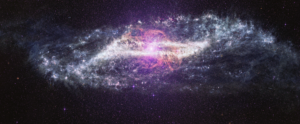
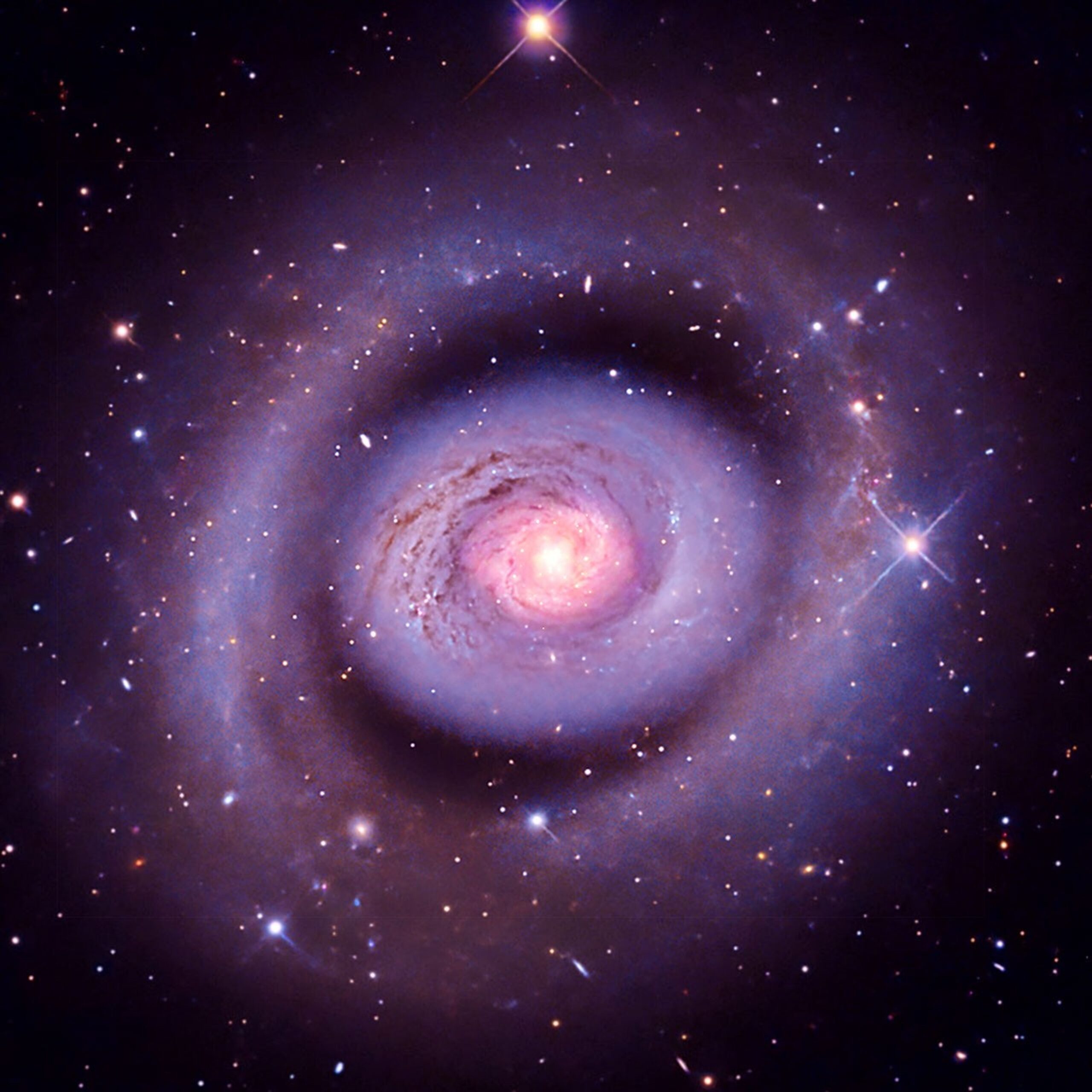
NGC 4736, also cataloged as Messier 94, is a spiral galaxy in the constellation Canes Venatici that features a striking central ring structure. Known as a starburst ring, this luminous belt undergoes an exceptionally high rate of star formation compared to typical galactic environments.
X-ray data from Chandra reveals high-energy phenomena within this ring, depicted as brilliant white and blue points of light. These X-ray sources represent point-like binaries containing compact objects, as well as expansive bubbles of million-degree gas inflated by supernova explosions. When blended with the red and golden optical glow of older stellar populations captured by space telescopes like Hubble, the internal dynamics of the galaxy take center stage.
Massive stars born inside the starburst ring live fast and die young, ending their short lives in catastrophic supernova blasts within a few million years. The resulting shockwaves heat the surrounding gas to extreme temperatures, driving X-ray emitting bubbles outward into the galactic disk. These energetic feedback loops demonstrate that galaxies are active, evolving systems. The vivid interplay of red and blue light in NGC 4736 paints a compelling picture of stellar mortality and cosmic regeneration.
ZwCl 0024+1652: The Invisible Realm of Galaxy Clusters and Gravity
Far out in the constellation Cetus lies ZwCl 0024+1652, a massive galaxy cluster bound together by the relentless pull of gravity. As some of the largest gravitationally bound structures in the universe, galaxy clusters contain hundreds of individual galaxies immersed in a vast sea of diffuse, high-temperature gas.
Because this intracluster gas reaches tens of millions of degrees, it glows brightly in X-rays while remaining completely invisible in optical light. Chandra detects this pervasive glow, mapping it as a subtle blue haze spanning millions of light-years across the cluster center. When overlaid with optical images depicting the reddish hues of ancient elliptical galaxies, the true scale and mass distribution of the cluster become evident.
Furthermore, the immense mass of ZwCl 0024+1652 acts as a powerful gravitational lens, warping and magnifying the light from background galaxies located far behind it. By comparing the distribution of X-ray emitting gas with the gravitational lensing signatures, astrophysicists can trace the hidden framework of dark matter that anchors the cluster. The ethereal blue X-ray clouds filling ZwCl 0024+1652 reveal the unseen scaffolding of the cosmic web and the fundamental influence of gravity.
Summary
The red, white, and blue celestial views captured by the Chandra X-ray Observatory remind us of the incredible energy and continuous cycles shaping our universe. Taking a moment to appreciate these harmonious colors allows us to reflect on the deep mysteries waiting across the cosmos.
Reference Link:
NASA’s Chandra Reveals Red, White, and Blue Universe