Awakened in the Abyss: New Horizons Powers Back On Beyond Pluto
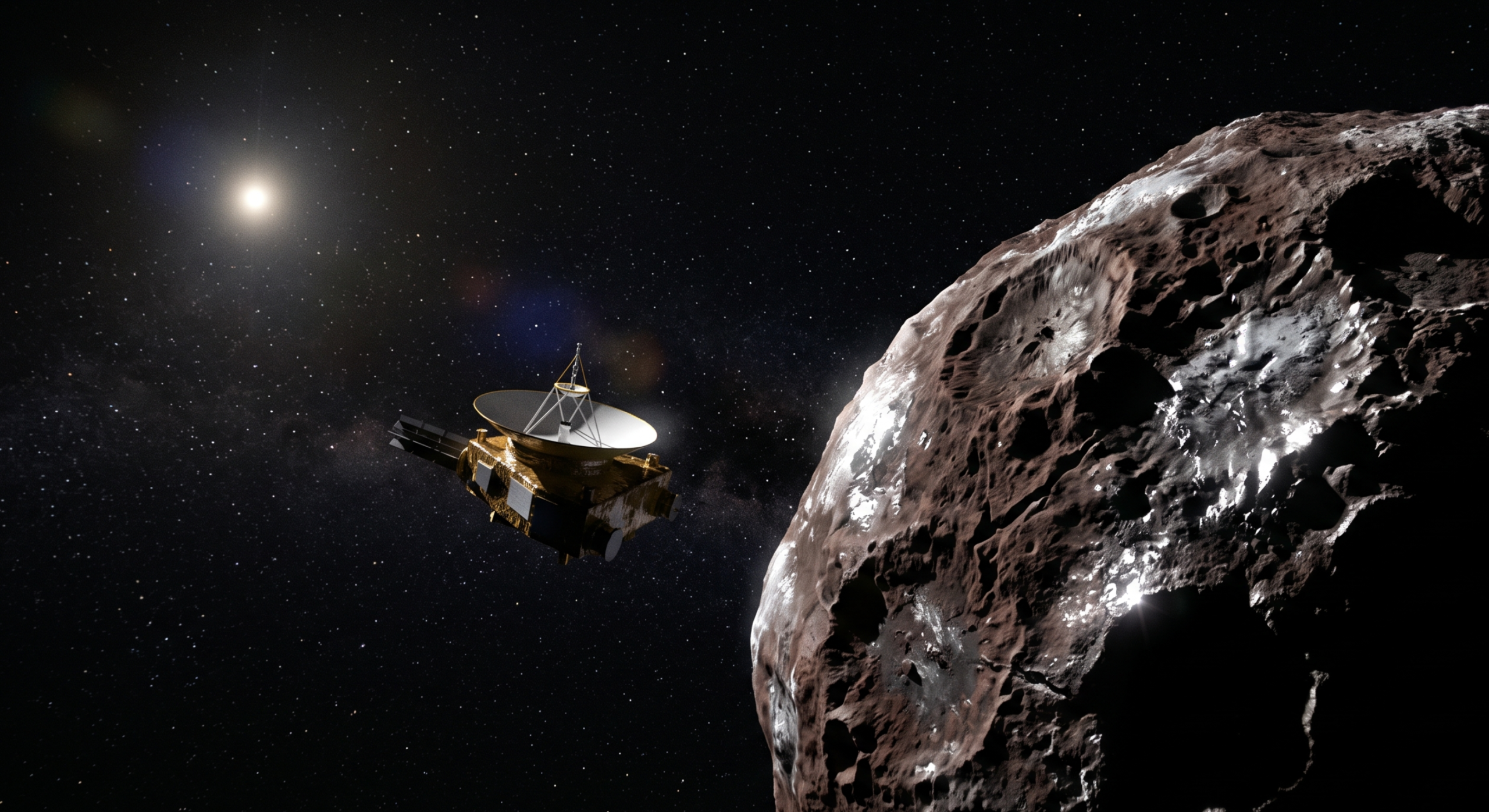
Far beyond the sun’s warm reach, the iconic New Horizons spacecraft has successfully emerged from its planned electronic hibernation.
Transmitting clear signals across billions of miles, the probe confirmed to mission controllers that all primary systems remain in excellent health.
Famous for providing humanity’s first up-close views of Pluto in 2015, this heroic robotic explorer continues to press deeper into the Kuiper Belt.
Despite years of exposure to the brutal radiation and freezing temperatures of deep space, the spacecraft stands fully operational and ready for its next scientific chapter.
Placing spacecraft into hibernation is a calculated technique designed to conserve onboard power, minimize component wear, and extend mission longevity.
While drifting silently through the dark, the probe maintained a minimal heartbeat, periodically checking its own internal stability.
The recent wake-up sequence executed flawlessly, establishing a stable communication link with Earth and confirming that every scientific instrument is responsive.
Maintaining such precise engineering over vast cosmic distances highlights the incredible resilience of modern space exploration technology.
The data gathered during its journey has fundamentally altered our understanding of planet formation and the outer reaches of our solar system.
Now fully awake, New Horizons will resume scanning its surroundings for interstellar dust, cosmic ray environments, and potential distant Kuiper Belt objects.
As it sails toward the outer boundaries of solar influence, the spacecraft continues to push the frontier of human knowledge.
Echoes of Creation: Unlocking Solar System Secrets in the Kuiper Belt
The realm New Horizons navigates—the distant Kuiper Belt—is a vast cosmic graveyard filled with icy planetesimals untouched since the birth of our solar system.
Preserved in a deep freeze for nearly 4.6 billion years, these ancient bodies represent pristine building blocks of planets.
Following its historic Pluto flyby, the probe captivated the world once more by zooming past Arrokoth, revealing a dual-lobed world forged in the solar system’s dawn.
Studying these untouched objects directly provides astronomers with unprecedented clues about how terrestrial worlds and gas giants originally coalesced.
Navigating this realm requires extreme patience, as radio signals traveling at the speed of light take hours to cross the immense void back to Earth.
Despite these operational delays, researchers meticulously scan the spacecraft’s path to identify fine-scale physics data and unique orbital characteristics.
Equipped with sensitive optical cameras and particle detectors, New Horizons measures solar wind interactions at distances no previous mission of its kind has analyzed in such detail.
Each data packet transmitted back across the void adds another piece to the puzzle of our cosmic origin story.
As New Horizons eventually charts a path toward interstellar space, its ongoing journey exemplifies the enduring spirit of exploration.
Powered by its reliable radioisotope generator, the spacecraft will continue sending home invaluable discoveries for as long as its energy holds.
Its solitary trek into the unknown stands as a brilliant beacon of human curiosity reaching into the dark.
Summary
It is truly inspiring to watch our lonely explorer awaken in the icy outer reaches to continue its remarkable journey.
We can look forward to many more fascinating discoveries as it whispers secrets of the early universe back home to Earth.
Reference:
https://science.nasa.gov/missions/new-horizons/nasas-new-horizons-spacecraft-wakes-from-hibernation-in-good-health/