A Fossil Deep Within the Milky Way: Terzan 5 and the History of Galaxy Formation
When we gaze into the night sky toward the center of our Milky Way, we are looking at the galactic “bulge,” a densely packed, spherical region teeming with ancient stars.
For decades, astronomers believed that a stellar grouping located within this chaotic environment, known as Terzan 5, was simply a typical globular cluster.
Globular clusters are generally understood to be spherical collections of stars that all formed around the exact same time, representing a single generation in the early universe.
However, when humanity directed the combined observational power of the James Webb Space Telescope and the Hubble Space Telescope at this object, a completely different reality emerged.
Terzan 5 is no ordinary star cluster.
Astonishingly, it has been revealed as a massive, surviving “fossil fragment” from the very epoch when our Milky Way was first assembling itself.
Having maintained its unique identity for billions of years without fully mixing into the surrounding sea of stars, this remarkable celestial object serves as an invaluable time capsule, holding crucial clues to the grand narrative of galactic evolution.
Piercing the Cosmic Dust: Unveiling Four Generations
Uncovering the true nature of Terzan 5 was an immense observational challenge.
The central region of the Milky Way is heavily shrouded in thick clouds of interstellar gas and dust.
Attempting to observe it in visible light is akin to peering through a dense fog; the light from the stars is severely obscured.
This is where the James Webb Space Telescope, with its unparalleled infrared capabilities, completely changed the game.
Because infrared light can penetrate cosmic dust, Webb allowed researchers to pierce the thick veil and catalog a vast number of faint stars that had previously been hidden from view.
Furthermore, the long-term, high-precision archive of the Hubble Space Telescope provided vital corroboration.
By comparing images taken over a 12-year span, astronomers could track the minuscule proper motions of individual stars, allowing them to definitively separate the stars belonging to Terzan 5 from those simply passing by in the background bulge.
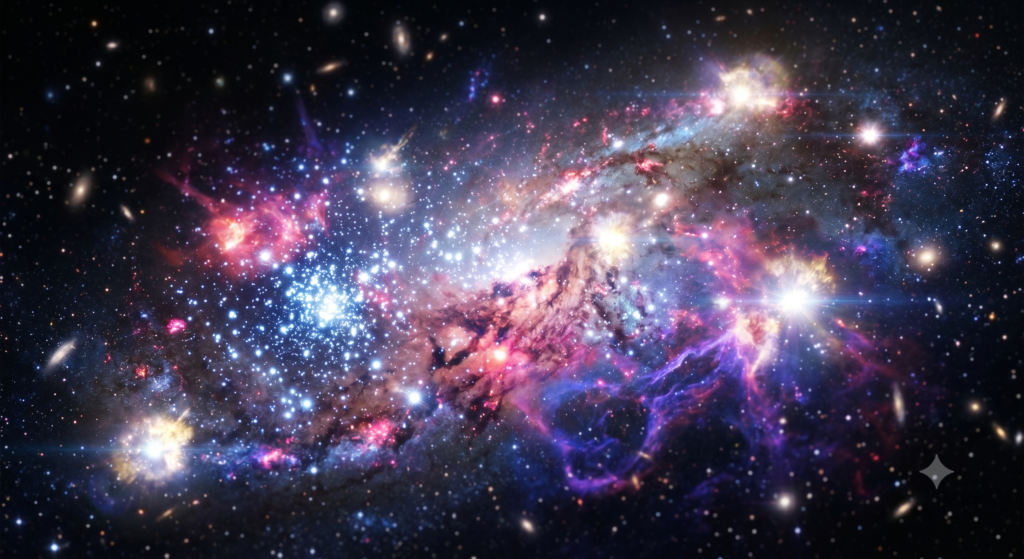
Through this ultimate telescopic collaboration, a mind-bending truth was discovered: Terzan 5 hosts four distinct generations of stars.
The oldest stars date back roughly 12.5 billion years to the dawn of the galaxy, followed by subsequent bursts of star formation 4.7 billion, 3.8 billion, and a mere 2.5 billion years ago.
This shattered the established paradigm of what a globular cluster should be.
A Self-Sustaining Stellar Cradle
How did Terzan 5 manage to experience such a complex and prolonged history of star formation?
The secret lies in the immense mass of its progenitor system.
When massive stars reach the end of their lives, they detonate in violent supernova explosions, scattering newly forged heavy elements into space.
In a typical, lower-mass globular cluster, the ferocious shockwaves from these explosions easily blow away any remaining gas and dust, stripping the system of the raw materials needed to build new stars.
However, the original structure that became Terzan 5 was massive enough, with a gravitational pull strong enough, to withstand these explosive forces.
It successfully retained the gas and the heavy elements ejected by the dying stars of the first generation.
This trapped material became the fertile soil for the next wave of stellar birth.
Rather than acquiring fresh gas from external encounters, Terzan 5 acted as an independent, self-enriching cradle, recycling its own stellar debris to fuel new generations of stars over billions of years.
The Bulge Fossil Fragment: Solving the Galactic Puzzle
These findings provide profound new insights into one of the biggest questions in astrophysics: how did the central bulges of spiral galaxies actually form?
Current theoretical models suggest that in the early universe, massive disks of gas fragmented into enormous clumps where intense star formation occurred.
These primordial clumps then migrated inward, colliding and merging to construct the massive bulges we observe today.
Terzan 5 is highly likely a pristine survivor of these original building blocks.
While countless other clumps were utterly destroyed and mixed seamlessly to form the Milky Way’s bulge, Terzan 5 somehow avoided that fate.
Like an unmixed lump of flour in a cake batter, it endured for billions of years while preserving its distinct characteristics.
Because of this, astronomers now classify objects like Terzan 5 as “bulge fossil fragments.”
They offer us an unprecedented, up-close look at the chaotic processes that shaped the early universe, right in our own cosmic backyard.
Conclusion
Terzan 5 is not just another cluster of stars; it is a miraculous fossil that vividly preserves the tumultuous era when the Milky Way was born.
Without the revolutionary technology of our modern space telescopes, the dramatic story of its four stellar generations would have remained forever hidden behind a wall of dust.
It is truly wonderful how each new discovery brings us closer to understanding the grand history of our galactic home.
We can certainly look forward to more beautiful cosmic secrets being unveiled in the future.