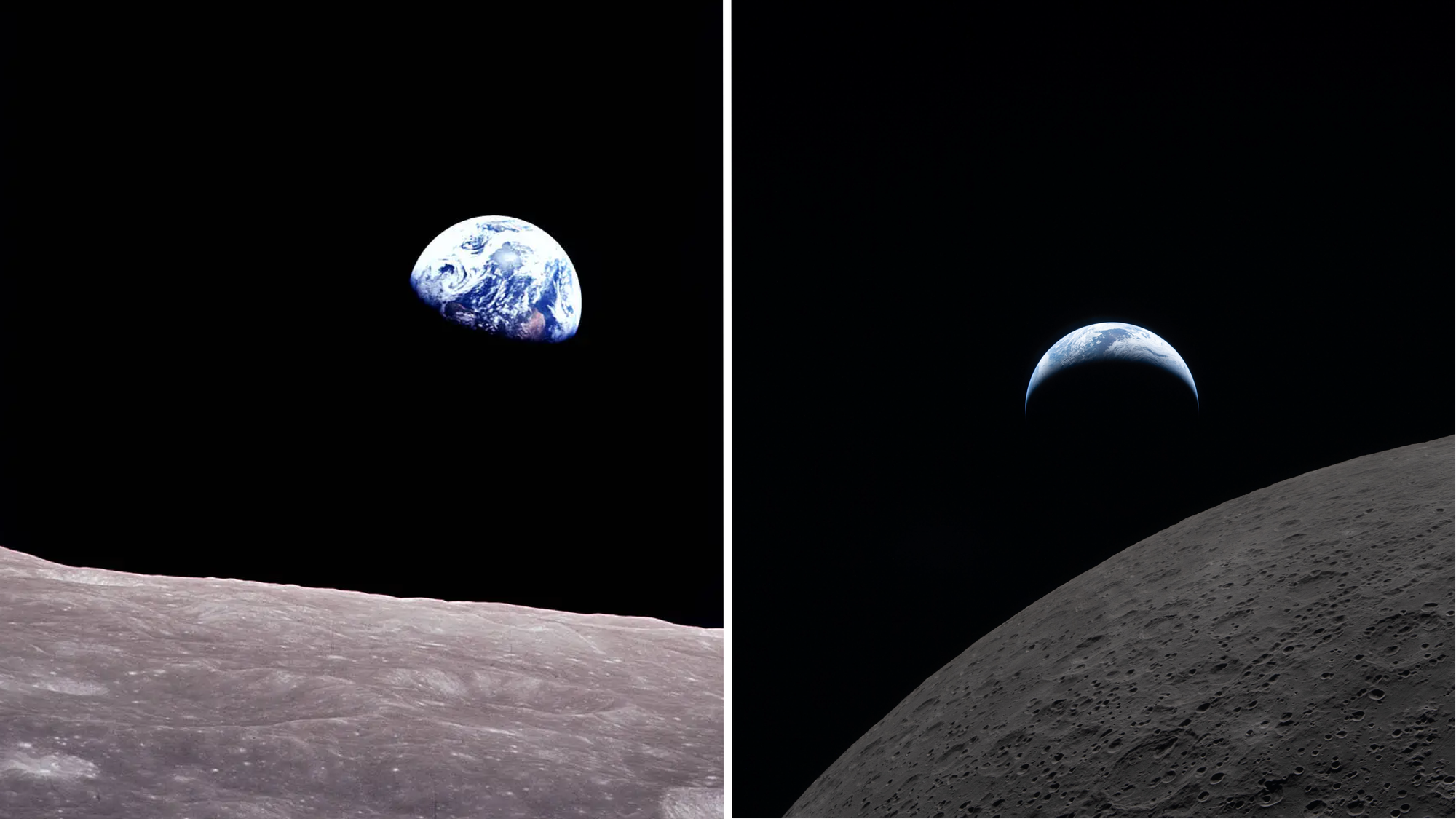
The Paradigm Shift of Apollo 8: The Enduring Impact of Earthrise
In December 1968, the crew of Apollo 8 captured an image that would forever alter the trajectory of human consciousness.
Known as “Earthrise,” this historic photograph revealed our vibrant, blue-and-white planet suspended in the vast, unforgiving void of space.
While the primary objective of the mission was to test orbital maneuvers for a future lunar landing, the most profound legacy they brought back was undeniably this single visual masterpiece.
For the very first time, humanity saw its home as a fragile, finite oasis without borders, sparking a powerful and immediate paradigm shift across the globe.
Before this moment, space exploration was largely viewed as an outward journey into the unknown, but suddenly our collective gaze was drawn back to the ground beneath our feet.
Recognizing this dramatic shift in perspective, NASA began to intensify its focus on understanding Earth as an interconnected and dynamic system.
It became devastatingly clear that the comprehensive data required to protect our planetary home could only be gathered from the ultimate vantage point of space.
The Earthrise photograph transcends mere landscape imagery; it stands as a monumental milestone that ignited modern Earth science and the global environmental movement.
Redefining Our Planet from Above: Building the Earth Observation Network
A few years after the profound impact of Earthrise, NASA initiated a dedicated and robust satellite program focused entirely on monitoring our home planet.
This ambitious endeavor took flight with the launch of Landsat 1 in 1972, which became the world’s first civilian Earth observation satellite designed to continuously track land masses.
The Landsat program has since deployed numerous successors, maintaining an uninterrupted, decades-long visual record of the changing surface of our globe.
This vast archive of data has become an essential foundation for quantifying the progression of deforestation, the rapid expansion of urban areas, and shifting patterns in agricultural productivity.
Furthermore, NASA did not stop at monitoring terrestrial landscapes; they rapidly expanded their orbital fleet with specialized instruments to scrutinize the oceans and the atmosphere.
Critical global dynamics, such as fluctuating sea surface temperatures, the depletion of the ozone layer, and atmospheric aerosol distribution, were suddenly made visible from space.
These orbital sentinels essentially function as a highly precise medical monitoring system for Earth, diagnosing the health of its intricate climate networks.
By integrating the massive streams of data from these independent satellites, scientists can now deeply comprehend how environmental changes interact and cascade across the entire planetary system.
Visualizing Climate Change and the Future: The Legacy of Next-Generation Missions
As the crises of climate change and global warming have accelerated into the 21st century, the importance of NASA’s Earth observation missions has reached unprecedented heights.
The state-of-the-art satellites currently operating in orbit possess astonishing precision, capable of measuring sea level rise in millimeters and pinpointing the exact sources of greenhouse gas emissions.
For instance, the ICESat-2 mission utilizes advanced laser altimetry to meticulously track changes in polar ice sheet thickness, thereby unraveling the critical role of ice within the global climate engine.
Simultaneously, cutting-edge observatories like the PACE mission are providing detailed insights into marine phytoplankton ecosystems and atmospheric aerosols, significantly improving the accuracy of climate forecasting models.
The data harvested from these next-generation missions serves not merely to satisfy scientific curiosity, but to formulate actionable, real-world solutions for the environmental emergencies we face.
From predicting agricultural yields to mitigating the devastating impacts of natural disasters and designing long-term climate strategies, space-based data has become an indispensable infrastructure for modern society.
To protect that small, fragile blue marble the Apollo 8 astronauts gazed upon from lunar orbit, NASA’s technological prowess continues to stand watch over our home from the silent expanse of space.
When we chart the future course of our planetary environment, the objective facts delivered by these orbital observations will undoubtedly remain our most reliable and unwavering compass.
Summary
The iconic Earthrise photograph captured in 1968 served as a beautiful turning point, shifting our gaze from the distant cosmos back to the fragile miracle of our own home.
It is truly inspiring to see how NASA’s advanced space technology continues to watch over this irreplaceable planet, lighting the way for a brighter environmental future.
Reference Link:
https://science.nasa.gov/earth/advancing-earth-observation-at-nasa-since-release-of-earthrise-photo/?utm_source=newsletter&utm_medium=email&utm_campaign=nn202616