Voyager 1: Humanity’s Solitary Emissary in Interstellar Space
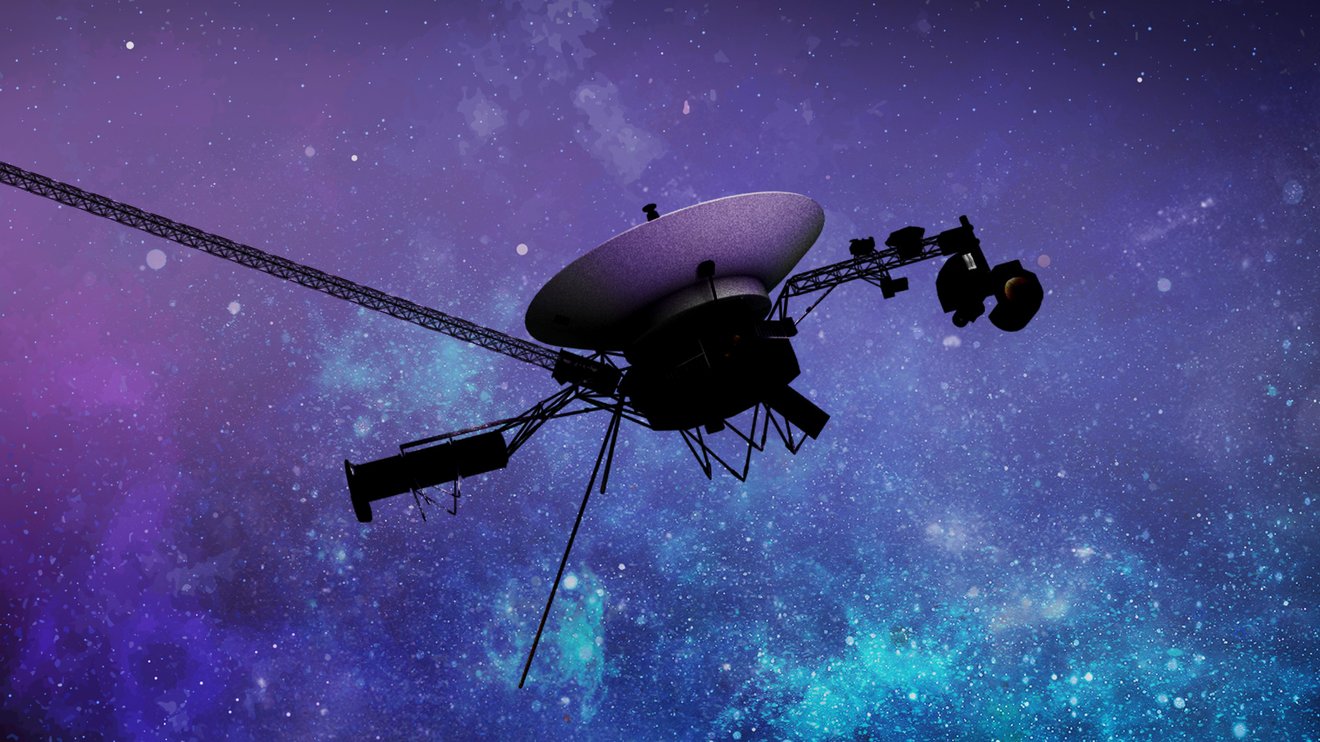
Launched on September 5, 1977, atop a Titan IIIE-Centaur rocket, Voyager 1 remains humanity’s farthest artificial object, continuously extending our reach into the cosmos.
Weighing a mere 722 kilograms, this uncrewed space probe embarked on an epic mission to conduct highly detailed observations of the outer gas giants of our solar system.
Although launched after its twin, Voyager 2, it followed a faster trajectory, quickly overtaking it and spearheading our exploration into the unknown depths.
At its core lies a radioisotope thermoelectric generator, providing a steady supply of electrical power in the freezing, sunless environment of deep space.
Attached to the spacecraft is the Golden Record, a time capsule containing the sounds, images, and cultural heritage of Earth, waiting to be discovered by extraterrestrial intelligence.
The journey of Voyager 1 transcends mere scientific observation, carrying the profound philosophical weight of proving humanity’s existence to the far reaches of the galaxy.
The Grand Tour and a Miraculous Trajectory
Behind the Voyager program lay the visionary concept of the Grand Tour, capitalizing on a rare planetary alignment that occurs only once every 175 years.
This ambitious plan involved using a technique called gravity assist, or a slingshot maneuver, to hop from Jupiter to Saturn, Uranus, and Neptune as they formed a massive arc.
Voyager 1 was programmed with a highly specialized trajectory, focusing primarily on the close-up exploration of Jupiter, Saturn, and Saturn’s largest moon, Titan.
Scientists already suspected that Titan possessed a thick atmosphere, and analyzing its composition was considered one of the most critical objectives in planetary science at the time.
By prioritizing this close encounter with Titan, Voyager 1 was deflected out of the ecliptic plane, ultimately ending its planetary encounters earlier than its twin.
However, this bold navigational choice became the very catalyst that propelled the spacecraft out of the solar system, paving the way for humanity’s first foray into interstellar space.
The Astonishing Faces of Jupiter and Saturn
Arriving at Jupiter in 1979, Voyager 1 captured the dynamic, complex atmosphere of the gas giant in unprecedented detail, revealing phenomena invisible from Earth-based telescopes.
It provided the first close-up images of the intricate swirling storms of the Great Red Spot, discovered a faint planetary ring system, and detected active volcanism on the moon Io.
This groundbreaking discovery of active geological processes on a celestial body other than Earth triggered a massive paradigm shift in our understanding of planetary science.
Continuing to Saturn in 1980, the probe unveiled the breathtaking complexity of the planet’s iconic rings, showing them to be composed of thousands of intricate, narrow ringlets.
During its close flyby of Titan, Voyager 1 confirmed that the moon’s dense atmosphere consists primarily of nitrogen and methane, hinting at the possibility of liquid hydrocarbon lakes on its surface.
The invaluable data transmitted across millions of miles provided essential puzzle pieces for unraveling the formation and evolutionary history of our solar system.
The Pale Blue Dot: A Look Back at Home
On February 14, 1990, having completed its primary planetary mission and heading toward the outer edges of the solar system, Voyager 1 executed a historic maneuver to look back at Earth.
From a staggering distance of approximately 6 billion kilometers, the probe captured our home planet as a tiny, fragile speck of light caught in a sunbeam, smaller than a single pixel.
This iconic image visually demonstrated the insignificance of our world against the vast, unforgiving expanse of the cosmic arena.
Championed by the renowned astronomer Carl Sagan, this photographic endeavor went beyond scientific data collection, offering humanity a profoundly humbling perspective of our only home.
Today, the cameras on Voyager 1 have long been powered down to conserve vital energy, making this family portrait of the solar system the spacecraft’s final visual record.
This single photograph, taken by a solitary traveler in the dark abyss, continues to be celebrated as a poignant symbol of humanity’s unyielding curiosity and necessary humility.
Piercing the Heliopause: Entering the Interstellar Realm
On August 25, 2012, exactly 35 years after its launch, Voyager 1 made history by crossing the heliopause, the boundary where the sun’s solar wind is halted by the interstellar medium.
Instruments aboard the probe detected a sudden surge in plasma density and a sharp increase in cosmic rays, confirming its exit from the giant magnetic bubble that shields our solar system.
Plunging into the entirely uncharted territory of interstellar space, Voyager 1 operates as humanity’s only active laboratory, directly sampling the environment between the stars.
The power output from its nuclear battery steadily declines each year, necessitating strict energy management protocols, including shutting down heaters and systematically turning off scientific instruments.
Despite these immense challenges, the engineering team continues to perform miracles, optimizing the limited resources to maintain a fragile lifeline with the distant spacecraft.
As it ventures deeper into the cosmic ocean, communication delays stretch to dozens of hours, and eventual silence is inevitable, yet the probe itself will silently wander the Milky Way forever.
Summary
Voyager 1’s lonely journey reminds us of how far human curiosity and brilliant engineering can reach into the deep, dark unknown.
Let’s continue to softly watch over this brave little explorer as it carries our hopes into the stars, shall we?