A Cosmic Relay at the Galactic Core: From Hubble to Roman
The galactic bulge at the heart of our Milky Way is a bustling, crowded metropolis of stars, cloaked in cosmic dust and mystery.
For decades, astronomers have pieced together its secrets, but a new era of discovery is dawning through a magnificent collaboration between two space icons.
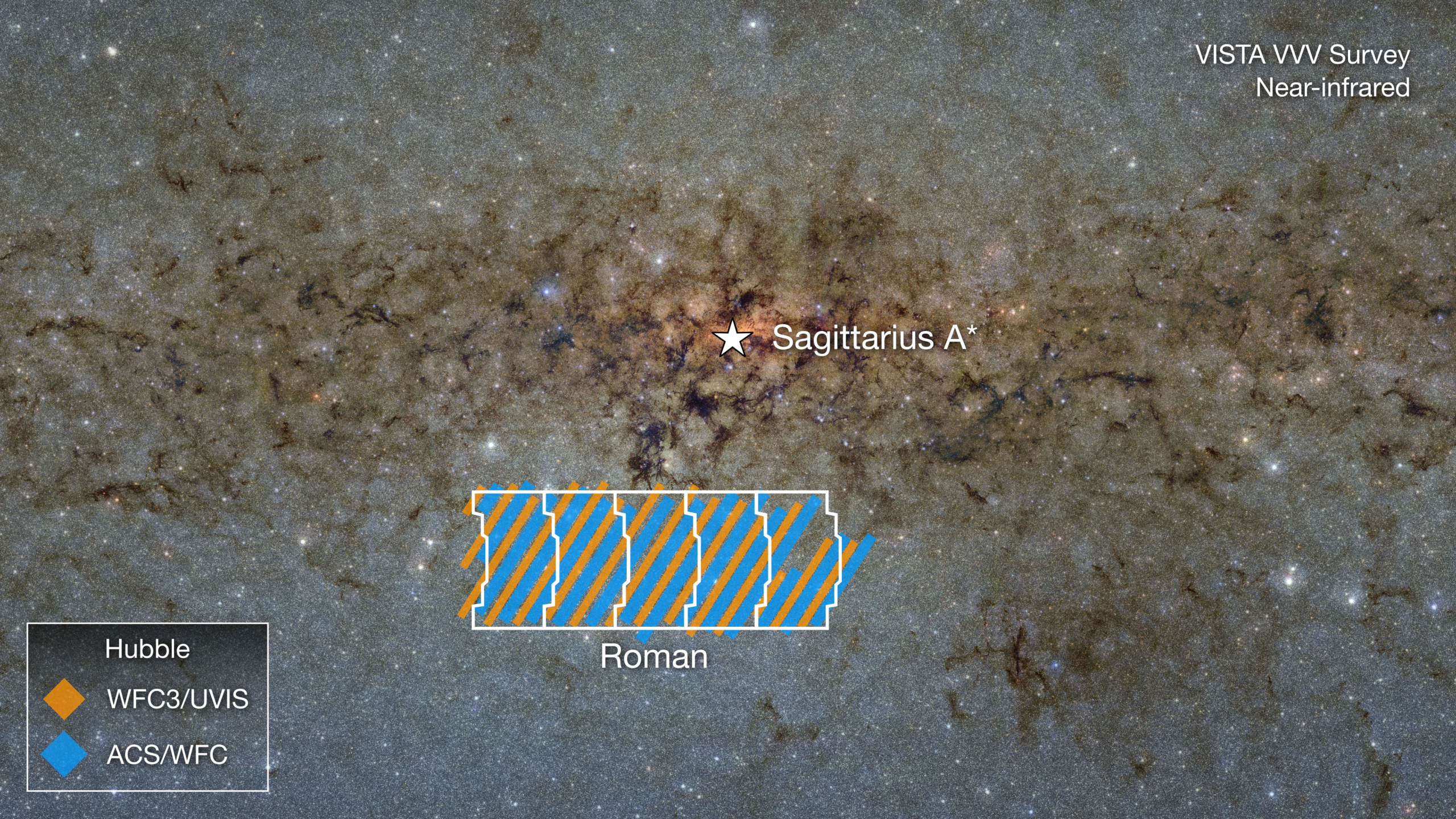
The legendary Hubble Space Telescope has embarked on an ambitious precursor survey, meticulously mapping the very regions that the upcoming Nancy Grace Roman Space Telescope will examine after its planned launch in late 2026.
This cosmic relay leverages Hubble’s sharp vision to create a baseline map, paving the way for Roman’s revolutionary wide-field observations.
By analyzing the same patches of the sky years in advance, scientists are securing a vital “before” picture of millions of stars.
This extensive Hubble initiative covers a vast area of the sky, even surpassing the scale of previous legendary mosaics like that of the neighboring Andromeda galaxy.
When Roman begins its deep, continuous stare at the galactic center, having this archival Hubble data will allow astronomers to distinguish between overlapping starlight sources.
It is a beautiful testament to how vintage and future technologies can intertwine to unlock the deepest secrets of our cosmic home.
Unveiling Rogue Worlds Through Microlensing
One of the most thrilling aspects of Roman’s upcoming Galactic Bulge Time-Domain Survey is its ability to find the invisible.
By snapping images of the crowded galactic core every 12 minutes over multiple seasons, Roman will monitor billions of stars for a phenomenon known as gravitational microlensing.
This occurs when the gravity of a foreground object acts like a natural magnifying glass, temporarily warping and brightening the light of a distant background star.
Through this subtle cosmic alignment, astronomers can detect objects that emit no light of their own, such as isolated black holes, cold neutron stars, and dark planets.
What makes this survey truly groundbreaking is its sensitivity to free-floating “rogue planets” that wander through interstellar space without a parent star.
Thanks to the precursor data gathered by Hubble, scientists will no longer have to guess the characteristics of the cosmic lenses.
Instead of merely estimating the mass ratio between a star and its planet, the combined data will allow for direct measurements of their individual masses.
This shifts our understanding from statistical probability to absolute certainty, transforming how we study the architecture of alien planetary systems.
Building the Deepest Atlas of the Milky Way
The collaboration between Hubble and Roman is already laying the groundwork for an unprecedented celestial catalog.
Hubble’s current observations are set to produce a detailed archive featuring roughly 20 to 30 million individual point sources near the galactic center.
This impressive database will serve as the foundation for identifying host stars of newly discovered exoplanets.
Yet, this is only the beginning of a quantum leap in data volume, as Roman is expected to expand this initial catalog by an entire order of magnitude.
By the conclusion of Roman’s survey, the catalog is projected to swell to an astonishing 200 to 300 million stars, resulting in some of the deepest images ever captured of the night sky.
This monumental atlas will not only catalog individual stars but will also map out regions of cosmic extinction where thick pockets of interstellar dust obscure our view.
By understanding exactly where the dust hides the stars, astronomers can construct a flawless three-dimensional model of our galaxy’s core.
The future of astrophysics is being written today as Hubble passes the torch to Roman, promising to redefine our place in the universe.
Summary
The powerful partnership between Hubble and Roman is set to revolutionize our understanding of the Milky Way’s core.
By combining historic archival clarity with next-generation wide-field technology, we are on the verge of uncovering thousands of hidden worlds.
参照リンク:
https://science.nasa.gov/missions/roman-space-telescope/hubble-survey-sets-up-romans-future-look-near-milky-ways-center/?utm_source=newsletter&utm_medium=email&utm_campaign=nn202619