Unlocking Mars’ Atmosphere: A Surprise Discovery from a Solar Storm
An extraordinary phenomenon has been detected in the skies of the Red Planet, defying all previous scientific expectations.
Scientists analyzing data from NASA’s MAVEN spacecraft discovered a strange energy fluctuation deep within the Martian atmosphere.
This signal pointed to a complex physical process previously observed only in the protective magnetic shield surrounding Earth.
A massive solar storm that struck Mars in December 2023 amplified this hidden effect, allowing it to be seen for the very first time.
This groundbreaking finding challenges our current understanding of how space weather interacts with planetary atmospheres.
It provides a crucial piece of the puzzle in explaining how Mars interacts with the harsh solar environment and how its atmosphere evolves over time.
The Power of the Zwan-Wolf Effect: Squeezing Through Space
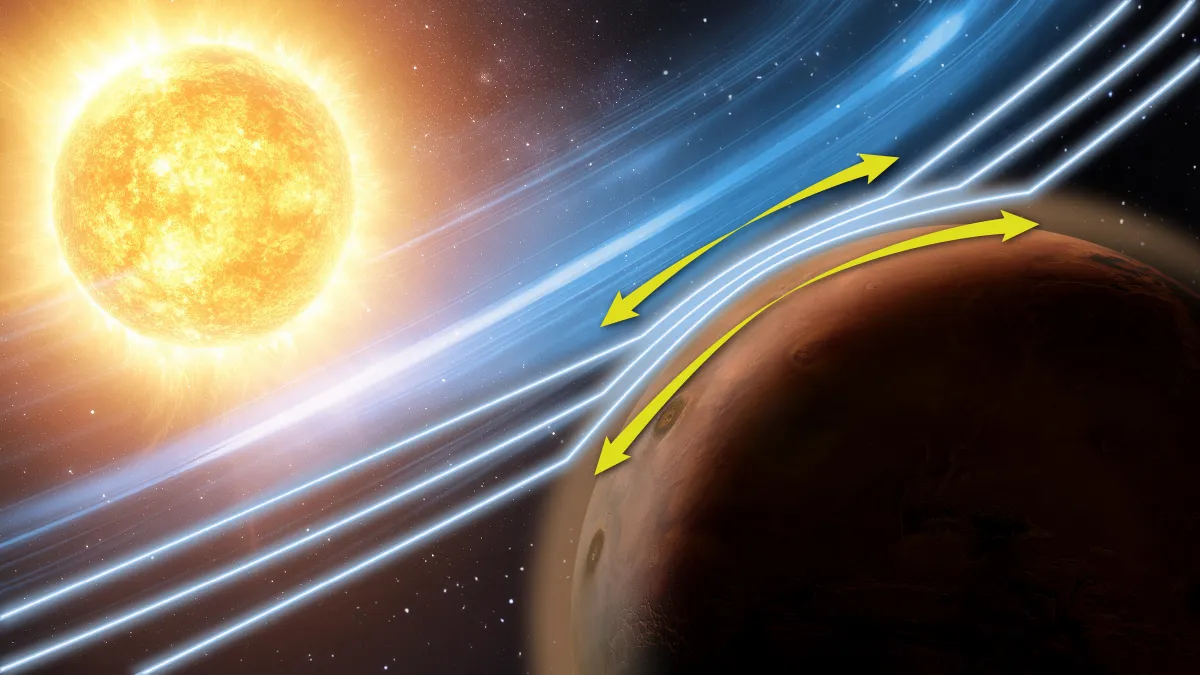
The mysterious phenomenon identified in the Martian sky is known to physicists as the Zwan-Wolf effect.
First proposed in 1976, this effect describes how charged particles from the Sun are compressed along magnetic structures, much like toothpaste being squeezed from a tube.
On Earth, this process takes place high above the planet within our strong global magnetosphere, helping to deflect the powerful solar wind away from us.
Because it was always studied as a feature of a planet’s magnetic shield, no one ever expected to find it buried deep inside an atmosphere.
This discovery reveals that the complex physics of space plasma can manifest in environments we previously thought impossible.
How an Unmagnetized Planet Defies the Solar Wind
Unlike Earth, Mars lacks a strong global magnetic field to protect it from the constant stream of solar particles.
Instead, as the solar wind collides with the Martian ionosphere, it creates a temporary, induced magnetic field around the planet.
Using MAVEN’s suite of scientific instruments, researchers located the Zwan-Wolf effect deep within this ionosphere, below an altitude of 200 kilometers.
Under normal conditions, this subtle atmospheric squeezing is far too weak for our current instruments to detect.
However, the intense space weather event of late 2023 acted as a natural amplifier, magnifying the effect until it was clearly visible in the data.
This unexpected discovery proves that the Martian atmosphere undergoes dynamic changes driven by the Sun in ways we are only beginning to comprehend.
New Horizons in Planetary Science and Space Weather
This remarkable breakthrough opens up a brand-new field of study in planetary physics and the evolution of celestial bodies.
Understanding how the Zwan-Wolf effect operates within an atmosphere will help scientists model the environments of other unmagnetized worlds, such as Venus or Saturn’s moon Titan.
It offers fresh insights into how solar radiation shapes the habitability of planets across our solar system and beyond.
Furthermore, as humanity prepares for future crewed missions to Mars, understanding these violent atmospheric disruptions becomes vital for keeping explorers safe.
Even as the MAVEN mission faces operational challenges, its rich archive of data continues to unveil the deep secrets of our neighboring world.
Summary
This incredible discovery of the Zwan-Wolf effect on Mars reminds us that the universe still holds countless beautiful surprises.
Together, we are taking small steps toward understanding the deep connections between our host star and the planets that call this solar system home.
参照リンク:
https://science.nasa.gov/missions/maven/nasas-maven-makes-1st-discovery-of-atmospheric-effect-at-mars/?utm_source=newsletter&utm_medium=email&utm_campaign=nn202620