Revolutionizing Off-World Mobility with the Next-Gen ERNEST Rover
For decades, navigating the alien surfaces of other celestial worlds has been a slow and perilous endeavor.
While traditional rovers like Curiosity and Perseverance have logged incredible scientific achievements, they rely on a passive rocker-bogie suspension system designed for safety rather than speed, leaving them vulnerable to getting stuck in deep cosmic dust or blocked by steep, rugged terrain.
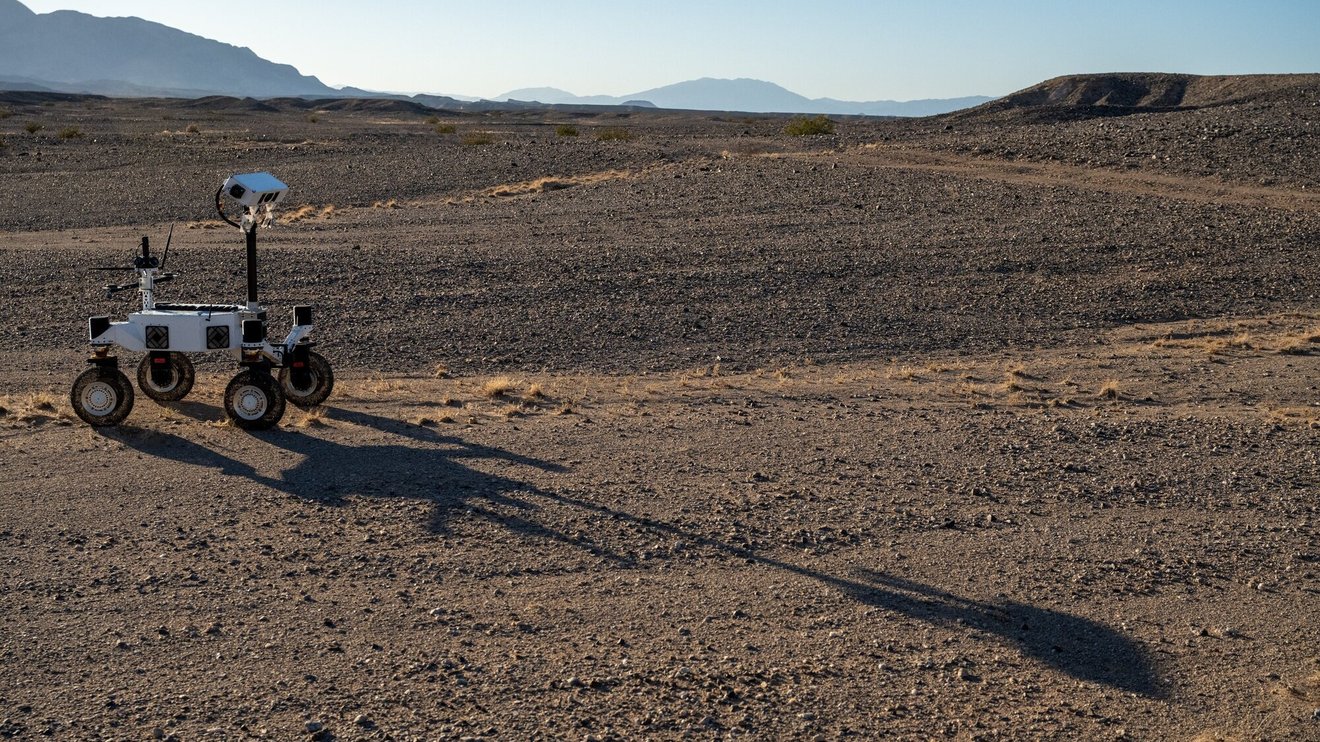
To shatter these mobility barriers, robotics engineers have developed a brilliant new prototype called ERNEST (Exploration Rover for Navigating Extreme Sloped Terrain).
Measuring just 4 feet long, this compact four-wheeled rover recently completed a monumental field test in the grueling expanse of Southern California’s Colorado Desert.
Over the course of a seven-day campaign, ERNEST independently traversed roughly 16 miles (26 kilometers) across natural, unpredictable terrain with almost zero human intervention.
Crucially, the prototype achieved autonomous speeds of up to 0.6 mph (1 kph)—surpassing the navigation speed of current Mars rovers by an order of magnitude and effectively rewriting the playbook for deep space surface operations.
Active Suspension and Adaptive Gaits: A Masterclass in Robotics
The core engineering breakthrough powering ERNEST is its innovative active suspension system, which marks a complete departure from past robotic designs.
By embedding two powered joints in its front chassis, the rover can dynamically adjust its internal weight distribution among its specialized mesh wheels in real-time.
This structural flexibility unlocks an array of biological-inspired movements, allowing the rover to execute distinct gaits such as “squirming” through shifting sands, “wheel-walking” over large debris, and even driving completely sideways to skirt hazards.
An integrated clutch mechanism lets ERNEST seamlessly toggle between passive and active suspension modes, conserving critical battery power on flat terrains while retaining the brute physical capability needed to tackle extreme vertical slopes.
This mechanical versatility opens up entirely new scientific frontiers, turning previously suicidal pathways—such as steep crater walls, ancient lava tubes, and the rugged, unmapped expanses of our solar system—into accessible terrain for the next generation of robotic explorers.
Reinforcement Learning and the Conquest of Eternal Shadows
To operate successfully on distant planets where communication delays with Earth can span up to 24 minutes each way, a rover must possess true cognitive autonomy.
ERNEST’s advanced decision-making engine was forged using reinforcement learning inside a high-fidelity virtual simulation environment, accumulating thousands of hours of driving experience in a matter of days before ever touching actual desert soil.
This AI allows the vehicle to instantly analyze topographical features and plan highly efficient paths over or around treacherous obstacles without waiting for instructions from a human operator.
To push this autonomy to its absolute limit, the engineering team deliberately deployed ERNEST during dusk, dawn, and pitch-black nighttime conditions.
This specific regimen simulated the low-angle lighting conditions of the lunar South Pole, where extreme topography creates blinding high-contrast glares and long, deceptive shadows.
By masterfully coordinating its intelligent long-range navigation with its active suspension, the autonomous rover proved it could successfully navigate through blinding darkness.
The immense treasure trove of field data secured during this campaign will now pave the way for a full-scale lunar rover twice the size of the prototype, bringing humanity closer than ever to conducting expansive scientific road trips across the rugged, untouched surfaces of the Moon and Mars.
Summary
The groundbreaking successful desert trial of the ERNEST prototype showcases a dramatic leap forward in planetary surface mobility and real-time AI autonomy.
As these advanced robotic pioneers prepare to conquer extreme vertical inclines and the deep shadows of alien worlds, the horizon of cosmic discovery expands further than ever before.
References:
https://www.jpl.nasa.gov/news/nasa-testing-advanced-capabilities-for-moon-mars-rovers/