Revolutionizing Mars Exploration with SkyFall’s Flexible Fabric Antenna
As humanity sets its sights on setting foot on Mars, NASA is accelerating preparations for its next groundbreaking mission known as SkyFall.
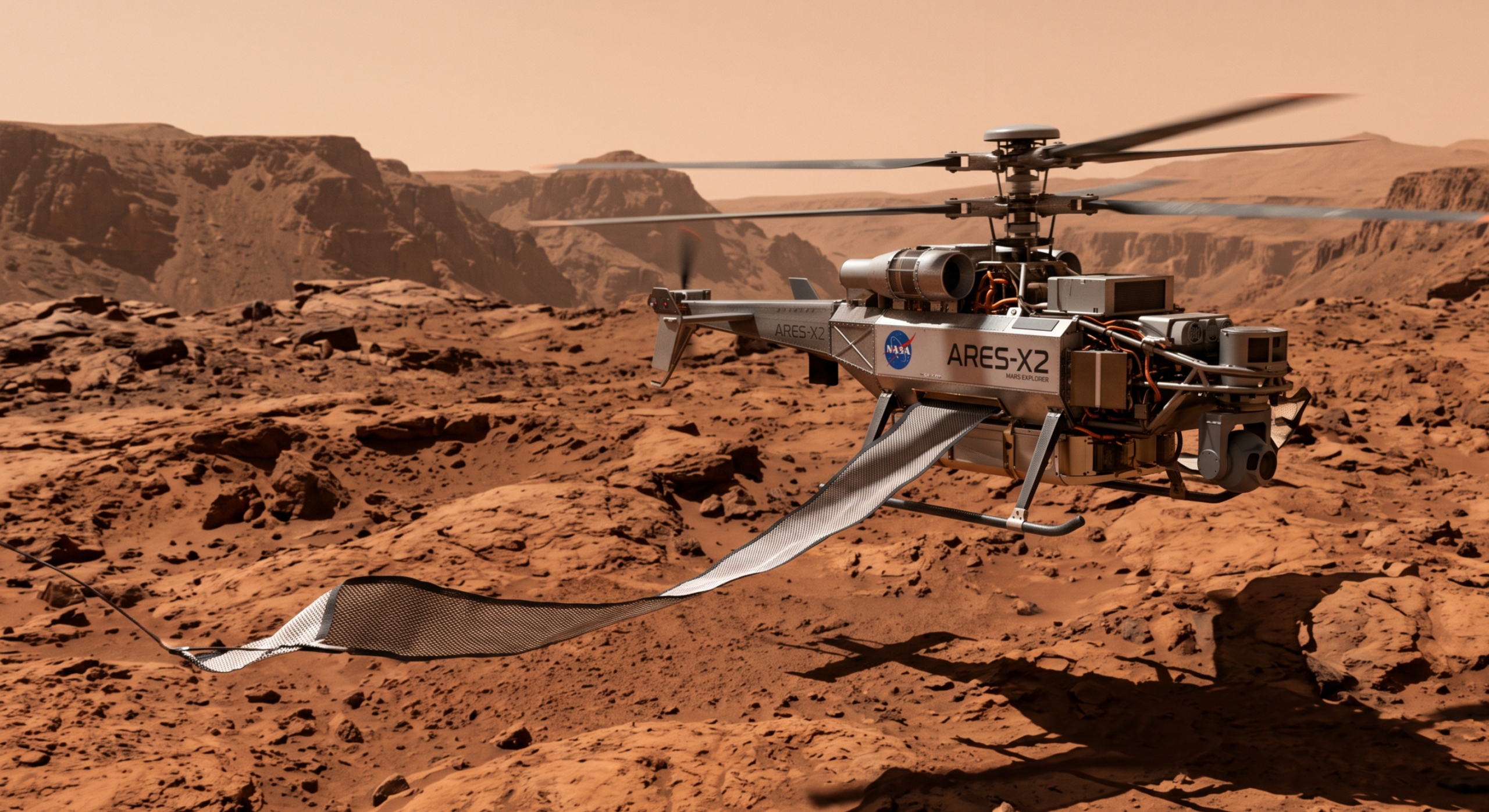
This ambitious project will deploy a trio of advanced helicopters into the Martian skies to search for water, a resource that will be a matter of life and death for future astronauts.
The frozen ice resting just a few yards beneath the Martian surface is an invaluable asset, capable of providing drinking water, breathable oxygen, and even rocket fuel.
Because orbiting spacecraft struggle to capture high-resolution data of this shallow subsurface, conducting ground-penetrating radar scans from low-flying helicopters has emerged as the most effective strategy.
The greatest engineering hurdle in this endeavor was designing an antenna capable of transmitting and receiving the necessary radar frequencies.
A traditional metal antenna operating in this spectrum would need to be about 19 inches long, which is simply too large to fit in the mere 6-inch clearance between the helicopter’s underbelly and the rugged Martian terrain.
To overcome this, engineers drew inspiration from the Vivaldi antenna to create a remarkably thin and highly flexible fabric-based solution.
Constructed from layers of polyester and Vectran, the same ultra-strong material used in the landing airbags for previous Mars rovers, this innovative antenna weighs a mere 5 ounces.
It possesses the incredible ability to bend completely out of the way if it strikes a rock during landing, and then instantly spring back into its precise shape for data collection upon takeoff.
Recently, this ingenious hardware underwent a grueling series of environmental tests and passed with flying colors.
It successfully endured the dramatic thermal shifts of the Martian day-night cycle, which can fluctuate by as much as 170 degrees Fahrenheit, as well as the physical strain of being repeatedly flexed to simulate over 200 landings.
This rigorous testing represents more than double the stress expected during its primary mission, and remarkably, the antenna showed absolutely no degradation in its radar signal performance.
Building upon the legendary legacy of the Ingenuity Mars Helicopter, the SkyFall mission is currently slated for launch in late 2028.
It won’t be long before this lightweight, resilient fabric antenna helps uncover the hidden subsurface oases that will ultimately pave the way for human exploration of the Red Planet.