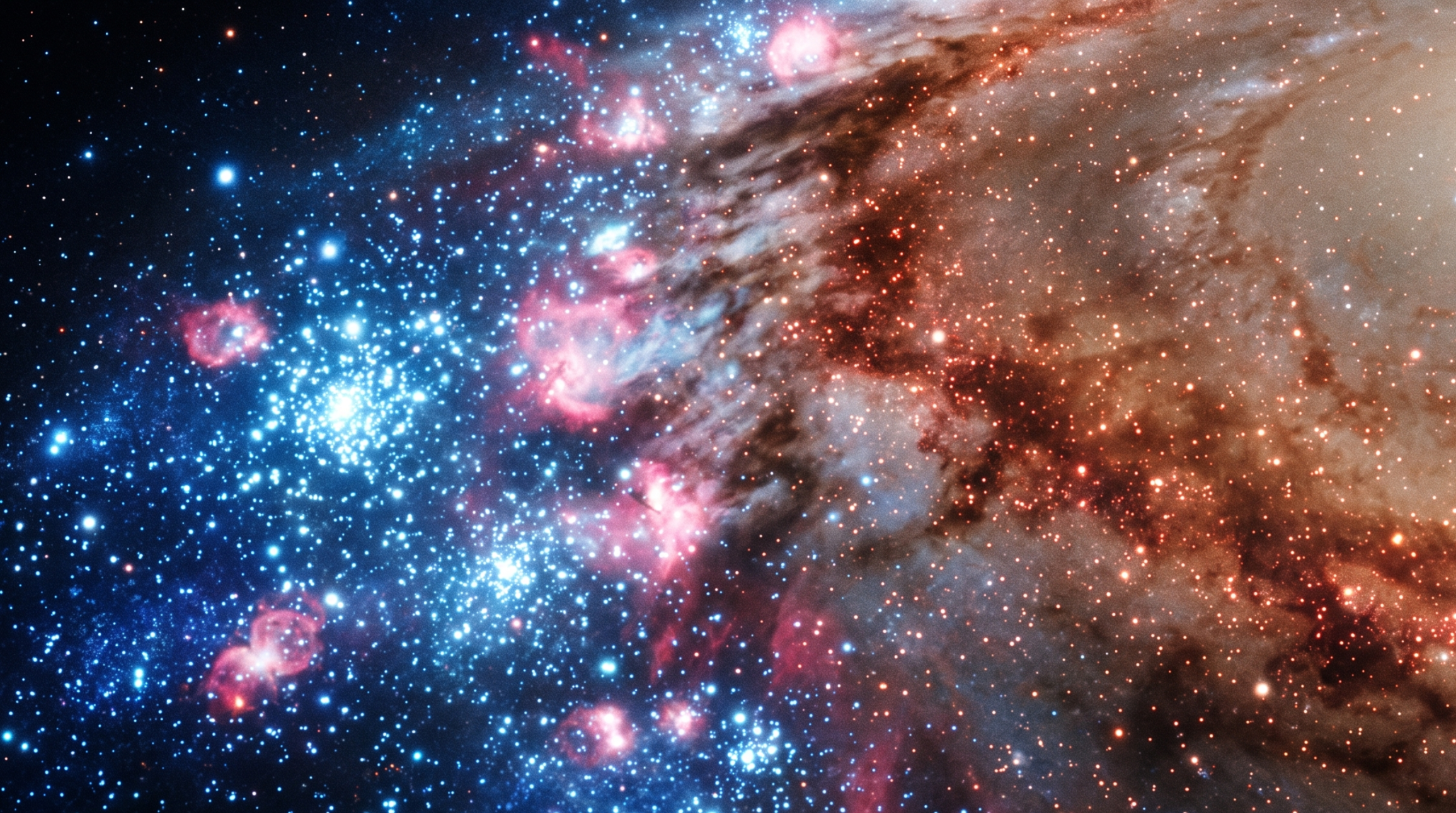
Hubble Unveils the Quiet Slumber of the Andromeda Galaxy
When we look up at the night sky, our closest galactic neighbor, the Andromeda Galaxy, stands as a majestic testament to the cosmos.
Located roughly 2.5 million light-years away, a mere stone’s throw in cosmic terms, this magnificent spiral galaxy offers profound clues to understanding the past and future of our own Milky Way.
Recent, unprecedented data captured by the Hubble Space Telescope has revealed a dramatic slowdown in Andromeda’s star-forming engine.
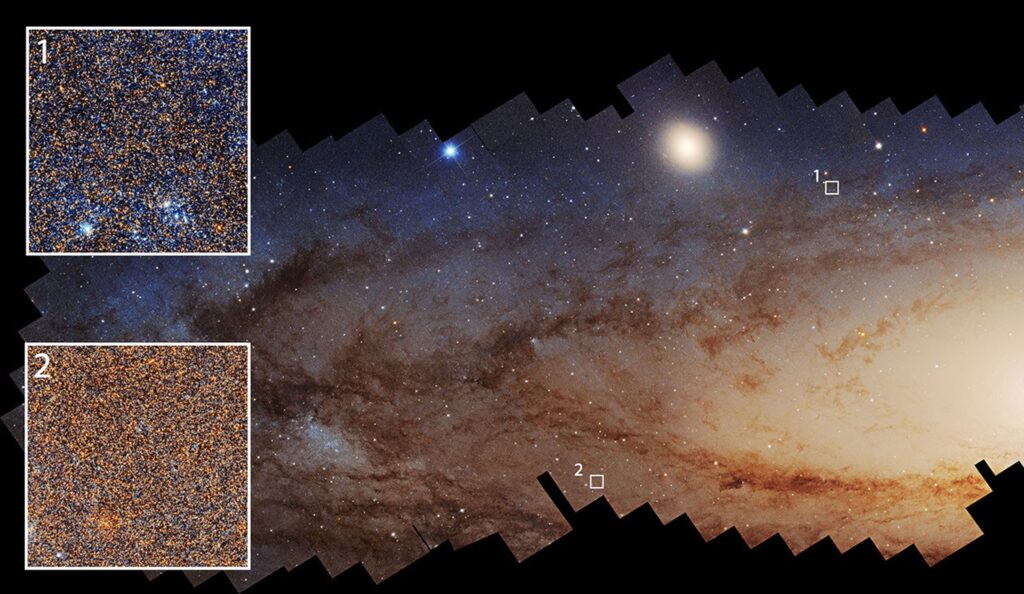
An extensive survey scanned two-thirds of the galaxy’s disk, allowing researchers to meticulously measure around 200 million individual stars.
These stars act as fossil records, chronicling the galaxy’s evolutionary history.
Massive, blue stars have fleeting lifespans and indicate recent stellar birth, whereas less massive, red stars tell the story of an older, established population.
Without Hubble’s unparalleled resolving power, it would be impossible to map these individual stellar fossils across such a vast expanse and decode the deep history of our galactic neighbor.
A Drastic Drop in Star Birth and a Cosmic Breather
Tracing back the cosmic timeline, astronomers believe Andromeda experienced a colossal burst of star formation around two billion years ago, likely triggered by a dramatic collision or merger with another galaxy.
However, this meticulous new analysis shows a steady, undeniable decline in star birth over the past 500 million years.
In astronomy, the star formation rate is measured by the amount of solar mass converted into stars each year.
Half a billion years ago, Andromeda was churning out about one solar mass worth of new stars annually, but by 40 million years ago, that rate had plummeted by half.
Today, the pace has drastically dropped to a mere fraction—producing roughly one-fifth of our Sun’s mass per year.
This sharp decline is especially pronounced in a star-forming ring situated about 32,000 light-years from the galactic center.
Fascinatingly, this slowdown isn’t caused by a lack of raw materials like gas and dust.
Instead, it seems the galaxy is naturally winding down after its previous, turbulent era of intense activity.
It is a quiet, majestic cosmic drama, much like a marathon runner catching their breath on the sidelines after finishing an exhausting race.
The Suspect Satellite M32 and the Future of Exploration
As researchers investigate this sudden drop in stellar production, a prime suspect has emerged: Andromeda’s small satellite galaxy, M32.
While M32 appears to be only 16,000 light-years away in the plane of the sky, its true three-dimensional position and orbital history remain shrouded in mystery.
By focusing on the star formation history in the region nearest to M32, the team discovered distinct signs of suppressed activity compared to the rest of the galaxy.
This localized dip in star birth is estimated to have begun around 60 million years ago.
Although scientists cannot definitively declare M32 guilty of halting stellar production, it is highly probable that past gravitational interactions between the two disrupted Andromeda’s star-forming gas clouds.
To completely unravel this mystery, we must look to the future of astronomical observation.
Soon, the Nancy Grace Roman Space Telescope will come online, boasting a field of view more than 100 times larger than Hubble’s.
With this revolutionary new eye in the sky, astronomers will be able to capture the entirety of Andromeda and its intricate surroundings in a single sweep, turning a brilliant new page in our understanding of cosmic evolution.
Summary
It seems our massive neighbor, 2.5 million light-years away, is taking a long, peaceful breath after a very chaotic past.
I am incredibly excited to see what the next generation of space telescopes will reveal about this ongoing cosmic drama!
Reference Link:
https://science.nasa.gov/missions/hubble/nasas-hubble-shows-star-formation-in-andromeda-galaxy-winding-down/?utm_source=newsletter&utm_medium=email&utm_campaign=nn202630