Ionization Fronts and Protostellar Jets in the Pelican Nebula
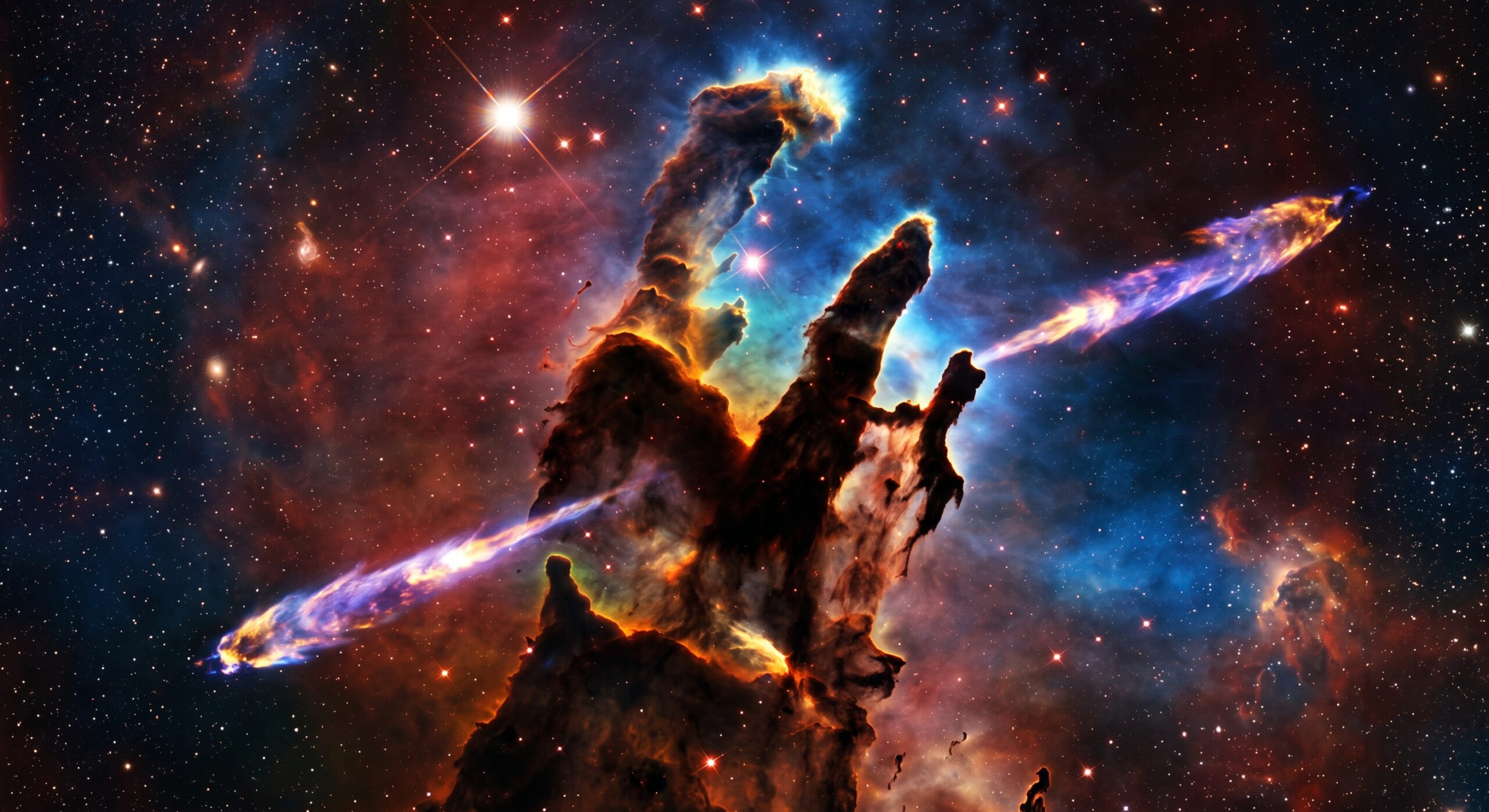
Featured on NASA’s Astronomy Picture of the Day, new high-resolution narrowband composite imagery captures the turbulent boundary physics within the Pelican Nebula (IC 5070 and IC 5067). Situated roughly 2,000 light-years away in the constellation Cygnus, this active star-forming complex is directly sculpted by intense ultraviolet radiation originating from massive young stars within the adjacent North America Nebula (NGC 7000) system.
The narrowband emission mapping isolates ionized sulfur, hydrogen, and oxygen, delineating an advancing ionization front where energetic stellar winds erode diffuse gas while compressing dense molecular globules. Embedded deep within these dark, towering dust pillars, proto-stellar accretion drives high-velocity collimated outflows. Astronomers have resolved twin relativistic gas jets known as Herbig-Haro object 555 (HH 555), extending across light-years as bipolar shockwaves that plow into the surrounding interstellar medium, providing a clear snapshot of angular momentum transfer during early stellar infancy.
Rubin Observatory’s 3.2-Gigapixel Survey Reshapes Time-Domain Astronomy
On the summit of Cerro Pachón in the Chilean Andes, the NSF–DOE Vera C. Rubin Observatory has commenced operational data acquisition for its landmark 10-year Legacy Survey of Space and Time (LSST). Utilizing the largest digital camera ever constructed for optical astronomy—a 3.2-gigapixel focal plane array cooled to cryogenic vacuum conditions—Rubin photographs the entire accessible southern sky every few nights.
The survey’s high-cadence imaging pipeline is designed to detect subtle transient events, generating automated public alerts within 60 seconds of image readout. By logging millions of variable stars, eruptive stellar flares, distant supernovae, and faint near-Earth asteroids every single night, LSST creates an unprecedented temporal cinema of the cosmos. This continuous stream of time-domain alerts will provide immediate targeting coordinates for orbital observatories like the Nancy Grace Roman Space Telescope and the James Webb Space Telescope to conduct rapid spectroscopic follow-ups.
Multi-Wavelength Synthesis: Unveiling Galactic Energetics with Chandra and Webb
Complementing optical and near-infrared surveys, new cross-mission archives from NASA’s Chandra X-ray Observatory and the James Webb Space Telescope showcase the power of panchromatic astrophysics. While infrared detectors excel at peering through dense interstellar dust to reveal embedded stellar embryos and cool molecular gas, X-ray observatories capture the highest-energy thermal environments in the universe.
Chandra’s sub-arcsecond X-ray vision maps superheated gas clouds reaching millions of degrees, energized by shock fronts from recent core-collapse supernovae and the magnetic coronae of active young stars. Co-registering Chandra’s high-energy emissions with Webb’s structural infrared imaging across crowded galactic cores allows astrophysicists to trace the complete feedback loop: measuring how black hole accretion and extreme stellar winds heat the interstellar medium, thereby regulating or quenching subsequent generations of star formation across entire galaxies.