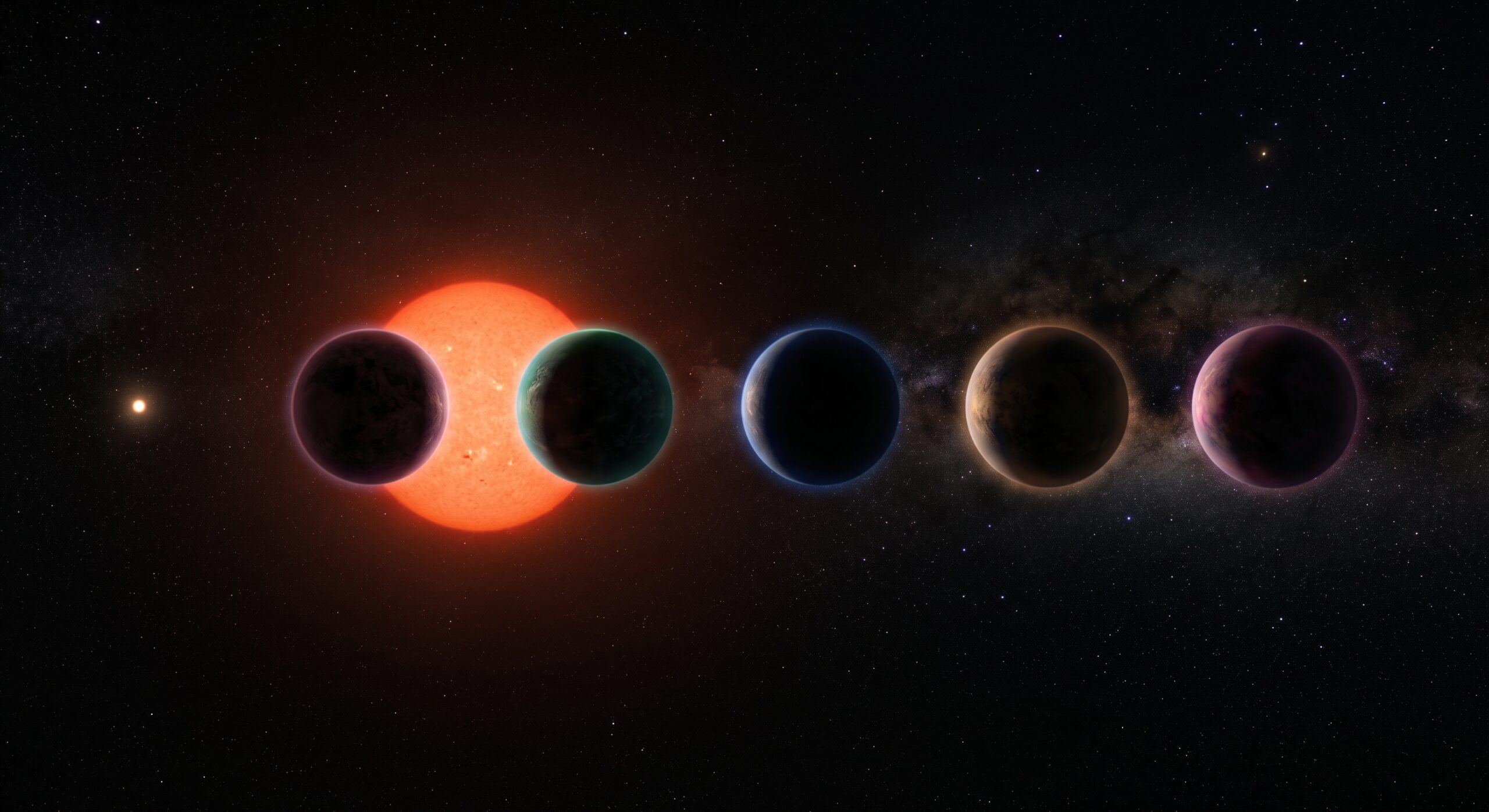
Hubble Transmission Spectra Map Atmospheric Constraints Across Six TRAPPIST-1 Worlds
In a major expansion of comparative exoplanetology, the NASA Exoplanet Archive has ingested 48 new high-precision planetary spectra, anchored by a comprehensive set of transmission and eclipse observations targeting six Earth-sized planets in the celebrated TRAPPIST-1 system (TRAPPIST-1 b, c, d, e, f, and g). Gathered using the Space Telescope Imaging Spectrograph (STIS) and Wide Field Camera 3 (WFC3) aboard the Hubble Space Telescope, these observations provide vital spectroscopic baselines across the ultra-cool red dwarf system located 40 light-years away.
By filtering starlight passing through the upper atmospheric limbs of each planet during transit, Hubble searched for the absorption fingerprints of extended, hydrogen-rich primordial atmospheres. The flat transmission spectra definitively rule out cloud-free hydrogen/helium envelopes across the inner rocky worlds, confirming high-density terrestrial bulks. These empirical constraints establish whether worlds in the habitable zone—such as TRAPPIST-1 e and f—have retained secondary, heavy-molecule atmospheres (such as carbon dioxide, nitrogen, or water vapor) or have experienced atmospheric stripping from intense stellar flares.
Kuiper Belt Geodynamics: New Horizons Unveils Pluto in Enhanced Color
Featured on NASA’s Astronomy Picture of the Day, newly recalibrated multispectral imagery from the New Horizons spacecraft presents Pluto in enhanced, high-fidelity color. Acquired by the Multispectral Visible Imaging Camera (MVIC) on the Ralph instrument suite during its historic 2015 flyby, the synthetic color composite exaggerates subtle compositional gradients across the dwarf planet’s frozen surface.
The data delineates the stark physical boundary between the pristine, pale nitrogen and carbon monoxide glaciers of Sputnik Planitia and the deep tholin-stained topography of Cthulhu Macula. Solar ultraviolet photons process atmospheric methane and nitrogen into complex macromolecules known as tholins, which settle onto the landscape as an insoluble reddish precipitate. Surrounding this dynamic glacial basin, towering bedrock mountains composed of water ice—such as Hillary Montes—persist as rigid crustal blocks under temperatures of -230 degrees Celsius, underscoring active cryo-convective geology in the outer solar system.
Rapid Stellar Emergence: Hubble and Webb Redefine Star Cluster Lifecycles in M51
Bridging galactic morphology and stellar astrophysics, joint investigations using the Hubble Space Telescope and James Webb Space Telescope (JWST) across the Whirlpool Galaxy (M51) have upended models of massive star cluster formation. Historically, astronomers theorized that newborn star clusters remain embedded within their natal molecular dust cocoons for tens of millions of years before clearing their surrounding gas.
By pairing Hubble’s ultraviolet resolving power with Webb’s mid-infrared penetration through M51’s spiral arms, researchers discovered that massive clusters clear their birth clouds in less than three million years. Intense radiation pressure and concentrated stellar winds from infant OB-type stars expel dense molecular envelopes far more violently and rapidly than previously simulated, providing vital empirical data for galactic-scale simulations of stellar feedback.