From the successful execution of a propellant-saving Mars gravity assist to the continuous operation of its highly efficient solar electric propulsion system, we will delve into the latest factual updates regarding NASA’s Psyche spacecraft as it accelerates toward a mysterious metal-rich asteroid in the deep solar system.
Continuous Operation of Solar Electric Propulsion After Mars Flyby
Following its launch in October 2023, the Psyche spacecraft managed by NASA’s Jet Propulsion Laboratory has successfully completed a critical Mars flyby to gain a momentum-boosting gravity assist while simultaneously initiating a near-continuous operation phase of its main engines to stay precisely on track for a summer 2029 arrival in the main asteroid belt.
Furthermore, mission controllers have instructed the spacecraft to maintain this aggressive cruising strategy by running the propulsion system approximately ninety percent of the time, pausing only briefly once a week to transmit vital engineering data and receive necessary navigation commands from Earth.
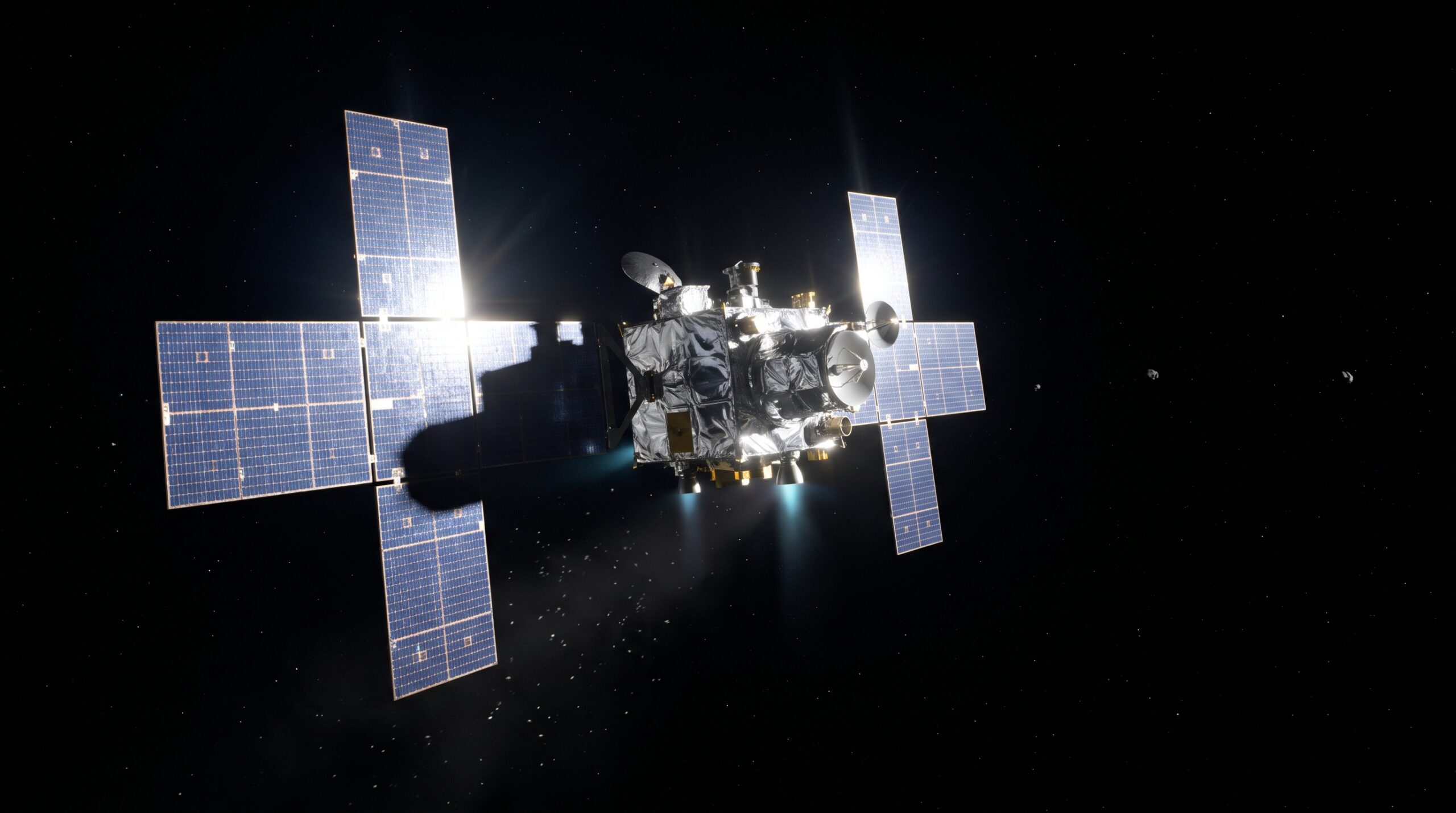
Additionally, to power this demanding long-duration journey, the spacecraft relies entirely on two massive cross-shaped solar arrays that collect sunlight to generate electricity, which allows the probe to steadily build up incredible speed that will eventually exceed 100,000 miles per hour relative to observers on Earth.
Hall-Effect Thrusters and the Scientific Mission at a Metal-Rich Asteroid
Instead of relying on conventional chemical combustion, the Psyche spacecraft utilizes highly efficient Hall-effect thrusters that employ electromagnetic fields to accelerate and expel charged xenon ions into the vacuum of space, creating a gentle but steady thrust accompanied by a distinctive bright cyan blue glow.
Moreover, while the actual physical force generated by these advanced ion engines is incredibly small and comparable to the weight of holding a single AA battery in your hand, this continuous gentle push over several years allows the spacecraft to achieve massive interplanetary velocities while conserving its precious xenon propellant supply.
Ultimately, when the spacecraft finally arrives at the 173-mile-wide asteroid Psyche, it will conduct a comprehensive multi-year orbital survey to determine if this metallic body is indeed the exposed partial core of an ancient planetesimal, which could offer unprecedented scientific insights into the hidden interior structures of rocky planets like Earth.