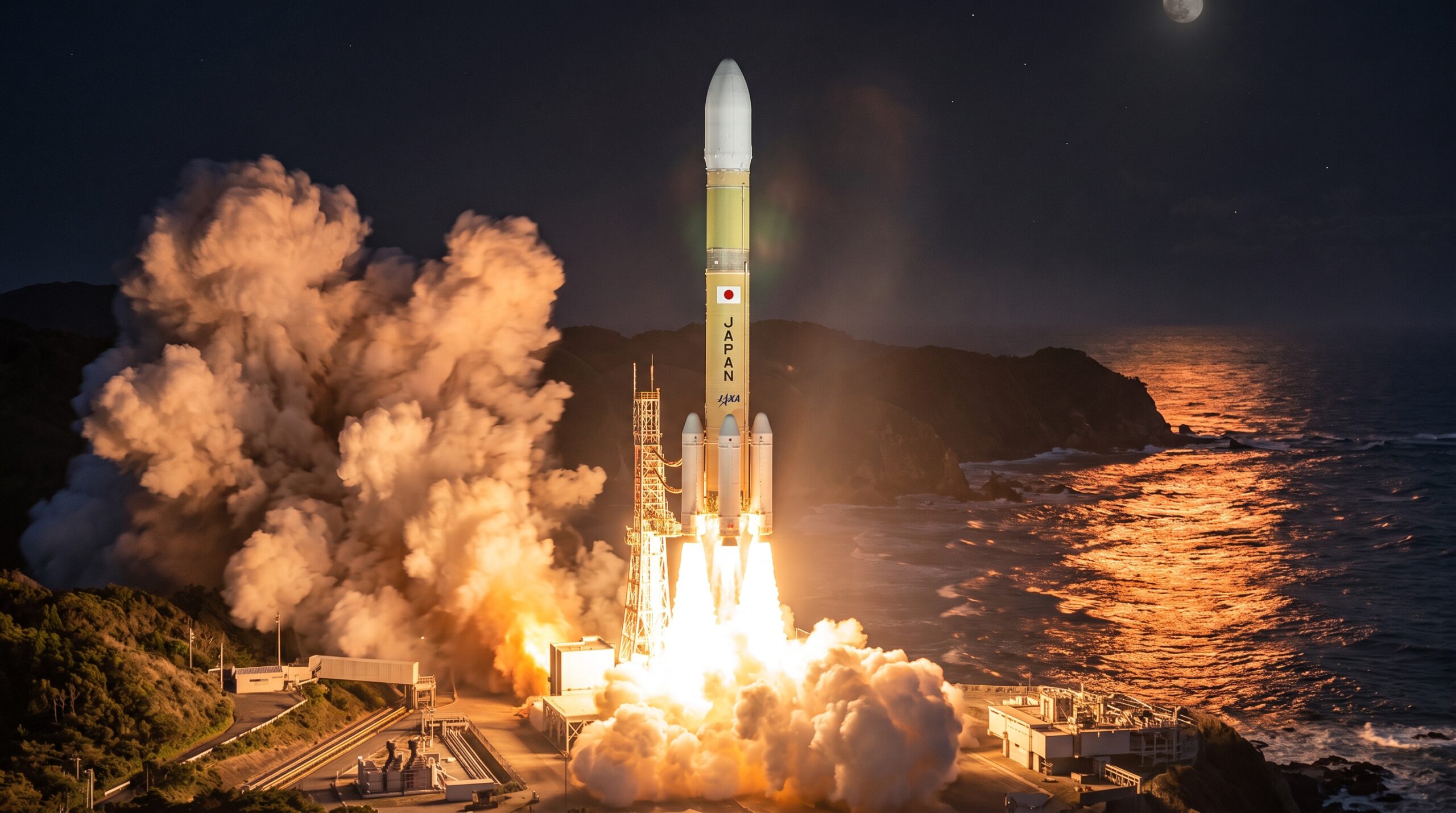
Marking a major triumph in interplanetary exploration, Japan successfully launched the H3 Launch Vehicle flight No. 10 in the early morning hours of October 20, 2026, flawlessly dispatching the Martian Moons eXploration spacecraft toward the Martian gravitational system. This article details the factual achievements of the launch, the unprecedented scientific goals of retrieving samples from Phobos, and the confirmed operational reliability of Japan’s flagship rocket.
The Historic Mission of JAXA’s MMX Spacecraft to Explore and Sample Martian Moon Phobos
Led by the Japan Aerospace Exploration Agency, the Martian Moons eXploration mission officially departed Earth to conduct high-resolution remote observations of both Phobos and Deimos before attempting a high-precision landing to collect the world’s first surface samples from Phobos.
Furthermore, analyzing these pristine samples will allow international planetary scientists to definitively resolve whether the Martian moons formed through a colossal impact with Mars or represent captured asteroids, while uncovering essential evidence about the transport of volatile substances across the early inner solar system.
Additionally, the spacecraft carries a highly sophisticated suite of scientific instruments alongside a custom micro-rover contributed by global partners including NASA, ESA, and CNES, standing as a benchmark of international collaboration in cutting-edge deep space exploration.
Flawless Pre-Dawn Liftoff at 4:41 AM and Orbital Deployment by H3 Rocket Flight 10
Providing heavy-lift orbital transport, Japan’s next-generation H3 Launch Vehicle flight No. 10 lifted off precisely at 4:41 AM JST on October 20, 2026, blazing into the dark sky above the Yoshinobu Launch Complex at the Tanegashima Space Center.
Moreover, the launch vehicle executed all critical flight events according to plan, successfully jettisoning its solid rocket boosters and payload fairings before upper-stage burns precisely injected the MMX spacecraft into its planned interplanetary trajectory.
Consequently, this clean mission success convincingly establishes the H3 rocket’s capability to deliver heavy scientific payloads into complex interplanetary trajectories, reinforcing its credibility and flexibility for commercial and international deep space architectures.
Expanding Deep Space Transport Technologies and the Global Frontier of Solar System Exploration
Inheriting the technical heritage of the Hayabusa missions, this successful departure signifies that Japan’s autonomous deep space transport capabilities have now officially expanded outward from near-Earth asteroids toward the Martian system.
Furthermore, mastering long-range transit operations, complex interplanetary navigation, and surface sample handling provides indispensable operational experience directly benefiting upcoming international lunar and Martian exploration frameworks.
Ultimately, as MMX begins its approximately one-year journey toward orbital insertion at Mars, this milestone sets the stage for groundbreaking discoveries concerning planetary formation, orbital dynamics, and the primordial origins of our solar system.
Reference URL: https://www.jaxa.jp/projects/sas/mmx/