NIAC 2026: Turning Science Fiction into Space Exploration Reality
At the very forefront of space exploration, a multitude of entirely new technologies are emerging that blur the line between science fiction and reality.
The NASA Innovative Advanced Concepts program has officially announced its 18 Phase I award-winning concepts for the year 2026.
This incubator program is not aimed at mere incremental technological progress, but rather at achieving the giant leaps that will fundamentally transform the future of space missions.
A total of approximately 3.2 million dollars has been allocated to these selected projects, with each research team receiving up to 175,000 dollars to embark on an intensive nine-month initial investigation.
These visionary ideas are still in their early conceptual stages and are not considered official space missions just yet.
However, every great technological revolution begins with a single, tiny seed of an idea.
These concepts harbor the potential to bring immeasurable benefits to future solar system exploration, the unraveling of cosmic mysteries, and the entire aerospace industry.
From advanced life support in extreme environments to entirely new propulsion systems, the sheer ambition of these projects is truly exhilarating for any space science enthusiast.
Visionary Concepts Reaching from the Moon to Deep Space
The concepts awarded this year cover an incredibly broad spectrum, ranging from establishing lunar infrastructure to mapping exoplanets light-years away.
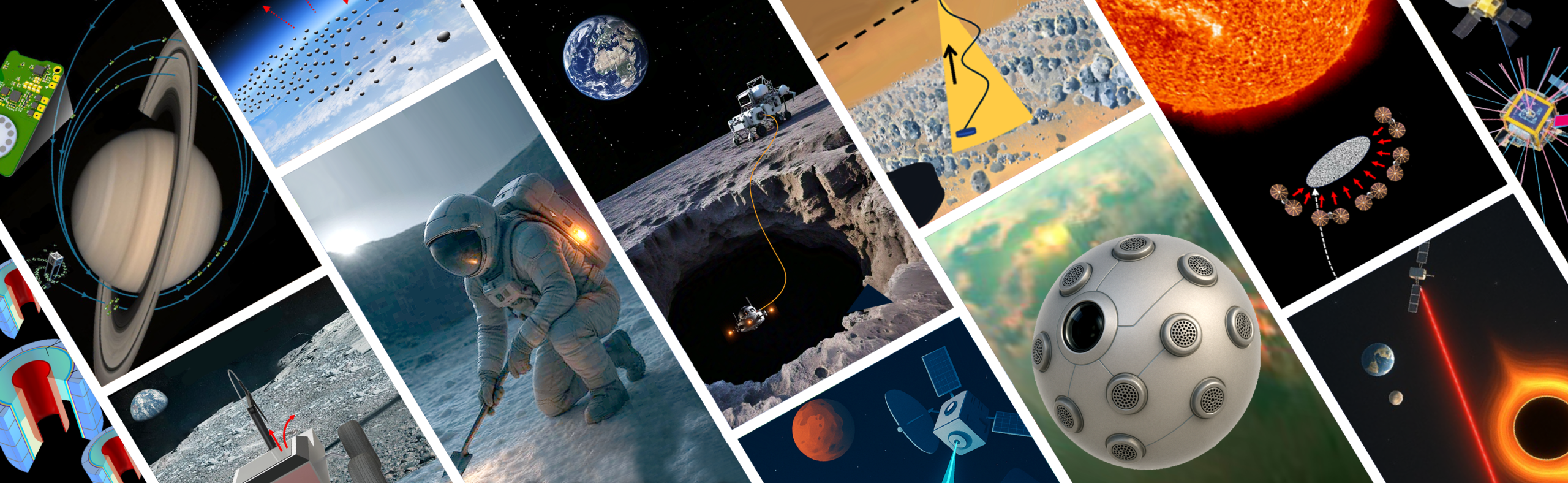
In the realm of lunar exploration, which is currently capturing global attention, technologies designed to sustain long-term operations have been selected.
These include hovering robots to investigate underground lava tubes and spacesuits integrating radioisotope heat sources to survive the freezing lunar night.
Building reliable infrastructure in the harsh environment of the Moon demands these kinds of unprecedented approaches.
Looking further across the solar system, groundbreaking ideas have also been chosen, including astonishing durability technologies to keep instruments alive in the scorching environment of Venus.
Another remarkable concept proposes the use of actively steerable femtosatellite constellations to directly explore the rings of Saturn.
If we can achieve observations that directly touch the particles making up Saturn’s rings, it would undoubtedly be a discovery of the century in planetary science.
The concepts aimed beyond our solar system are equally captivating, featuring proposals for new power sources for interstellar spacecraft and techniques to map continents on exoplanets.
They even include innovative methods to observe the photon rings surrounding black holes and detect subtle gravitational waves.
If these technologies mature successfully, space exploration a few decades from now will evolve into a dimension entirely different from what we can imagine today.