The Monumental Rollout of the Artemis III Core Stage
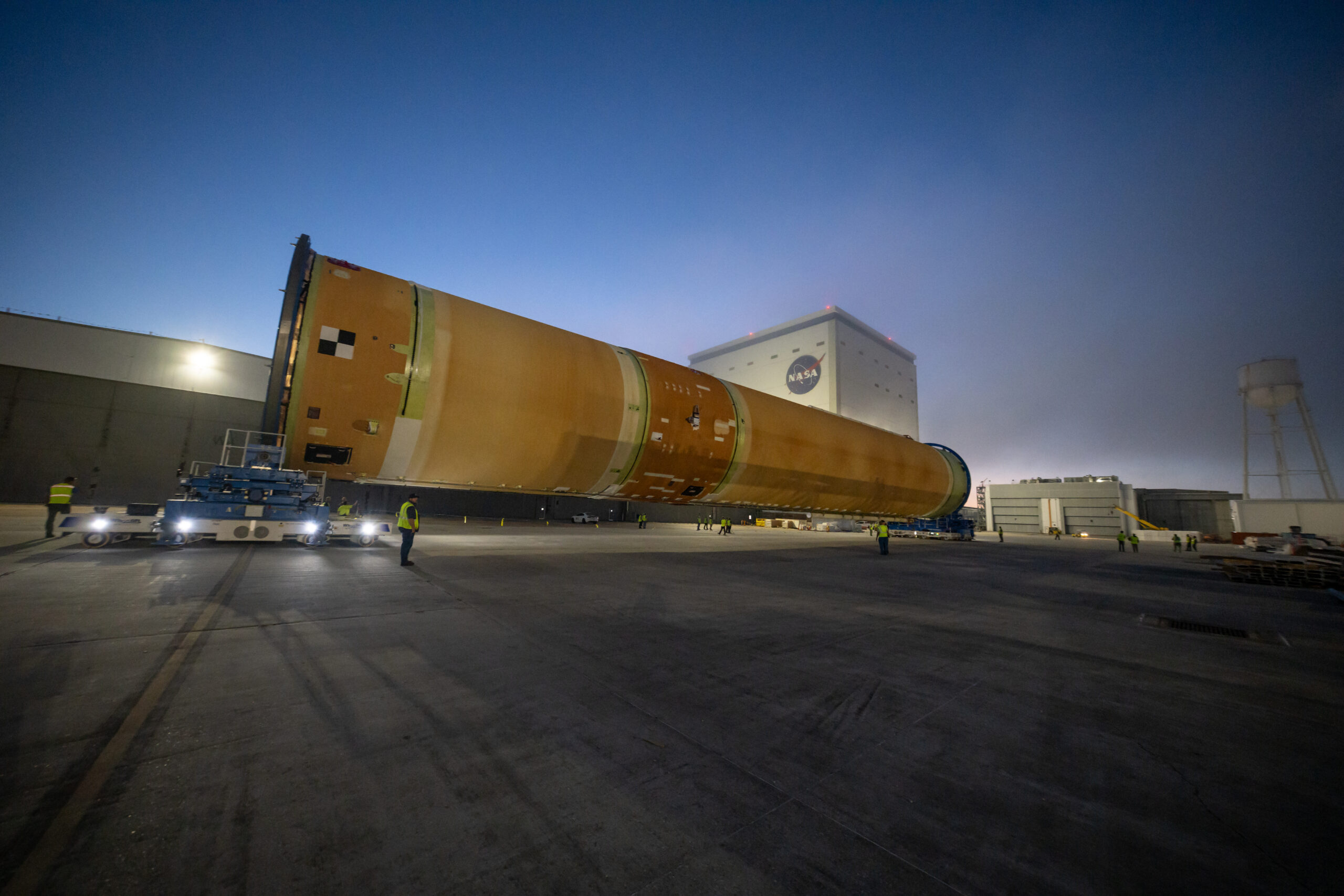
On April 20, 2026, a truly historic milestone in the next chapter of human lunar exploration will unfold at the Michoud Assembly Facility in New Orleans, Louisiana.
The massive core stage of the Space Launch System (SLS), currently under development by the United States, will finally make its long-awaited public rollout.
Serving as the colossal beating heart of the vehicle, this stage encompasses the liquid hydrogen and liquid oxygen tanks, the intertank, and the forward skirt, collectively accounting for roughly four-fifths of the entire rocket.
Witnessing the completion and deployment of such a massive structure serves as powerful, tangible proof that the Artemis III mission is moving rapidly from engineering blueprints to concrete reality.
This core stage bears the ultimate responsibility of generating the sheer, overwhelming thrust required to propel the Orion spacecraft and its human crew out of Earth’s gravitational pull and into the unforgiving depths of deep space.
From a purely aerospace engineering standpoint, observing the assembly and transport of what is arguably the most complex propulsion system ever conceived is an undeniably thrilling experience.
The Michoud Assembly Facility is nothing short of hallowed ground in the aerospace community, having famously birthed the mighty Saturn V rockets of the Apollo era and the external tanks for the Space Shuttle program.
The advanced welding techniques and meticulous assembly protocols perfected over decades at this facility are now being combined with cutting-edge composite materials to forge a resilient backbone for the next generation of lunar explorers.
Establishing a standardized, highly efficient manufacturing process for the SLS, achieved through seamless collaboration with Boeing and other vital aerospace contractors, ensures the long-term sustainability and cadence of future deep-space missions.
Final Integration and the Raw Power of the RS-25 Engines
Once the completed core stage finishes its voyage aboard the specially designed Pegasus barge and arrives at the Kennedy Space Center, an incredibly strict and delicate integration sequence will commence.
This vertical integration phase is arguably the most critical period of preparation, as engineers must guarantee that millions of individual, highly sensitive components communicate and function flawlessly together.
We have already seen significant progress, with the engine section and the protective boat-tail structure having successfully arrived at the Vehicle Assembly Building back in July 2025.
A key focal point of this process will be the arrival of the four RS-25 engines from the Stennis Space Center in Mississippi, which are scheduled to be integrated into the engine section no later than July 2026.
The RS-25 engine boasts an unparalleled legacy of reliability and high-performance, having safely carried Space Shuttle crews to low Earth orbit across dozens of demanding missions.
By upgrading these veteran engines with state-of-the-art modern avionics and bundling four of them together at the base of the SLS, the vehicle will unleash a staggering 2 million pounds of thrust.
Without this earth-shaking level of power, executing a single-launch architecture to deliver the heavy Orion capsule and critical life-support supplies to lunar orbit would be entirely impossible.
The sheer precision of the turbopumps, which aggressively force cryogenic liquid propellants into the intense heat of the combustion chambers, represents the absolute pinnacle of human mastery over fluid and thermodynamics.
After the hardware is fully integrated, the colossal rocket will be handed over to the Exploration Ground Systems program for the final stacking operations leading up to the launch countdown.
The highly choreographed parallel workflows across multiple specialized facilities stand as a testament to the elegant systems engineering required to safely manage a megaproject of this unprecedented scale.
It is the unified brilliance of these diverse engineering teams that is slowly bringing this vehicle to life, preparing it to carry humanity on a mission unlike any other.
Looking Ahead to the 2027 Launch of Artemis III
Building directly upon the critical lessons learned and the resounding success of earlier crewed test flights, the Artemis III mission is officially targeting a highly anticipated launch in 2027.
The primary, overriding objective of this complex flight profile is to launch American astronauts into Earth orbit aboard the Orion spacecraft to conduct rigorous tests of rendezvous and docking maneuvers.
Mastering these delicate orbital interactions with commercial spacecraft in the vacuum of space is a non-negotiable technical prerequisite before we can safely attempt a sustainable human landing on the lunar surface.
As it stands today, the SLS remains the only super heavy-lift launch vehicle on the planet capable of simultaneously sending a crewed spacecraft and necessary mission mass directly to the Moon.
This unique, heavy-lift capability is exactly what empowers us to incrementally expand our operational footprint on the lunar surface and systematically work toward establishing a permanent, self-sustaining human outpost.
The intensive exploration of vital water-ice resources hidden within the permanently shadowed regions of the lunar poles will provide the critical foundation needed to eventually push onward to Mars.
We must recognize that the Artemis program is far more than a nostalgic return to the Moon; it is a meticulously designed, long-term blueprint for permanently expanding humanity’s sphere of influence into deep space.
While the rollout of this specific core stage is just one milestone on a much larger timeline, it represents an undeniable leap forward in our quest to conquer the final frontier.
The day when we finally witness this magnificent hardware shatter the bonds of gravity is rapidly approaching.
Conclusion
The rollout of the SLS core stage at the Michoud Assembly Facility is an essential technical leap forward for the Artemis III mission.
This colossal structure, comprising the bulk of the rocket, will soon travel to the Kennedy Space Center to be integrated with the mighty RS-25 engines in preparation for deep space flight.
The completion of this super heavy-lift vehicle transforms the ambitious goals of the 2027 launch and future orbital docking tests into an imminent reality.
With every piece of hardware that rolls off the assembly line, humanity takes another concrete step toward establishing a permanent presence in the cosmos.