The Discovery of Interstellar Glaciers and the SPHEREx Mission
Deep within the endless dark of space, dramatic chemical reactions and the very seeds of life exist beyond our wildest imagination.
The latest observational data from NASA’s SPHEREx all-sky infrared space telescope has brought us an astonishing discovery that demands our attention.
SPHEREx is a highly advanced spectroscopic mission designed to unravel the history of the universe, the formation of galaxies, and the distribution of life-essential ice.
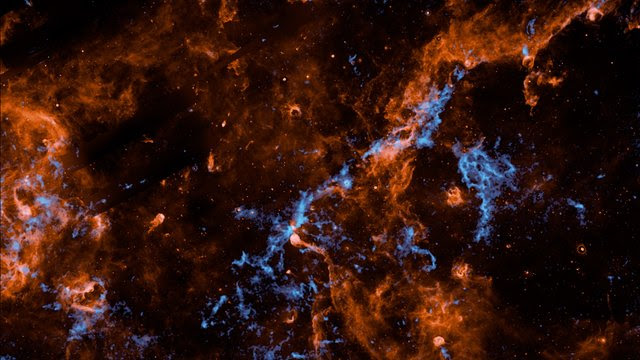
By observing the Cygnus X star-forming region in the Milky Way, this mission revealed a vast frozen complex spanning over 600 light-years, which can accurately be described as an interstellar glacier.
This is not a simple story of frozen water chunks floating freely in the void of space.
Molecules of water, carbon dioxide, and carbon monoxide are attached to the surfaces of microscopic dust grains, quietly accumulating deep inside giant molecular clouds.
These clouds are the cosmic nurseries where gas and dust collapse under gravity to give birth to new stars.
Equipped with the incredible ability to map the entire sky across 102 distinct wavelengths, SPHEREx has beautifully unveiled the massive spatial distribution of ice that previous observatories could not fully capture.
As a commentator on space science, examining this data reveals that the fundamental answer to where Earth’s oceans came from lies precisely within these massive icy clouds.
Unveiling the Mechanisms of Cosmic Ice Distribution Through Infrared Observation
Why has the complete picture of such vast interstellar glaciers remained hidden from us until now?
The answer lies in the dense interstellar dust drifting through space.
The deep interiors of molecular clouds, where stars are born, are so packed with dust that they completely block visible light, making it impossible for optical telescopes to peer inside.
However, the infrared instruments aboard SPHEREx can penetrate this thick veil of dust and accurately read the chemical signatures of the materials hidden within.
By utilizing the principle that specific infrared wavelengths are absorbed by ice molecules like water and carbon dioxide, scientists can analyze the faint background light to map exactly where and what types of ice are concentrated.
The observational data confirmed that the regions with the highest dust density perfectly match the areas where ice is most heavily concentrated.
This provides powerful evidence for the hypothesis that ice forms on the surfaces of incredibly tiny dust particles, no larger than those found in candle smoke.
Furthermore, it is a crucial fact that this thick layer of dust acts as a powerful shield, protecting the fragile ice molecules from the intense ultraviolet radiation emitted by newly born, scorching hot stars.
It has also become clear that the formation rates and abundances of water and carbon dioxide ice vary depending on the local environment.
Understanding the interactions between matter and these harsh cosmic environments is an extremely vital step in the physics of the interstellar medium.
An Icy Reservoir Nurturing New Solar Systems and the Origins of Life
The most thrilling reality presented by the discovery of these vast interstellar glaciers is that they represent the starting point of a magnificent process leading to future solar systems and unseen life.
The water and organic ice nurtured within these molecular clouds will eventually be incorporated into the protoplanetary disks that form alongside new stars.
In essence, SPHEREx is observing the very headwaters of a rain of life that will eventually fall upon countless newly born planets.
It is believed that the vast oceans on Earth, the ice locked within comets, and the icy surfaces of other planets and moons in our solar system were all supplied by similar interstellar glaciers billions of years ago.
As researchers point out, the existence of such a massive reservoir of ice suggests that the foundational materials for life are not rare in the universe, but rather exist universally.
Despite the environmental shifts and intense radiation accompanying the birth of new stars, these ice molecules, quietly protected in the shadow of dust, will eventually form oceans on planetary surfaces and set the stage for complex chemical evolution.
This data beautifully proves that the dynamism of the universe and the intricate dance of chemistry are connected in a single continuous line, from star birth to planetary formation, and ultimately to the genesis of life.
As SPHEREx continues to complete its all-sky map, there is no doubt that the chemical evolutionary history of the entire Milky Way galaxy will be drawn with unprecedented clarity.
Summary
SPHEREx unveiled massive interstellar glaciers, marking a breakthrough in understanding cosmic water.
Infrared mapping shows vast ice reservoirs clinging to dust in molecular clouds, shielded from stellar radiation.
These icy structures will eventually seed future planets with the elements for life.
Reference Link:
https://www.jpl.nasa.gov/news/interstellar-glaciers-nasas-spherex-maps-vast-galactic-ice-regions/?utm_source=iContact&utm_medium=email&utm_campaign=1-nasajpl&utm_content=spherex20260415