The August 2026 Total Solar Eclipse: A Spectacular Celestial Drama
On August 12, 2026, the skies of the Northern Hemisphere will set the stage for one of the universe’s most majestic performances, a total solar eclipse.
The moon’s shadow will sweep across the globe, cutting a path through Greenland, Iceland, the vast Atlantic Ocean, and into parts of Spain and Portugal.
During the fleeting moments of totality, daytime will plunge into a deep twilight, revealing the sun’s elusive outer atmosphere known as the corona, which shines like a brilliant pearl.
With partial eclipses visible across much of North America, Canada, and Europe, millions will have the opportunity to gaze into a daytime sky filled with breathtaking wonders.
This incredible alignment of the sun, moon, and Earth across the immense scale of space serves as a powerful reminder of our place within a colossal cosmic system.
Cutting-Edge Missions to Unlock Solar Mysteries
A total solar eclipse is much more than a visual spectacle, providing a rare scientific window to unravel the deep mysteries of our solar system.
Taking advantage of this astronomical phenomenon, scientists and researchers are launching extensive observation missions to gather invaluable data.
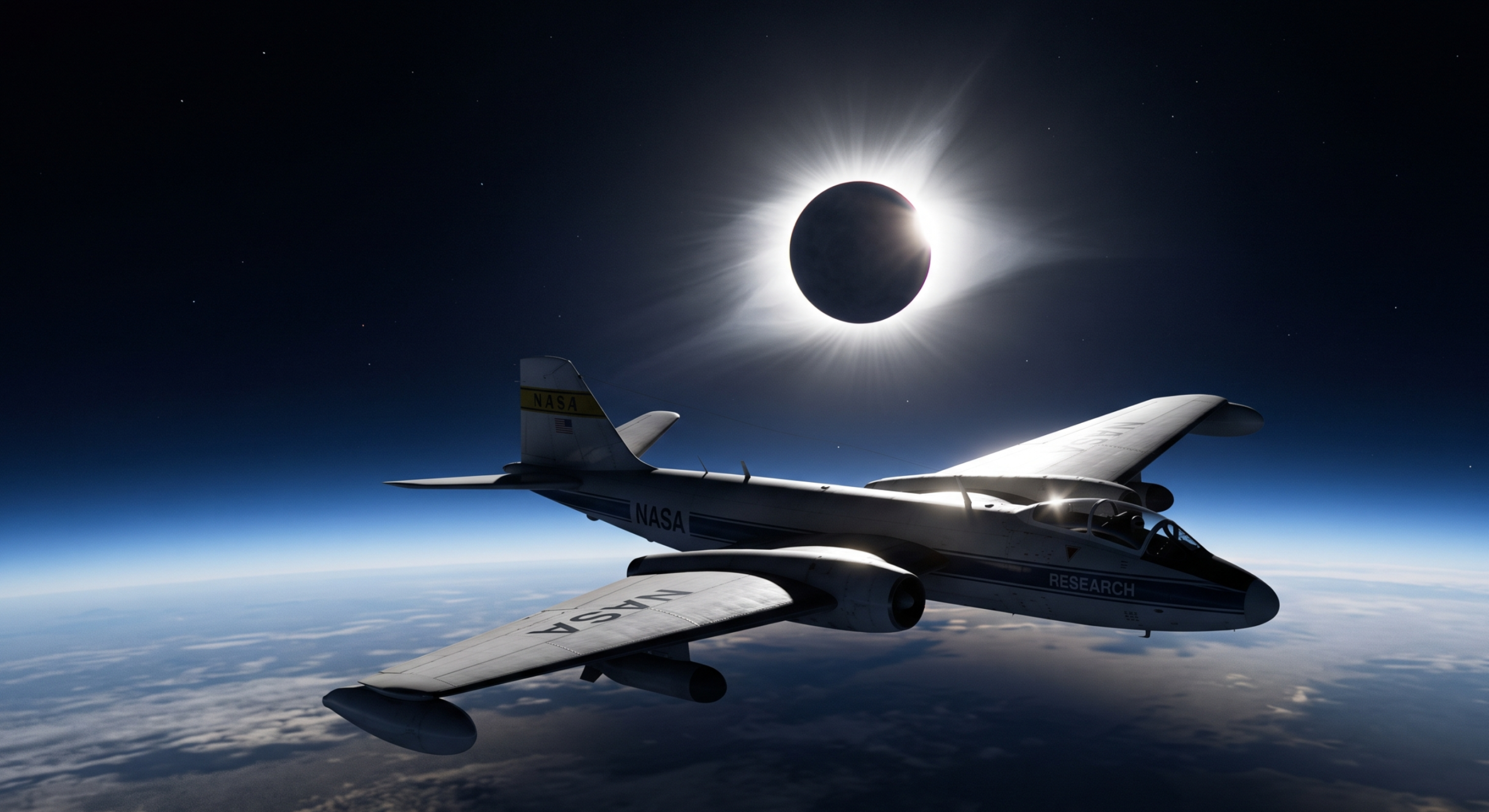
One of the most thrilling endeavors involves the WB-57 high-altitude research aircraft, which will literally chase the moon’s shadow across the darkening sky.
Flying in the stable stratosphere well above the clouds, this specialized aircraft aims to capture the dynamics of the solar corona with unprecedented precision.
The corona exists at scorching temperatures of millions of degrees, and understanding why it is exponentially hotter than the sun’s surface remains one of the greatest puzzles in modern astrophysics.
Furthermore, scientists are preparing to launch a fleet of high-altitude scientific balloons from observational sites in Iceland and Spain.
This nationwide ballooning project will meticulously study how the sudden darkness during the eclipse affects Earth’s atmosphere, temperature fluctuations, and global weather patterns.
Because solar activity directly impacts our planetary environment, these detailed observations hold profound significance for protecting and understanding the world we live in.
By exploring the hidden face of the sun from multiple perspectives, both on the ground and high in the stratosphere, these missions truly embody the pinnacle of human curiosity.
Conclusion
The 2026 total solar eclipse promises not only breathtaking beauty but also a profound lesson on the unbreakable bond between the sun and our home planet.
It is a wonderful opportunity to simultaneously witness the grand mechanics of the universe and the forefront of scientific discovery, so I hope you take a moment to look up and feel the romance of the cosmos!
Reference Link:
NASA Sets Coverage for August Northern Hemisphere Total Solar Eclipse