Cosmic Nucleosynthesis: Mapping the Atomic Origins of the Periodic Table
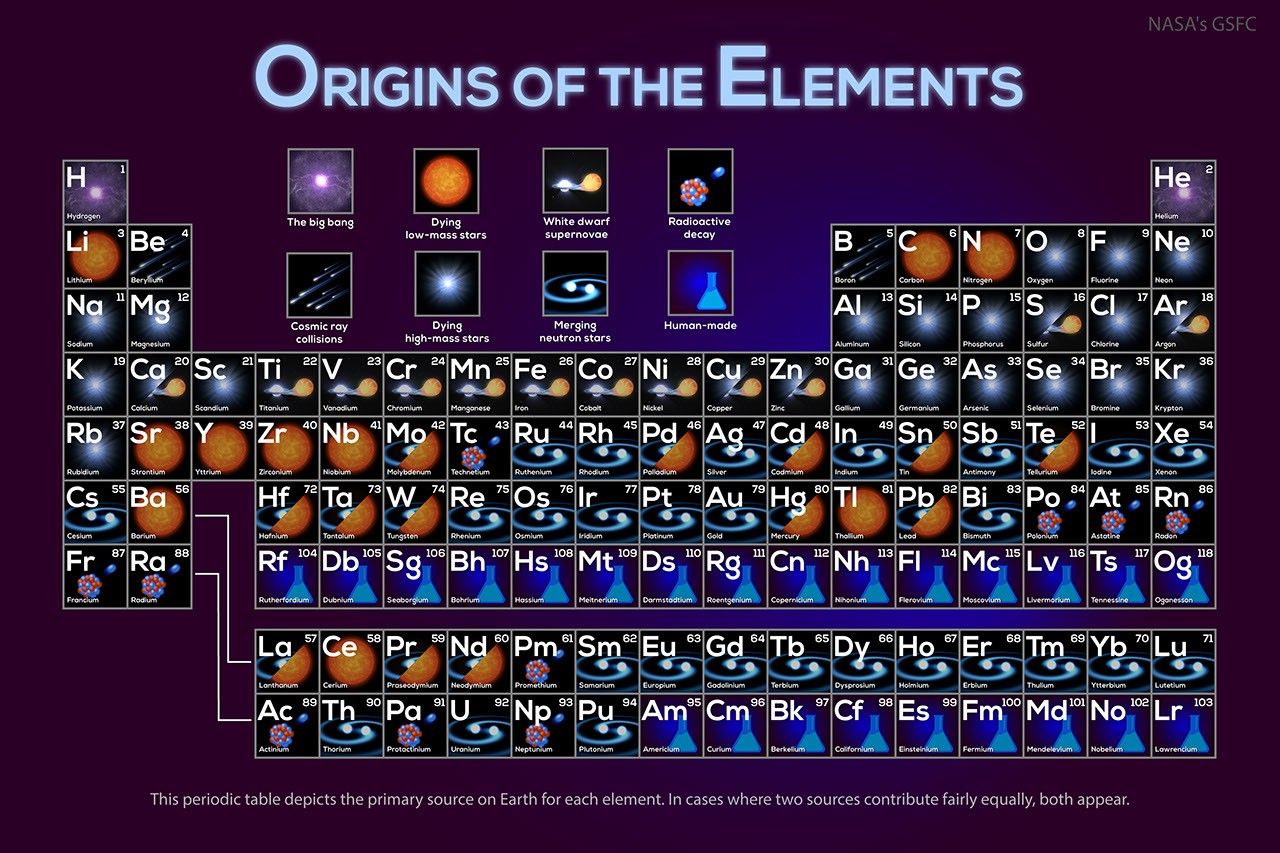
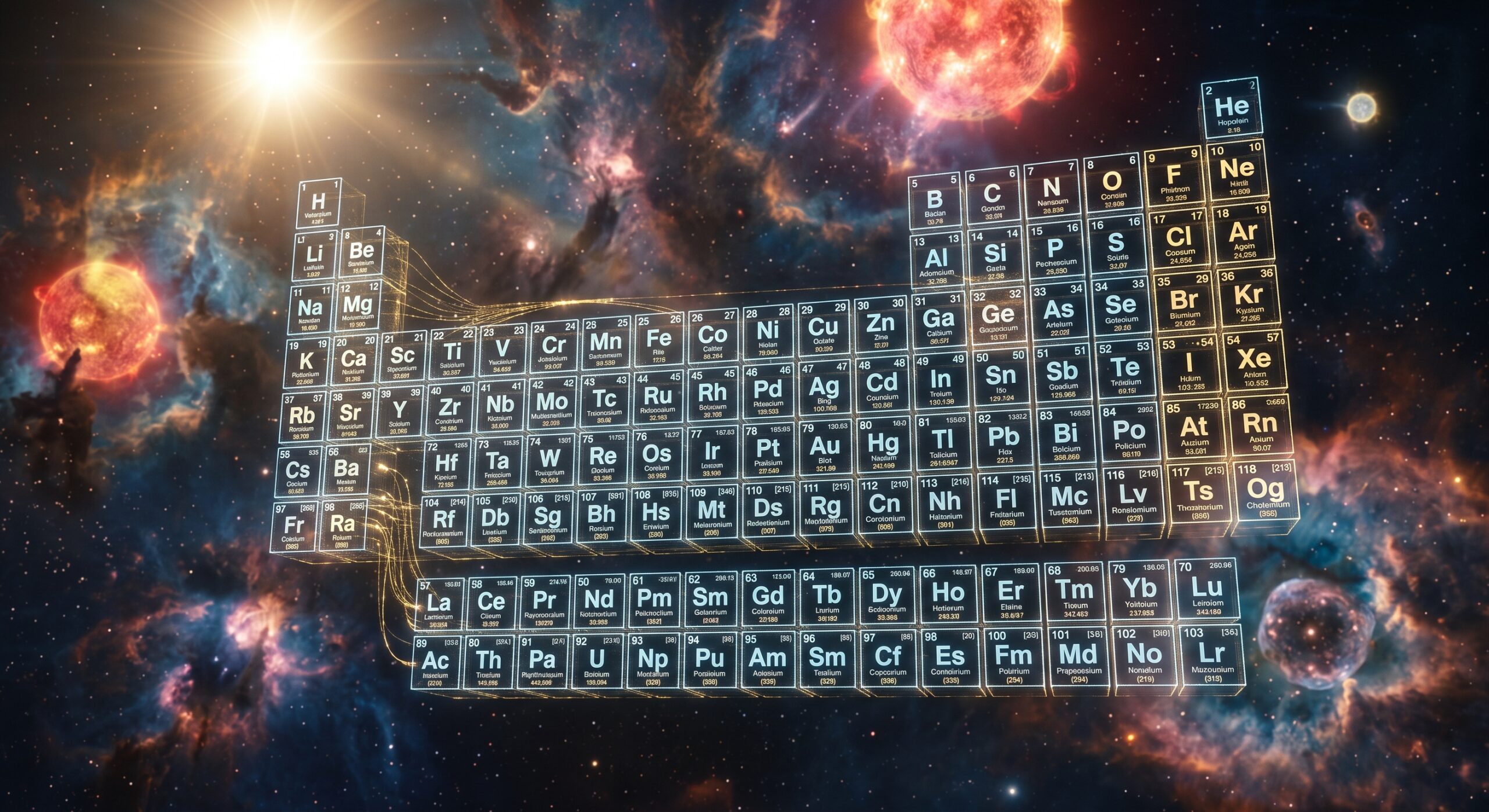
Featured on NASA’s Astronomy Picture of the Day from the Goddard Space Flight Center’s Scientific Visualization Studio (SVS), an updated astrophysical periodic table maps humanity’s best empirical understanding of where every atomic element in our bodies and across the cosmos originated. From the water in our cells to the mineral crust beneath our feet, every atom is the relic of a distinct cosmological epoch.
The hydrogen atoms that comprise roughly 60 percent of the human body and fuel stellar cores are unique: they were forged exclusively during Big Bang nucleosynthesis in the first three minutes of spacetime. In contrast, biological staples like carbon, nitrogen, and oxygen were synthesized through hydrostatic fusion deep within the cores of intermediate-mass and massive stars, subsequently dispersed across interstellar space via asymptotic giant branch winds and planetary nebulae. Heavier transition metals like iron and nickel required explosive silicon burning during core-collapse supernovae and white-dwarf thermonuclear detonations, illustrating that prebiotic chemistry is inherently dependent on generations of stellar recycling.
Pushing the Cosmic Frontier: Webb’s Spectroscopic Confirmation of MoM-z14
Complementing our understanding of cosmic chemical enrichment, new spectroscopic confirmations from the James Webb Space Telescope (JWST) continue to rewrite timelines of early galactic evolution. Utilizing Webb’s Near-Infrared Spectrograph (NIRSpec), astronomers in the COSMOS-Web survey confirmed the redshift of galaxy MoM-z14 at $z = 14.44$, capturing the stellar system as it existed just 280 million years after the Big Bang.
Standard cosmological models predicted that galaxies at this infant cosmic epoch would be ultra-faint, diffuse protogalactic clumps populated purely by metal-free Population III stars. Instead, NIRSpec’s high-resolution spectrum reveals an unexpectedly luminous galaxy displaying chemical ionization signatures of carbon and oxygen. This rapid enrichment proves that the very first generations of hypermassive stars lived and detonated within tens of millions of years, violently seeding the primordial intergalactic medium with metals far faster than classical hierarchical models anticipated.
Kilonova Forges: How Colliding Neutron Stars Seed the Universe with Gold
At the heavy end of the periodic table, astrophysicists have zeroed in on the extreme nuclear processes that forge precious elements like gold, platinum, and uranium. While core-collapse supernovae were historically assumed to drive all heavy-element creation, multi-messenger observations pairing gravitational-wave interferometers with space telescopes confirm that the dominant forge is the kilonova—the catastrophic merger of two neutron stars.
During a neutron star collision, immense tidal forces eject neutron-degenerate matter into deep space at relativistic velocities. In this hyper-dense, neutron-saturated environment, atomic nuclei capture free neutrons faster than they can radioactively decay—a nuclear synthesis chain known as the rapid neutron-capture process (r-process). Within milliseconds, the ejecta synthesizes heavy lanthanides and actinides, whose radioactive decay powers an infrared glow detectable across billions of light-years, explaining the elemental origin of the rarest metals found on Earth.
References & Data Sources
- NASA APOD (Where Your Elements Came From): https://science.nasa.gov/image-article/apod-2026-september-14-where-your-elements-came-from/
- NASA Science (James Webb Space Telescope Early Galaxy Science): https://science.nasa.gov/mission/webb/
- NASA SVS Nucleosynthesis Periodic Table: https://assets.science.nasa.gov/dynamicimage/assets/science/cds/apod/apod/2026/september/ElementOrigins2_svs_6000.jpg