The Bold New Frontier of the Hayabusa2# Extended Mission
After successfully returning pristine samples from the asteroid Ryugu in December 2020, Japan’s Hayabusa2 spacecraft did not simply power down and retire.
Instead, it embarked on an entirely new cosmic journey, utilizing its remaining xenon propellant for an ambitious extended mission dubbed “Hayabusa2#”.
Operating well beyond its original design lifespan, the spacecraft continues to navigate deep space to provide scientists with unprecedented insights into the formation of our solar system.
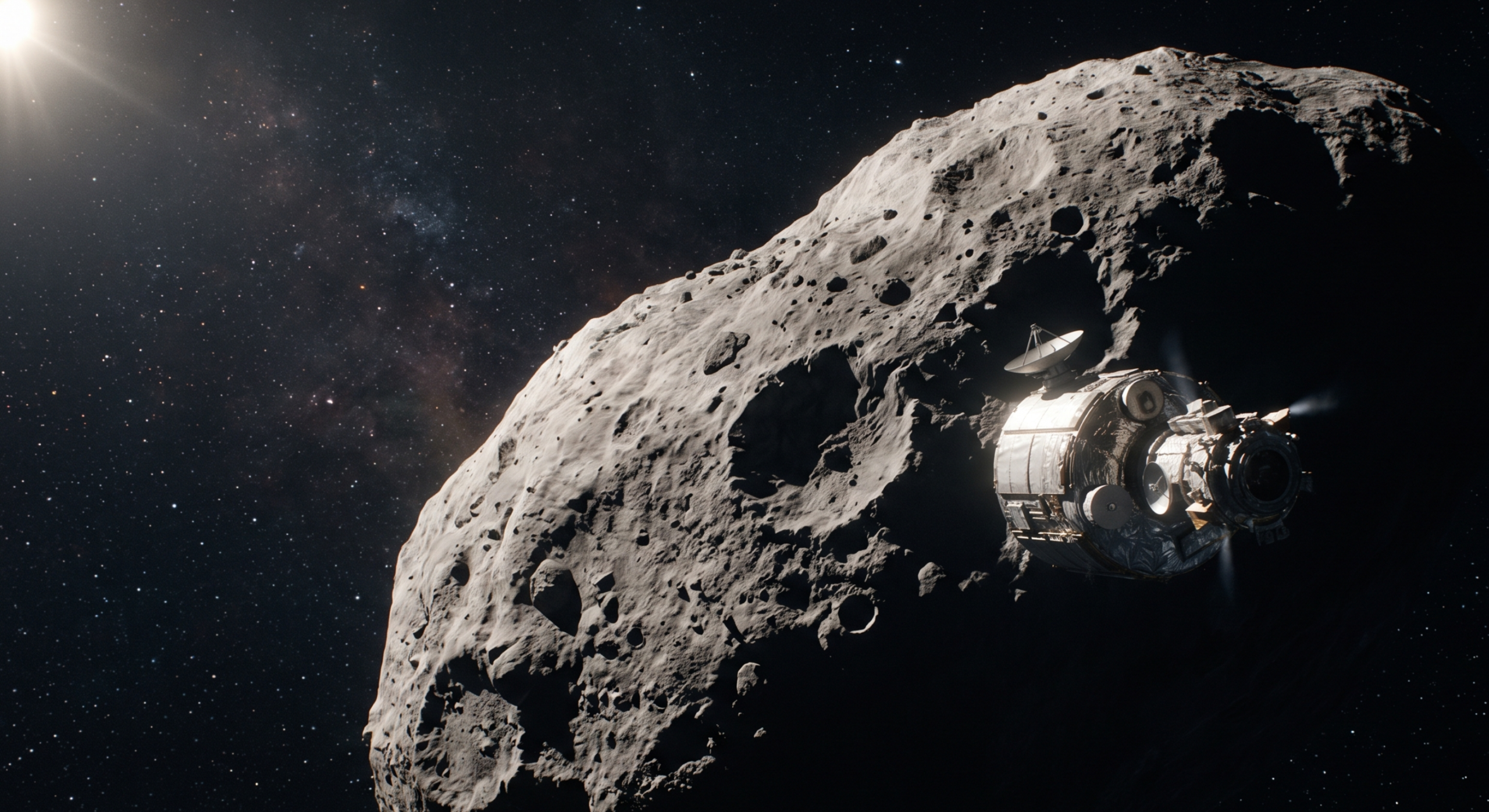
One of the most thrilling milestones of this extended voyage is the incredibly close flyby of the near-Earth asteroid Torifune, also known as 2001 CC21, scheduled for July 5, 2026.
While Hayabusa2 was meticulously engineered for slow-speed rendezvous and long-term hovering operations, this flyby represents a completely different operational challenge.
The spacecraft must rely on cameras and scientific instruments built for careful, deliberate observation to capture data in a fleeting fraction of a second as it hurtles past the asteroid.
Unveiling Torifune and the Perils of High-Speed Flybys
Torifune is estimated to be roughly 450 meters in diameter and is believed to be an S-type asteroid composed mainly of rocky silicate materials, presenting a stark contrast to the carbon-rich Ryugu.
Astronomers suspect that it might possess an elongated shape reminiscent of Itokawa, the very first asteroid visited by a Japanese probe.
Comparing these vastly different types of space rocks will help researchers piece together the complex evolutionary timeline of the primordial solar system.
However, capturing these secrets requires executing an astronomical maneuver of extreme precision and immense risk.
The relative speed between Hayabusa2 and Torifune will be a staggering 5.3 kilometers per second, leaving only a few precious minutes for the instruments to gather usable data.
To make matters even more intense, mission controllers are aiming to guide the spacecraft within a hair-raising distance of just 800 to 1000 meters from the asteroid’s surface.
Success hinges entirely on perfectly pre-programmed observation sequences and the spacecraft’s robust autonomous navigation capabilities.
A Crucial Stepping Stone for Planetary Defense
This high-speed encounter is much more than a scientific curiosity; it serves as a critical technology demonstration for global planetary defense efforts.
If humanity ever detects an unknown, potentially hazardous asteroid on a collision course with Earth, we will need the capability to rapidly assess its size, shape, and structural integrity.
The ability to fly past an unfamiliar celestial body at blistering speeds while instantly capturing high-quality data is an essential skill for protecting our home planet.
The autonomous tracking and rapid reconnaissance techniques being tested by Hayabusa2 directly complement initiatives pioneered by organizations like NASA, such as asteroid deflection missions.
Overcoming the technical hurdle of acquiring clear, noise-free images and spectral data during a fleeting encounter is a priority for space agencies worldwide.
The precise sequence of events executed at Torifune will undoubtedly provide a powerful blueprint for how we can better prepare for and mitigate future cosmic threats.
Charting the Course to the Ultimate Destination: 1998 KY26
As breathtaking as the Torifune flyby will be, it is ultimately just a spectacular waypoint on Hayabusa2’s grand tour of the solar system.
Following this encounter, the spacecraft will perform crucial Earth gravity assist maneuvers in 2027 and 2028 to sling itself further into the cosmic void.
Its final target, expected to be reached in 2031, is a microscopic asteroid named 1998 KY26 that measures a mere 30 meters across.
This ultimate destination presents a unique astronomical puzzle, as it spins at an incredible rate of roughly one rotation every ten minutes.
Attempting to rendezvous with such a tiny, rapidly rotating object has never been done before in the history of space exploration.
The Torifune flyby acts as both a vital health check for the aging onboard instruments and a monumental test of the mission team’s technical ingenuity, ensuring that this legendary spacecraft continues to rewrite the textbooks for years to come.
Summary
The extraordinary journey of Hayabusa2 beyond its original mission reminds us of the limitless potential of robotic space exploration.
It is truly inspiring to see how a single fleeting encounter can yield such vital knowledge for both planetary science and the defense of our world.