Catching the Solar Wind: From Apollo 11 Foil to Artemis Radiation Detectors
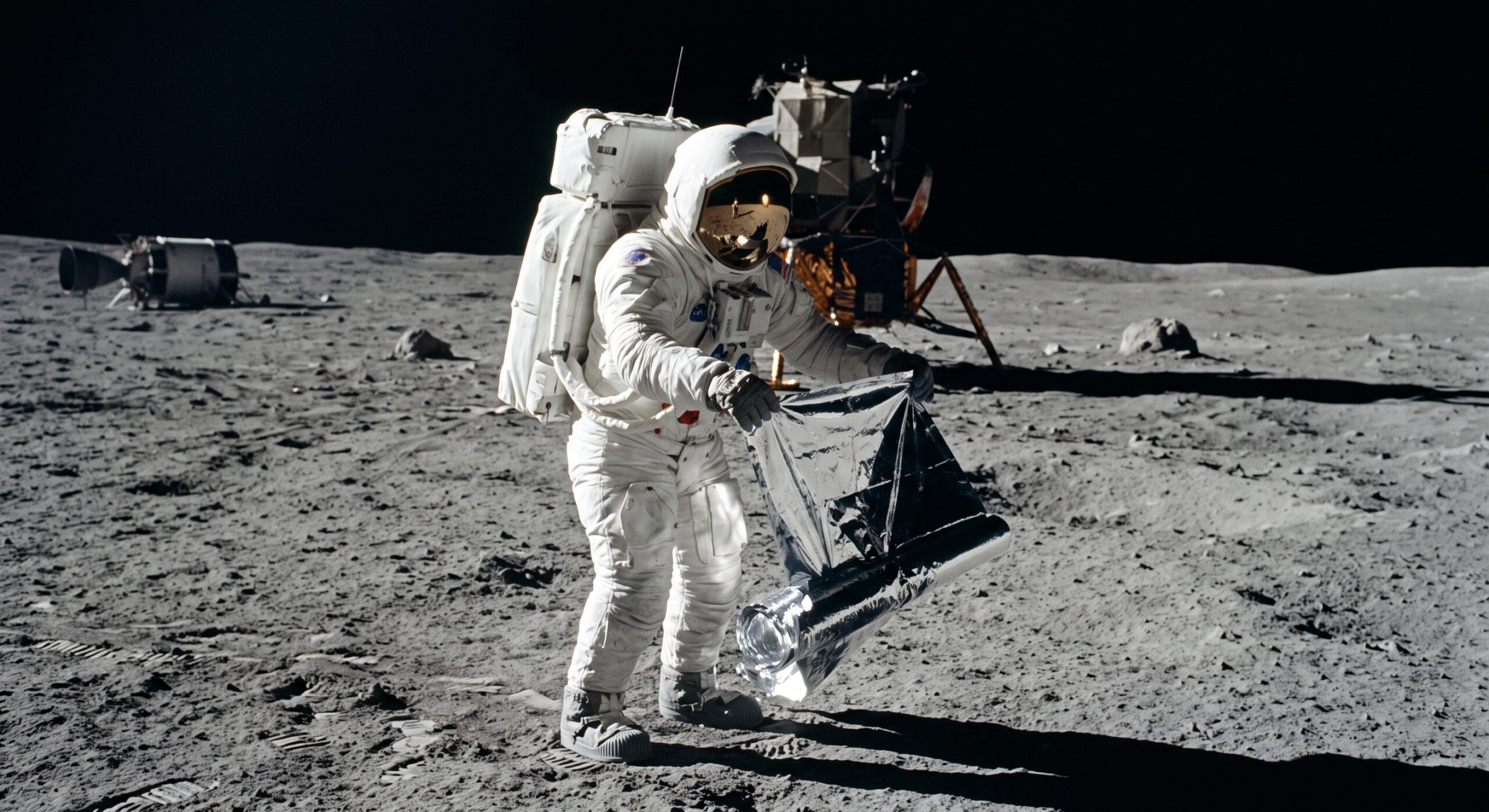
Featured on NASA’s Astronomy Picture of the Day, a newly restored high-resolution photograph taken by Neil Armstrong captures Buzz Aldrin unfurling a gleaming sheet of platinum-coated aluminum foil on the lunar surface during Apollo 11. Known formally as the Solar Wind Composition (SWC) experiment and designed by the University of Bern, this elegant instrument trapped noble gas ions—including helium, neon, and argon—hurled directly from the Sun at hundreds of kilometers per second.
Free from the magnetic deflection of Earth’s magnetosphere, the Moon serves as an unshielded natural witness plate for heliophysics. The isotopic ratios captured by the Apollo foils established our first direct measurements of the primordial solar corona’s elemental makeup. Today, this scientific legacy forms the bedrock for NASA’s upcoming Artemis surface missions, where modern active mass spectrometers and solid-state radiation detectors will monitor the real-time interaction between high-energy solar storms and volatile ice deposits at the lunar South Pole.
The Moon Formed in Hours: Supercomputer Simulations Rewrite Lunar Genesis
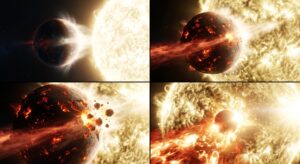
In planetary geophysics, advanced high-resolution smoothed particle hydrodynamics (SPH) simulations have upended classical models of how the Earth-Moon system originated. For decades, the standard giant impact hypothesis posited that a Mars-sized protoplanet named Theia struck the infant Earth 4.5 billion years ago, pulverizing both bodies into a massive, molten circumterrestrial debris disk that slowly accreted into the Moon over centuries.
Using billions of simulation particles to resolve fine-scale hydrodynamic turbulence, astrophysicists have demonstrated that the Moon did not require prolonged accretion. Instead, the collision immediately propelled a large, gravitationally bound, semi-molten planetary body into a stable, wide orbit within mere hours of initial impact. This rapid-formation mechanism resolves the longstanding isotopic conundrum of lunar geology, explaining why Apollo and returned lunar samples display geochemical isotope signatures nearly indistinguishable from Earth’s mantle rather than reflecting the foreign composition of Theia.
NASA Refines Artemis Architecture for Sustainable South Pole Expeditions
Building toward the next chapter of human exploration, NASA has released its latest architectural refinements for the Artemis campaign. The updated framework integrates dedicated commercial cargo landers and an upgraded lunar communications relay architecture into the mission sequence preceding crewed surface sorties.
The refined strategy emphasizes mitigating cryogenic propellant boil-off during in-orbit orbital refueling operations for the Human Landing System (HLS). By deploying autonomous surface power grids and pressurized rover assets to the South Pole prior to astronaut arrival, NASA and its international partners ensure that long-duration expeditions can conduct deep geochemical sampling of permanently shadowed craters while operating with redundant life-support infrastructure.
References & Data Sources
- NASA APOD (Apollo 11: Catching Some Sun): https://science.nasa.gov/image-article/apod-2026-september-12-apollo-11-catching-some-sun/
- NASA Science (Lunar Geochemistry & Giant Impact Models): https://science.nasa.gov/moon/
- NASA Artemis Exploration Architecture: https://www.nasa.gov/humans-in-space/artemis/