NASA’s ERNEST Rover Conquers the Desert for Future Missions
NASA’s Jet Propulsion Laboratory has released a fascinating new report detailing the rigorous field testing of a groundbreaking next-generation rover designed for future Moon and Mars missions.
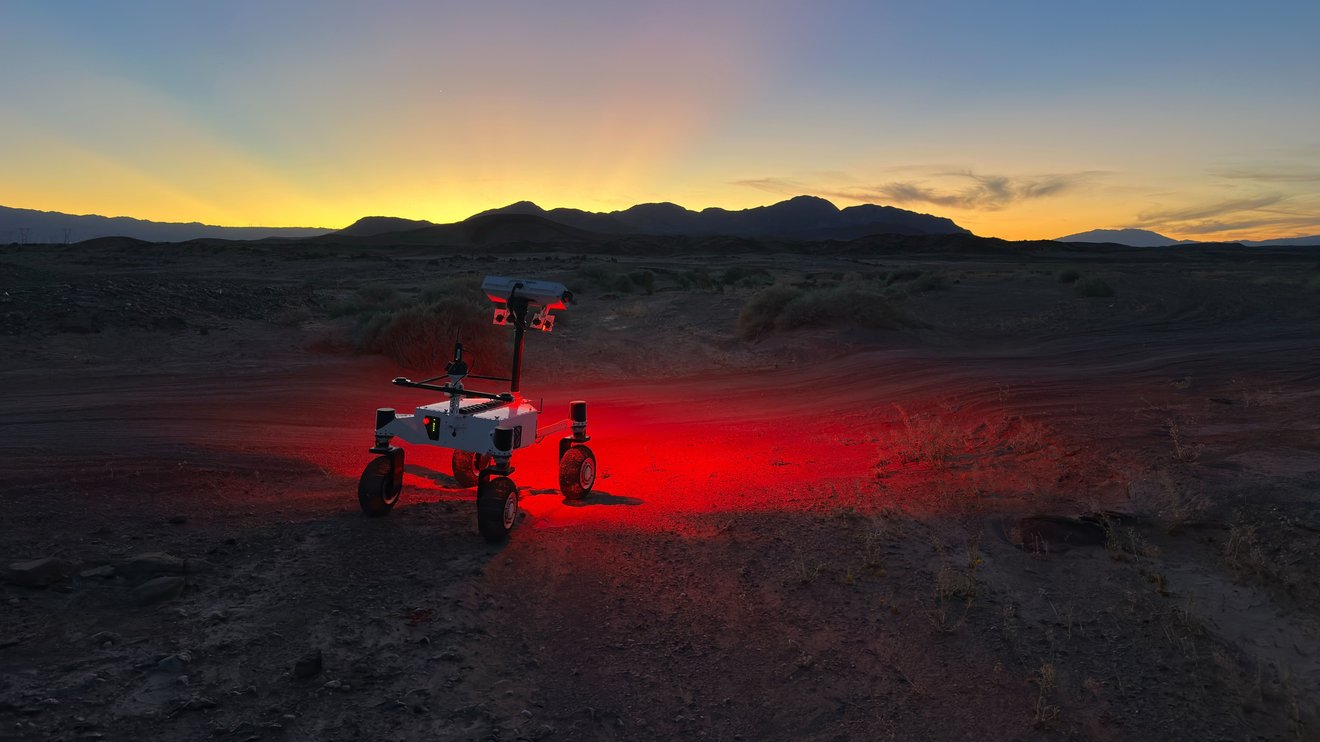
Taking place in the harsh, unforgiving environment of the Colorado Desert in Southern California, the star of this extensive field test is a prototype rover affectionately named ERNEST (Exploration Rover for Navigating Extreme Sloped Terrain).
In an effort to shatter the speed and mobility limitations of current Martian rovers, this compact, four-wheeled explorer successfully traversed approximately 16 miles across rugged terrain with minimal intervention from human engineers.
This impressive field campaign was conducted intermittently over seven days, achieving a top speed of roughly 0.6 mph during its 37 hours of active driving.
This represents a monumental leap, navigating at speeds an order of magnitude higher than the current six-wheeled stalwarts like Curiosity and Perseverance.
As planetary scientists at JPL enthusiastically noted, this vehicle could enable a genuine science road trip across the Moon or Mars, turning the dream of high-speed, long-distance extraterrestrial exploration into a tangible reality.
The ability to rapidly cover vast expanses of uncharted planetary surfaces exponentially increases the potential for groundbreaking scientific discoveries.
By reducing reliance on continuous remote commands from Earth, this unprecedented mobility has the potential to fundamentally revolutionize how we approach deep space exploration in the coming decades.
Next-Generation Mobility and AI Autonomy
What truly sets ERNEST apart from its predecessors is its departure from the traditional passive rocker-bogie suspension system in favor of a highly advanced active suspension mechanism.
Equipped with powered joints and a sophisticated gimbal system, the rover can individually lift each of its mesh wheels to step over obstacles, utilize a wheel-walking gait, and even drive completely sideways.
This extraordinary versatility ensures that the rover can forge its own safe path through treacherous landscapes, steep slopes, and boulder-strewn terrains that would easily trap conventional rovers.
Equally remarkable is the integration of advanced autonomous driving software powered by reinforcement learning, a cutting-edge subset of artificial intelligence.
Through months of rigorous virtual simulations, the JPL engineering team allowed the rover to learn how to optimally navigate and interact with diverse environmental challenges on its own.
Following these simulations, ERNEST proved its capabilities on the complex obstacle courses of JPL’s Mars Yard before tackling the unpredictable sands of the Colorado Desert.
Because communication delays between Earth and deep space are significant, a rover cannot afford to wait for human instructions every time it encounters a hazard.
The ability of ERNEST to autonomously recognize terrain and actively adjust its suspension in real-time is the ultimate tool required to pioneer unexplored regions beyond human reach.
Paving the Way for Extreme Lunar Exploration
The ongoing trials in the Colorado Desert are not just arbitrary driving tests; they are meticulously designed to simulate the extreme conditions anticipated during the upcoming Artemis lunar missions.
At the Moon’s South Pole, sunlight arrives at extreme angles, casting long, deep shadows that make optical navigation and terrain assessment incredibly difficult.
To accurately replicate these hazards, the JPL team deliberately deployed ERNEST during dusk, dawn, and nighttime operations, thoroughly validating the performance of its sensors and cameras under severely limited lighting.
While the current prototype measures about four feet in length, the final operational rover destined for actual space missions is projected to be twice that size.
With this evolved autonomous rover, scientists will finally be able to safely access and sample the depths of steep craters and rugged slopes that were previously considered strictly off-limits.
Particularly in the hunt for lunar water resources, the agility to freely navigate the freezing, permanently shadowed regions will be a decisive factor in mission success.
By fusing NASA’s decades of Mars exploration expertise with the latest advancements in artificial intelligence, a revolutionary new class of robotic explorer is being born.
There is no doubt that the meticulous testing being conducted in the desert today will eventually guide humanity into the deepest, unseen corners of the Moon and Mars.
Summary
NASA’s ERNEST rover tests demonstrate a thrilling future where advanced AI and active suspension enable rapid, autonomous exploration of extreme extraterrestrial terrains.
This groundbreaking technology will undoubtedly unlock the deepest mysteries of the Moon and Mars, paving the way for humanity’s ultimate expansion into the cosmos.