Unmasking Alien Worlds: NASA’s Pandora SmallSat Mission Takes Flight
As the catalog of known exoplanets swells well into the thousands, the grand pursuit of astrophysics has crossed an unprecedented threshold.
The central objective is no longer merely detecting distant worlds, but thoroughly characterizing their atmospheres to determine whether they could foster habitable environments.
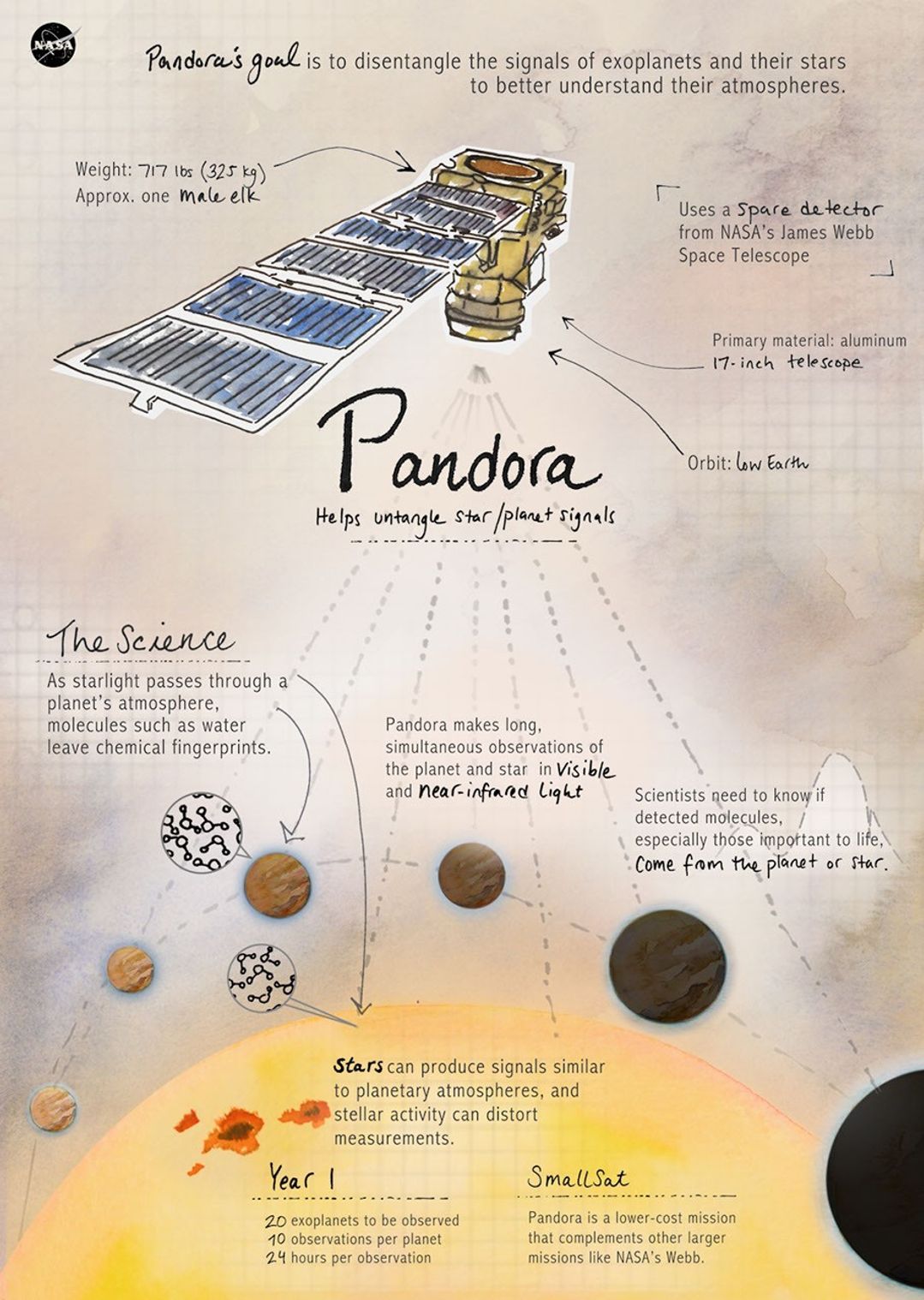
Stepping directly into this critical scientific frontier is NASA’s Pandora mission, an agile SmallSat project developed under the Astrophysics Pioneers program designed to punch far above its weight class.
Operating as a dedicated, low-cost space observatory in low Earth orbit, Pandora bypasses the multi-billion-dollar price tags of flagship missions to deliver highly focused, transformative planetary science.
The primary targets in Pandora’s sights span a rich variety of alien environments, from dense, sub-Neptune worlds shrouded in thick atmospheres to rocky terrestrial planets where oceans might persist.
Using advanced transmission spectroscopy, the satellite measures the faint starlight filtering through the thin sliver of a planet’s atmosphere as it transits across its host star.
This technique enables scientists to identify the unique spectral absorption lines carved out by essential molecules, including water vapor, carbon dioxide, methane, and atmospheric hazes.
By demonstrating that an engineered small satellite can execute high-precision pointing and sensitive infrared spectroscopy, Pandora sets a vital precedent for the future of agile, cost-effective space exploration.
The quest to understand whether our solar system is a cosmic rarity has officially gained a sharp and nimble new eye in the sky.
Conquering Stellar Contamination: Dissecting the True Signal of Distant Skies
Astronomers analyzing exoplanetary atmospheres have long faced an insidious astrophysical hurdle known as stellar contamination.
When attempting to isolate the faint chemical fingerprints in a transiting planet’s atmosphere, intrinsic features on the host star—such as starspots, bright faculae, and violent magnetic flares—can introduce severe spectral distortions.
These solar anomalies mimic or obscure atmospheric molecules, creating treacherous false positives that mislead even the most sophisticated planetary models.
The problem is particularly acute around low-mass red dwarf stars (M-dwarfs), the most common hosts of temperate, Earth-sized planets, which boast intense magnetic activity and immense starspot coverage.
Consequently, researchers have frequently found it nearly impossible to determine whether a water signature originates from the planet’s atmosphere or the cooler, spotted regions of the parent star itself.
To solve this persistent cosmic ambiguity, Pandora deploys a synchronized dual-channel observing strategy that marries visible light imaging with near-infrared spectroscopy.
By tracking the host star in visible wavelengths over extended durations, the observatory maps stellar rotation and the shifting presence of spots across the stellar disk in real time.
Simultaneously, its near-infrared spectrograph records the exoplanet’s transit spectrum, providing the crucial contextual data needed to disentangle and subtract the stellar noise cleanly from the genuine atmospheric signal.
Treating the star and its orbiting worlds as an interdependent physical system fundamentally changes the paradigm of exoplanet characterization.
This methodological breakthrough ensures that our interpretations of distant atmospheres remain unpolluted, setting an exacting new benchmark for planetary science.
The Vanguard of Discovery: How Pandora and JWST Form an Unstoppable Alliance
Pandora’s scientific value extends far beyond its standalone discoveries, serving as an indispensable operational partner to the flagship James Webb Space Telescope (JWST).
While JWST possesses unparalleled infrared sensitivity and resolving power, the extreme global demand for its observing time makes multi-week monitoring of single targets virtually impossible.
In contrast, Pandora’s agile orbital architecture allows it to stare patiently at targeted stellar systems for weeks at a time, establishing exhaustive baseline profiles of stellar magnetic variability.
By delivering long-term empirical catalogs of how host stars fluctuate, Pandora maximizes the efficiency and scientific return of every precious second JWST dedicates to exoplanetary targets.
This deliberate partnership between a focused SmallSat and an orbital behemoth represents the future of space-based astrophysics.
With Pandora stripping away the fog of stellar activity, JWST can dive deep into pristine spectral data to reconstruct complex atmospheric chemistry, cloud layer structures, and climate dynamics on worlds light-years away.
Together, they are uniquely equipped to answer profound questions: Can rocky planets retain atmospheres under the harsh radiation of red dwarfs, and could any of these distant spheres support liquid surface water?
Watching these collaborative platforms push the boundaries of human knowledge reaffirms that unlocking the mysteries of the universe requires not just immense power, but strategic ingenuity.
Summary
Seeing a nimble small satellite like Pandora unravel the true nature of distant stars brings us an exciting step closer to finding whether habitable worlds thrive beyond our own solar neighborhood.