PUNCH Mission: Ushering in a New Era of Space Weather Forecasting
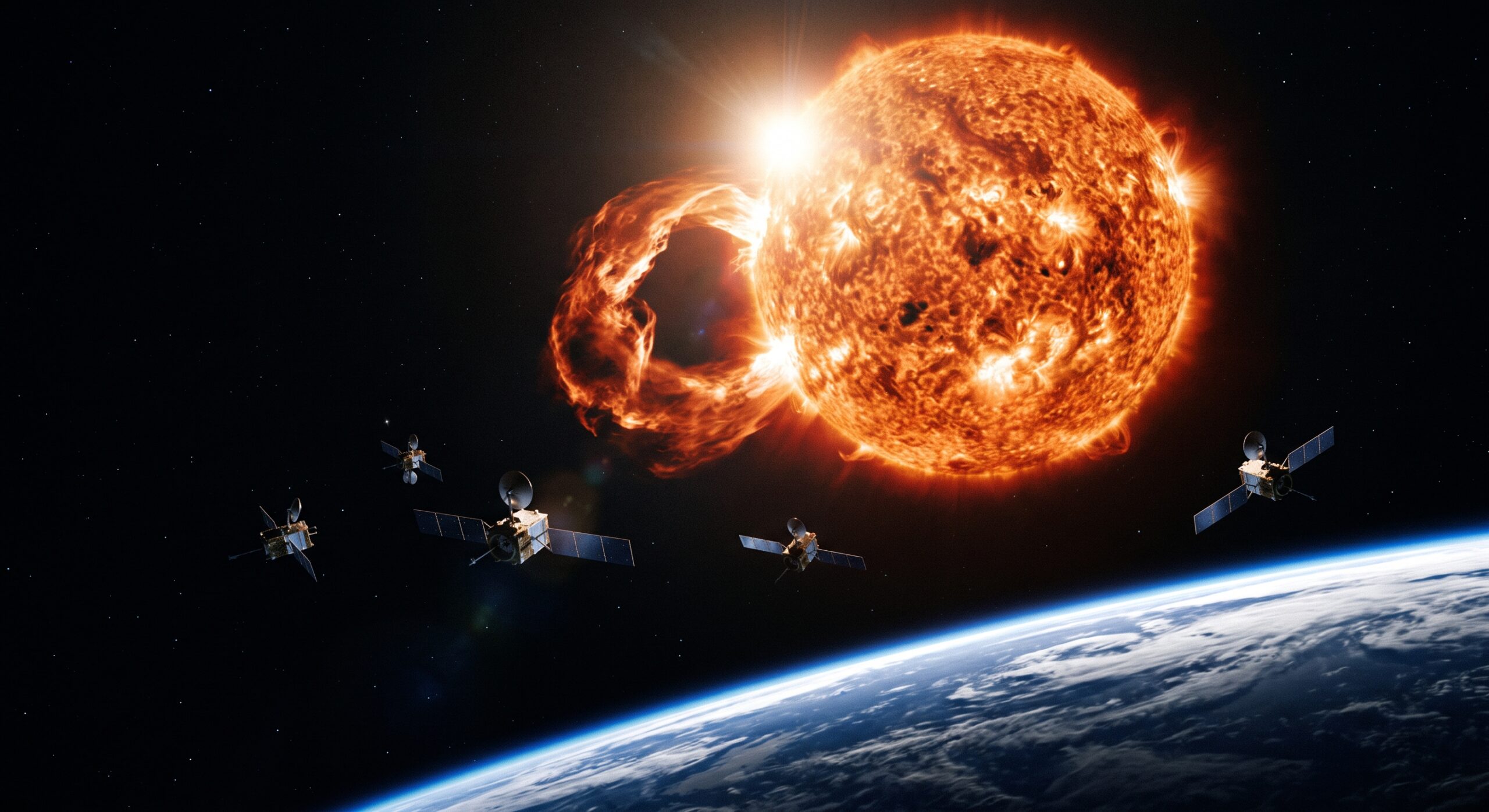
Have you ever checked the weather forecast for space? Just like Earth, the vast expanse of our solar system has its own dynamic weather systems. The most impactful of these events are Coronal Mass Ejections (CMEs)—massive explosions of solar plasma that hurtle through space. When one of these ferocious solar storms scores a direct hit on Earth, it can wreak havoc on our modern way of life, potentially crippling satellites, disrupting global communications, and even triggering massive power grid failures. Forecasting exactly when these colossal solar storms will strike has always been a monumental challenge for scientists.
Historically, keeping a watchful eye on a CME as it traveled across the solar system was incredibly difficult. Previous observation methods only allowed us to track these solar eruptions for about one-fifth of their journey from the Sun to Earth. After that, we were essentially flying blind, forced to rely on guesswork to fill in the gaps. That era of uncertainty is finally over, thanks to the deployment of the PUNCH (Polarimeter to Unify the Corona and Heliosphere) mission. By utilizing a synchronized fleet of four spacecraft in low Earth orbit, PUNCH provides continuous, 3D observations of the inner solar system. This revolutionary setup captures high-resolution images of solar explosions every four minutes, allowing us to seamlessly track a CME almost all the way to our home planet. We are no longer guessing; we are watching the mechanics of the solar system unfold in real time.
A Quantum Leap in Solar Storm Predictive Accuracy
The true power of the PUNCH mission was recently put to the test using data from a powerful CME that erupted on May 31, 2025. The results of this initial proof-of-concept run are nothing short of breathtaking for the space science community. In the past, forecasting the arrival of a solar storm meant dealing with a wide five-hour window of uncertainty. However, by feeding PUNCH’s continuous, wide-field imagery into an advanced computer model, scientists were able to track the changing geometry and speed of the CME across space. Just twelve hours after the solar eruption, the model locked in a prediction that proved accurate to within a staggering 30 minutes. That is a tenfold improvement over older methods—a leap in capability that experts compare to upgrading from a steam engine to a modern internal combustion engine.
But PUNCH is delivering far more than just accurate ETAs. Its unprecedented high-resolution visuals are peeling back the curtain on the fundamental nature of CMEs. For the first time, we can clearly see that these plasma clouds are much clumpier and far more structurally complex than previously imagined, constantly evolving as they travel through the vacuum of space. Understanding exactly how this solar material behaves provides a massive boost not only to our space weather defenses but also to our broader understanding of astrophysics and plasma dynamics across the galaxy.
This incredible leap forward in solar tracking means we are stepping into a future where our technology and astronauts will be better protected, giving us the crucial time we need to prepare before the storm hits.