Cosmic Horizons: Roman Telescope Encapsulated for Launch as Hubble Unveils Early Galactic Cannibalism
NASA’s observational capabilities are preparing for a transformative leap forward. At the Kennedy Space Center in Florida, engineers have officially encapsulated the Nancy Grace Roman Space Telescope inside its payload fairing, marking one of the final milestones before its integration atop a SpaceX Falcon Heavy rocket. Simultaneously, archival and new data from the Hubble Space Telescope continue to reshape our understanding of cosmic history, revealing unprecedented evidence of the Milky Way’s earliest galactic mergers.
Together, these developments underscore a pivotal era in astrophysics: leveraging next-generation wide-field infrared vision while continuing to extract profound insights from our long-standing orbital observatories.
Roman Space Telescope Encapsulated Ahead of Falcon Heavy Integration
Inside the cleanroom facilities at Kennedy Space Center, the Nancy Grace Roman Space Telescope reached a critical pre-launch milestone with its full encapsulation inside the protective payload fairing. Launching from Launch Complex 39A, Roman represents NASA’s next flagship astrophysics observatory, engineered to operate from the Sun-Earth Lagrange Point 2 (L2), roughly one million miles from Earth.
Equipped with a primary mirror measuring 2.4 meters in diameter—identical in aperture to Hubble—Roman’s Wide Field Instrument provides a panoramic field of view at least 100 times greater than Hubble’s infrared camera. This broad observational footprint allows the observatory to map large swathes of the sky in a fraction of the time, capturing millions of galaxies in single mosaic exposures. In addition, Roman carries the Coronagraph Instrument, a technology demonstration designed to directly image gas giant exoplanets by suppressing the blinding glare of their host stars by factors of up to one billion.
Hubble Extends Milky Way Archaeological History by 1.8 Billion Years
While Roman prepares for departure, the Hubble Space Telescope has delivered a landmark finding in galactic archaeology. By examining stellar kinematics and elemental abundances across ancient globular clusters and stellar streams, researchers have uncovered definitive evidence of a dwarf galaxy collision that merged into the proto-Milky Way during the earliest phases of its formation.
This discovery pushes back our verified timeline of Milky Way galactic mergers by approximately 1.8 billion years. Galaxies grow over cosmic epochs primarily through the assimilation of smaller satellite systems—a process known as hierarchical merging. Hubble’s precise astrometry has isolated the chemical signatures and orbital trajectories of these ancient immigrant stars, providing empirical constraints on the structural conditions of our galaxy just a few hundred million years after the Big Bang.
Unlocking the Dark Universe: The Synergy of Wide-Field and Deep-Space Astronomy
The transition toward Roman’s operational phase marks the beginning of a powerful triad in modern astrophysics, alongside the James Webb Space Telescope (JWST) and Hubble. While JWST delivers targeted, ultra-deep spectroscopic analysis of individual distant objects, Roman will conduct extensive cosmological surveys covering thousands of square degrees.
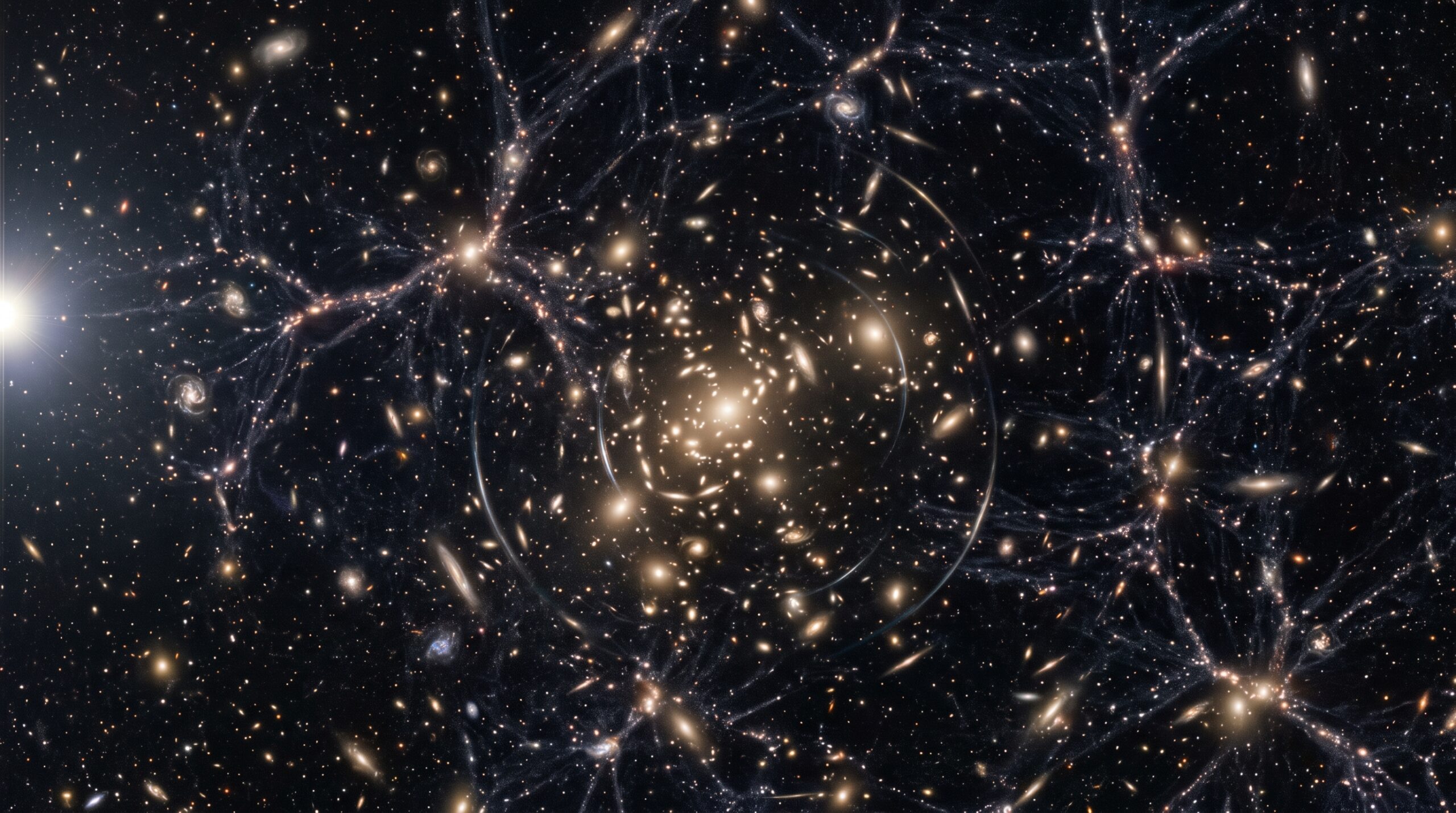
These large-scale statistical datasets will be crucial in tackling two of the most elusive puzzles in modern physics: dark energy and dark matter. By measuring the precise shapes and cosmological redshifts of hundreds of millions of galaxies through weak gravitational lensing, Roman will map the expansion history of the universe and test whether cosmic acceleration remains consistent with Einstein’s General Theory of Relativity.