Roman Space Telescope Enters Final Launch Countdown at Launch Complex 39A
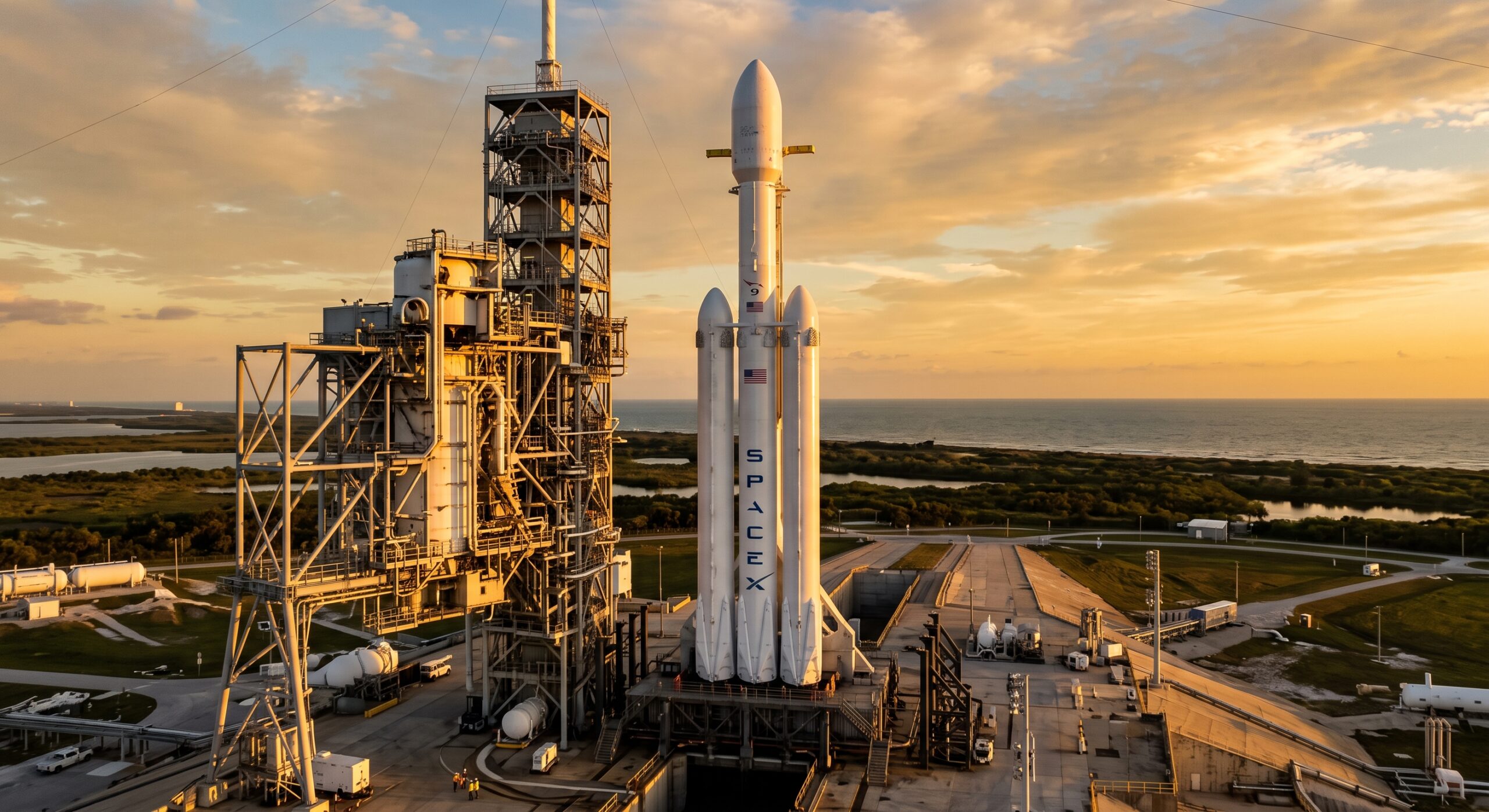
At NASA’s Kennedy Space Center in Florida, mission managers and SpaceX flight teams have completed the Launch Readiness Review and the official Mission Science Briefing for the Nancy Grace Roman Space Telescope. Standing poised atop a triple-core SpaceX Falcon Heavy rocket at the historic Launch Complex 39A, the next-generation infrared observatory is on track for liftoff toward the Sun-Earth Lagrange Point 2 (L2).
Operating from a halo orbit 1.5 million kilometers from Earth, Roman’s 2.4-meter primary mirror and 300-megapixel Wide Field Instrument (WFI) will capture panoramic fields of view at least 100 times larger than the Hubble Space Telescope with comparable angular resolution. The spacecraft will execute rapid survey slews across thousands of square degrees, collecting petabytes of high-precision cosmological data to map the three-dimensional cosmic web, measure dark energy expansion across cosmic time, and catalog thousands of new transiting and microlensed exoplanetary systems.
Starlight Suppression: The High-Contrast Coronagraph Instrument
Beyond its wide-field cosmological surveying power, Roman carries the Coronagraph Instrument (CGI), an advanced technology demonstration engineered to pioneer extreme starlight suppression. By combining deformable mirrors, active wavefront sensing, and precision mask architectures, CGI is designed to cancel out the glare of a host star by a factor of up to one billion.
This unprecedented contrast ratio enables the direct optical and near-infrared imaging of Jovian-class gas giants and circumstellar debris disks that were previously lost within the blinding diffraction spikes of their parent stars. The operational telemetry and optical wavefront control demonstrated by CGI will directly de-risk the instrument architectures needed for NASA’s future Habitable Worlds Observatory, which aims to image rocky, Earth-sized planets in the habitable zones of nearby stars.
AI Heliophysics Models Deliver 9-Hour Early Warning for Severe Solar Eruptions
Complementing deep space observational astronomy, new heliophysics research highlights the deployment of machine learning algorithms trained on multi-decade solar magnetic field data from the Solar Dynamics Observatory (SDO). The predictive model identifies subtle topological magnetic shear signatures in solar active regions up to nine hours before an energetic Coronal Mass Ejection (CME) erupts.
As space agencies expand human exploration beyond the protective envelope of Earth’s magnetosphere under the Artemis campaign, robust space weather forecasting is vital. Early detection of high-energy solar particle events provides crucial lead time for astronauts aboard orbital stations or lunar surface outposts to shelter within radiation-hardened storm shelters, while safeguarding orbital power grids and deep-space telemetry infrastructure.