Webb Resolves Starburst Dynamics in the Merging Galaxy Arp 263
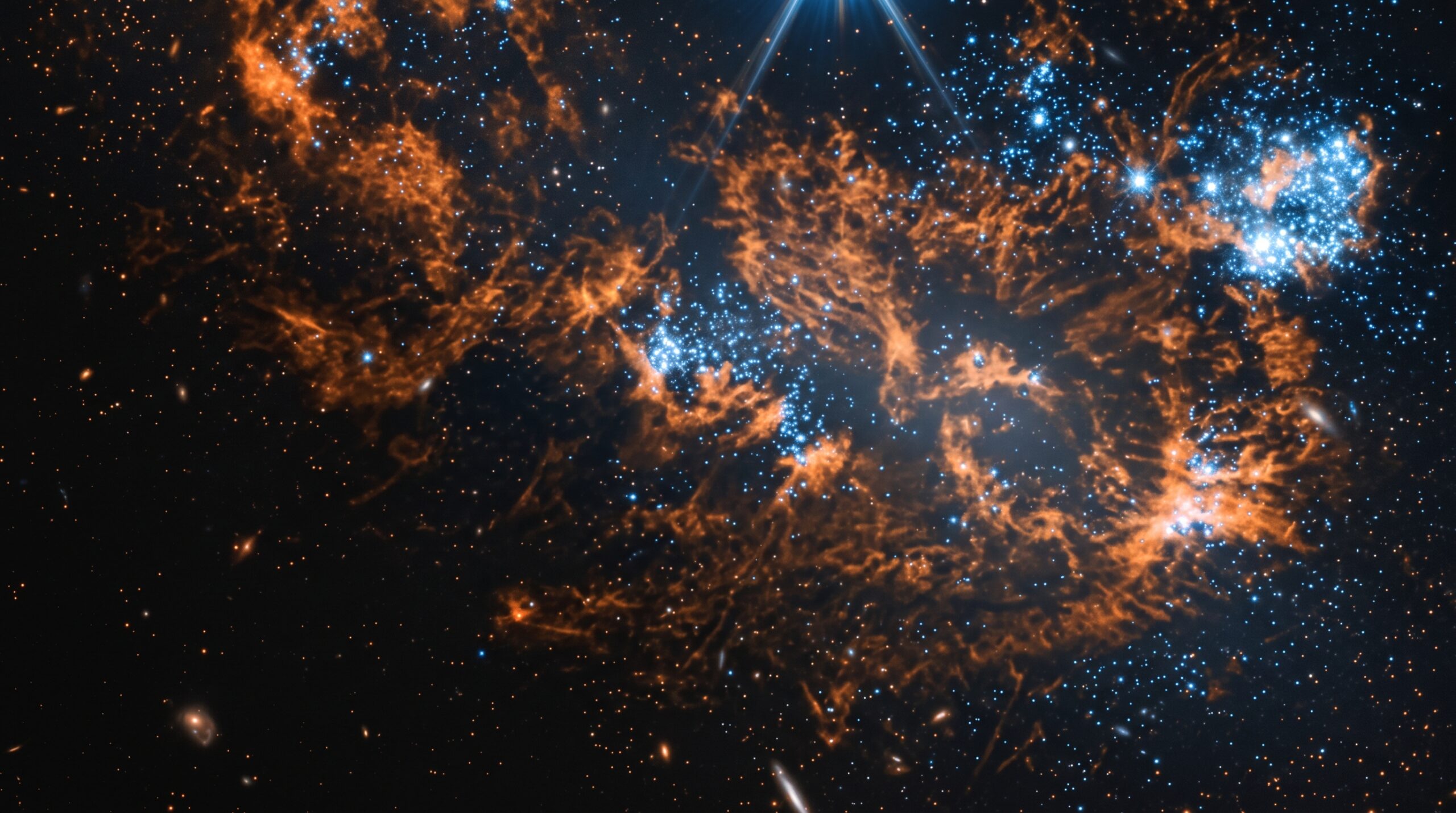
In new infrared observations released by the ESA/Webb science team, the James Webb Space Telescope has captured a high-resolution view of Arp 263 (also cataloged as NGC 3239), a peculiar irregular galaxy located approximately 25 million light-years away in the constellation Leo. Classified in Halton Arp’s iconic Atlas of Peculiar Galaxies, the system represents the violent aftermath of a collision between two progenitor galaxies.
While optical imaging from the Hubble Space Telescope mapped diffuse stellar light and patchy dust lanes, Webb’s Near-Infrared Camera (NIRCam) and Mid-Infrared Instrument (MIRI) penetrated the dense interstellar obscuration to reveal intense pockets of starburst activity. The infrared data isolated embedded young star clusters and mapped the kinematics of polycyclic aromatic hydrocarbons (PAHs) energized by intense ultraviolet radiation from massive newborn stars. These observations provide a detailed laboratory for studying how gravitational tidal forces compress cold molecular gas to trigger localized, rapid star formation in post-merger environments.
Planetary Protection Models Assess Microbial Survival in Lunar Cold Traps
As NASA and international partners prepare for extended surface operations at the lunar South Pole under the Artemis campaign, new planetary protection research published in astrobiology literature assesses the potential survivability of terrestrial extremophiles in permanently shadowed regions (PSRs). These deep polar craters, shielded from direct sunlight for billions of years, harbor volatile water ice deposits at temperatures dropping below 40 Kelvin.
Thermal and radiation modeling demonstrates that while ionizing solar wind and galactic cosmic rays sterilize exposed regolith, microbes sheltered beneath even a few millimeters of cryo-trapped dust could enter cryptobiotic dormancy rather than degrading. These findings establish critical operational guidelines for planetary protection teams, ensuring that future robotic sampling and crewed surface exploration maintain the pristine scientific integrity of lunar volatile reservoirs while preventing forward contamination.
Starbase Readies Starship for Flight 14 Orbital Trajectory Campaign
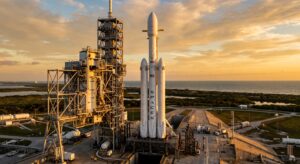
At SpaceX’s Starbase facility in Boca Chica, Texas, ground teams have entered final pre-flight checkouts for Starship Flight 14. Regulatory filings submitted to the Federal Communications Commission (FCC) designate the opening of the mission window, aiming to validate critical orbital capability milestones for the fully integrated launch system.
Flight 14’s primary flight profile focuses on testing the orbital payload bay deployment mechanisms, executing in-space propellant transfer demonstrations, and performing controlled reentry thermal protection trials across the vehicle’s upgraded heat shield architecture. These sequential test flights remain fundamental to qualifying Starship as the Human Landing System (HLS) for future Artemis lunar landing missions.