Hubble Discovers a Giant Ten-Sided Decagon Encircling Saturn’s South Pole
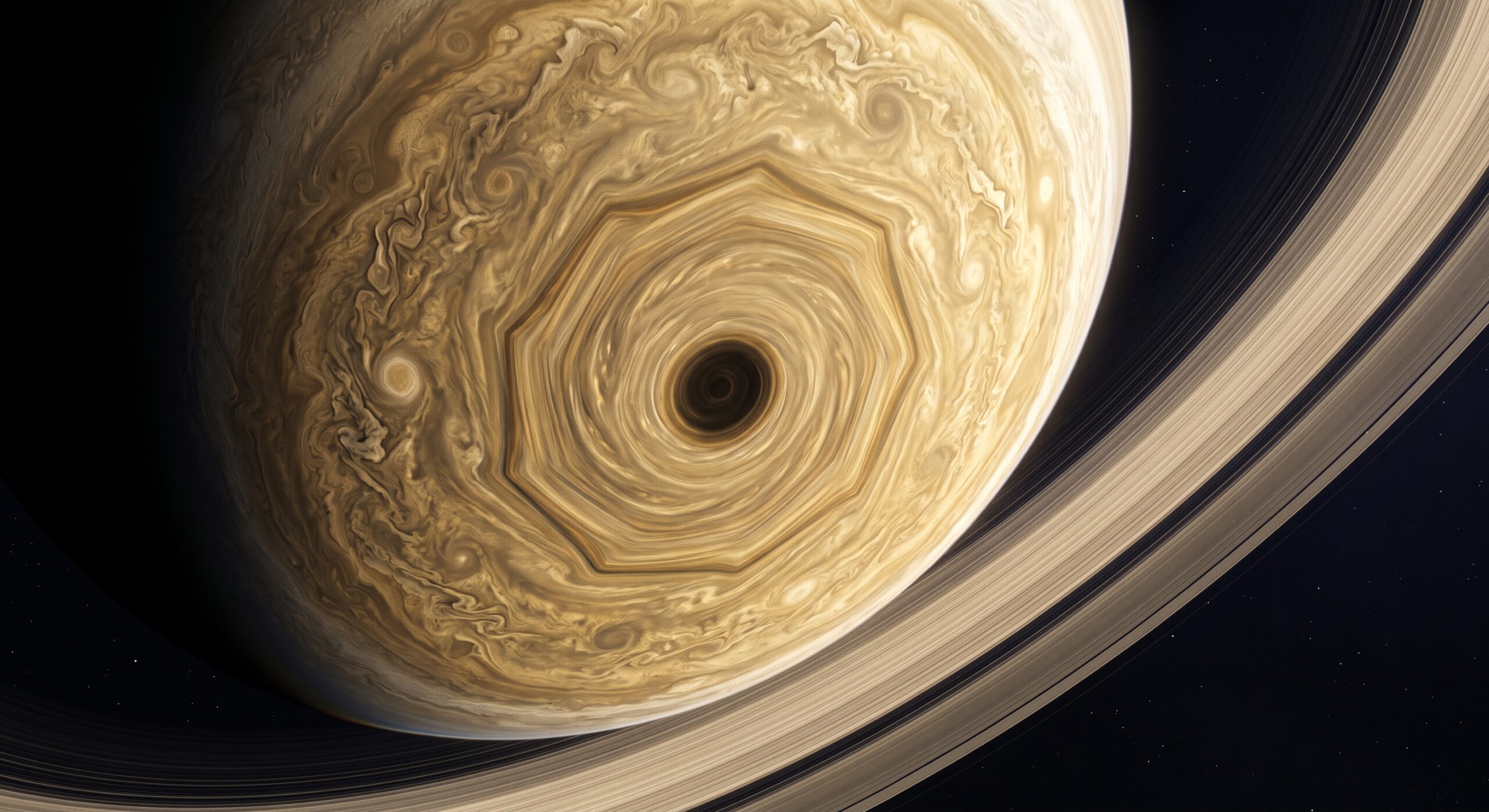
In a stunning planetary science revelation announced by NASA and the European Space Agency (ESA/Hubble release heic2612), astronomers analyzing high-resolution multi-filter imaging from the Hubble Space Telescope have detected an unprecedented regular atmospheric jet structure encircling Saturn’s south pole: a giant ten-sided polygon, or decagon.
While Saturn’s northern hemisphere is famous for its long-lived, six-sided polar hexagon first discovered by Voyager and mapped in detail by Cassini, the southern polar vortex was historically characterized as a circular hurricane-like storm. Hubble’s extended baseline observations show that seasonal solar insolation shifts and intense zonal wind shear have organized the southern circumpolar jet into a stable, ten-sided standing Rossby wave. This discovery marks the first time a decagonal wave pattern has ever been identified in a planetary atmosphere, providing a crucial empirical testbed for fluid dynamicists modeling non-linear atmospheric vortex dynamics across gas giant worlds.
Carving the Void: Hubble Resolves an Expanding Superbubble in the LMC
Turning its gaze beyond the Milky Way, new deep-sky observations from the Hubble Space Telescope have resolved the intricate boundary physics of a massive “superbubble” nebula inside the Large Magellanic Cloud (LMC), located 160,000 light-years from Earth. Spanning dozens of light-years across, this celestial void represents an extreme example of stellar feedback in an interstellar environment.
Superbubbles are carved out by the collective mechanical energy of young, massive stars. Intense ultraviolet stellar winds from a central cluster of short-lived OB stars—reinforced by consecutive supernova detonations—sweep up and evacuate cold interstellar gas, driving a high-velocity shock front into the surrounding molecular clouds. Hubble’s imagery reveals dense, glowing filaments and ionization rims along the bubble’s perimeter, where swept-up gas is actively compressed to trigger a secondary wave of star formation.
Stratospheric Science: NASA WB-57 Jets Race the Umbral Shadow
Featured on NASA’s Astronomy Picture of the Day, solar physics researchers have released stratospheric imaging captured during high-altitude solar eclipse chases. Operating at an altitude of 50,000 feet aboard twin NASA WB-57F research aircraft cruising off the coast of Iceland, scientific payloads pursued the Moon’s umbral shadow across the North Atlantic to maximize observation duration.
Flying in the stratosphere places the aircraft above 90% of Earth’s atmospheric moisture and turbulence, opening a clear, unattenuated window for high-speed mid-infrared cameras. The data captures the elusive middle solar corona and the fine-scale topology of magnetic loops and coronal mass ejections during peak solar maximum. These airborne observations supply the critical boundary-layer measurements needed to calibrate space-based coronagraphs and improve predictive models of solar energetic particle events.