Hubble Uncovers Omega Centauri’s Missing Black Hole Population
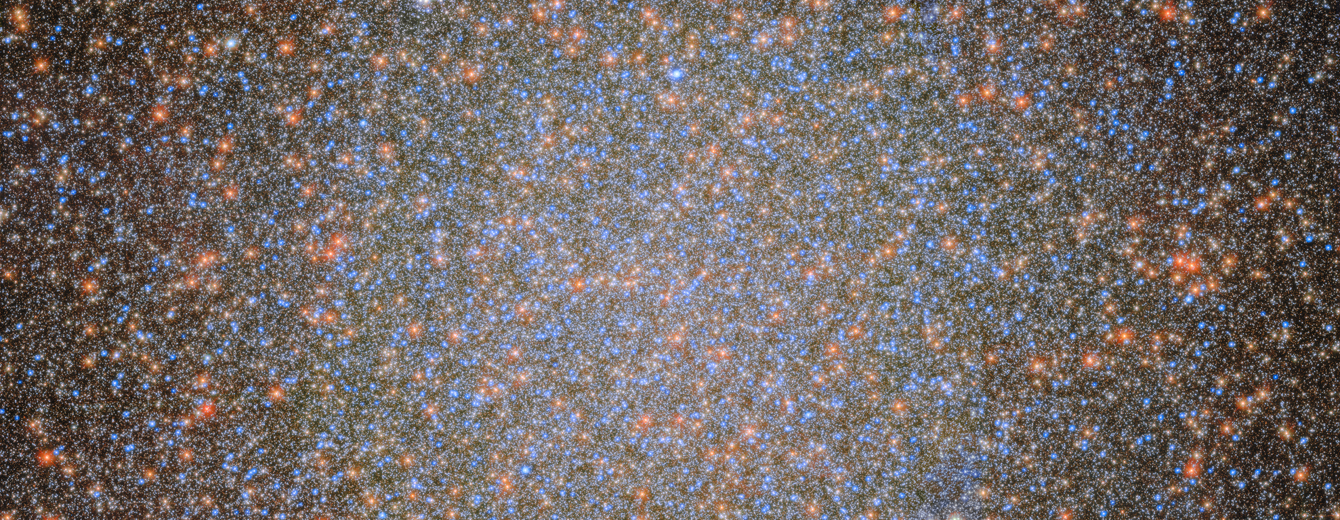
For decades, astrophysicists have debated the dynamic fate of black holes within dense stellar environments. Now, analyzing two decades of high-precision astrometry from the Hubble Space Telescope, an international research team has identified the first confirmed stellar-mass black hole inside Omega Centauri, cataloged as oMEGACat BH-2. Omega Centauri, containing roughly 10 million stars, is widely believed to be the stripped relic core of an ancient dwarf galaxy consumed by the early Milky Way.
Theoretical models previously suggested that gravitational recoil from dense stellar interactions would violently eject stellar-mass black holes from globular clusters early in their lifecycles. However, Hubble’s micro-arcsecond tracking of stellar orbits isolated a high-velocity companion star tethered to an invisible, non-luminous compact object weighing roughly eight solar masses. The confirmation of oMEGACat BH-2 demonstrates that dense cluster cores can retain substantial black hole populations, shedding light on the dynamical breeding grounds of binary black hole mergers detected by gravitational wave observatories.
Swift Detects Wandering Black Hole Devouring a Star on Galactic Outskirts
In a major discovery for transient high-energy astrophysics, NASA’s Neil Gehrels Swift Observatory, in coordination with the Zwicky Transient Facility (ZTF), observed a colossal optical and ultraviolet flare erupting 750 million light-years from Earth. At its peak, the flare radiated with the blinding luminosity of approximately 10 billion suns, outshining its host galaxy.
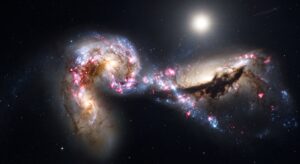
Analysis of the multi-wavelength light curve confirmed the signature of a Tidal Disruption Event (TDE)—the violent shredding of a star by gravitational tidal forces. Crucially, while TDEs typically occur in dense galactic nuclei, this cataclysm occurred on the distant outskirts of the galaxy. The culprit is a “wandering” intermediate-mass black hole, weighing roughly one million solar masses, likely stripped from a satellite galaxy during an ancient collision. The event provides direct observational proof that rogue massive black holes roam undetected through galactic halos until brief accretion flares betray their presence.
Solar Corona Polarization: Insights from Recent Eclipse Alignments
As the solar cycle reaches peak activity, heliophysicists are analyzing multi-spectral coronal polarization data gathered during recent total solar eclipse events. When the lunar disk completely obscures the intense photosphere, the faint, magnetized solar corona becomes visible to high-speed ground and airborne polarimeters.
The latest synthetic datasets delineate the fine-scale topology of coronal streamers, magnetic flux ropes, and Alfvén wave propagation across the Sun’s middle corona—a notoriously difficult region to observe with spaceborne coronagraphs due to stray-light limitations. Mapping these magnetic boundary conditions provides vital empirical constraints for magnetohydrodynamic solar wind models, improving our ability to predict severe geomagnetic storms that threaten orbital communications and power infrastructure.