When Earth Lost the Sun’s Shield: Heliosphere Compression Triggered Ancient Ice Ages
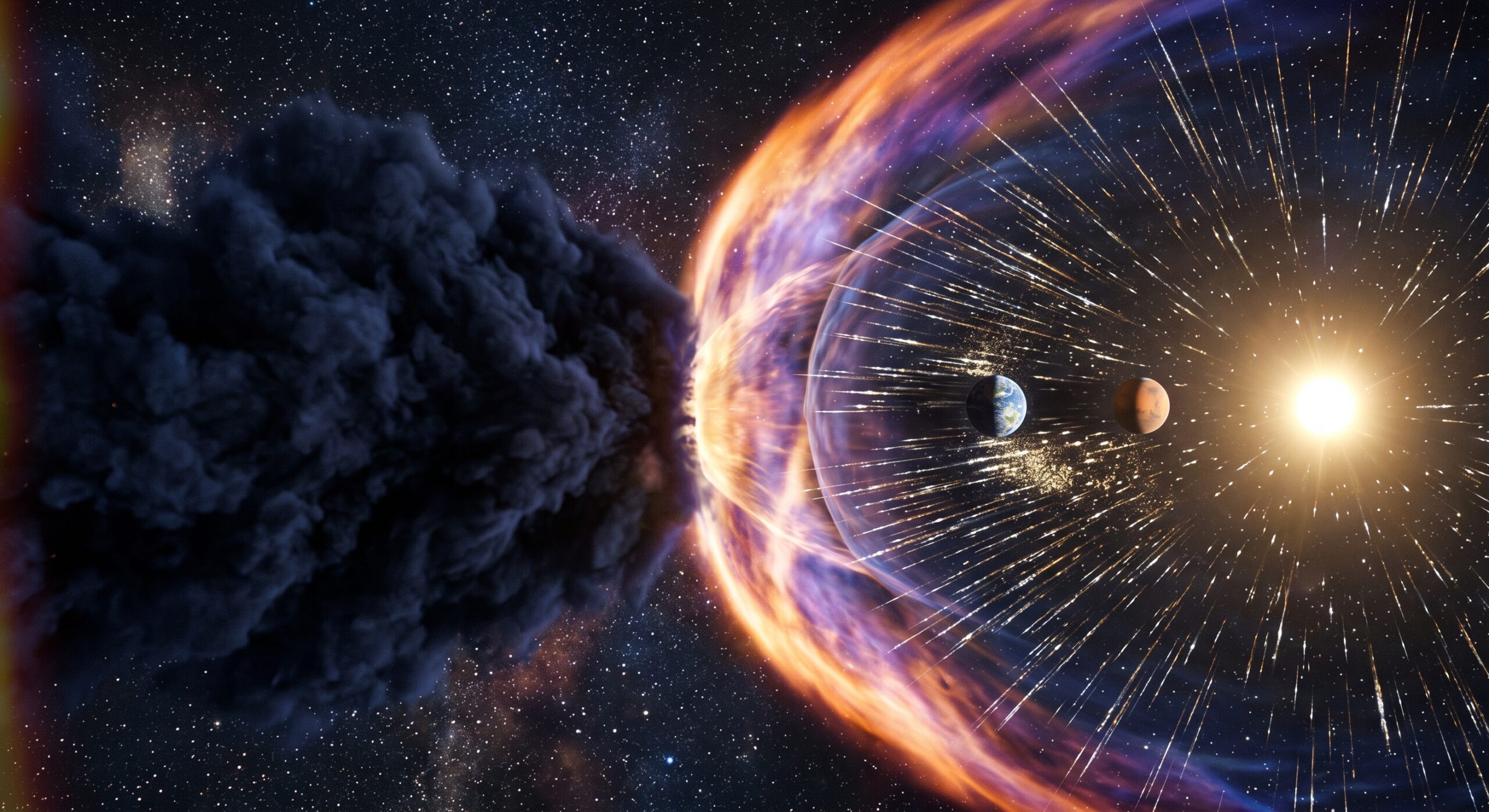
A groundbreaking astrophysical modeling study led by researchers at NASA’s Goddard Space Flight Center reveals that Earth may have been stripped of the Sun’s protective magnetic shield several million years ago. Normally, the heliosphere—the vast bubble of magnetized plasma blown outward by the solar wind—extends far beyond the orbit of Pluto, deflecting the vast majority of high-energy galactic cosmic rays away from the inner solar system.
However, advanced magnetohydrodynamic simulations demonstrate that roughly two to three million years ago, the solar system passed through a massive, ultra-dense interstellar “cold cloud” within the Local Interstellar Medium. The intense ram pressure of this cold gas compressed the heliopause drastically inward, shrinking the heliosphere’s boundary to within 0.22 astronomical units—well inside Earth’s orbit. This left our planet directly exposed to raw interstellar hydrogen, helium, and unattenuated cosmic radiation, potentially catalyzing atmospheric ionization, severe ozone depletion, and global cooling epochs documented in terrestrial geological records.
Terrestrial Isotopes Confirm Interstellar Cloud Encounters
The astrophysical simulations provide a long-sought theoretical framework explaining physical anomalies embedded in the Earth’s crust and deep-sea sediments. Geological core samples recovered from ocean floors have revealed sharp global spikes in iron-60 ($^{60}\text{Fe}$) and plutonium-244 ($^{244}\text{Pu}$)—radioactive isotopes that do not naturally originate on Earth and are forged primarily in core-collapse supernovae.
By correlating the timing of these isotopic influxes with the galactic trajectory of the Sun through the Local Ribbon of cold clouds, scientists confirmed that Earth was physically bathed in interstellar material during the Pliocene-Pleistocene transition. As the Sun continues its 230-million-year orbital journey around the galactic core, these findings highlight that planetary habitability is fundamentally coupled to the surrounding interstellar environment through which our solar system navigates.
Spacewalk 99 Concludes Solar Tracking Overhaul on the ISS
In low Earth orbit, NASA and European Space Agency (ESA) astronauts completed U.S. Spacewalk 99 outside the International Space Station. The extravehicular activity focused on preventative structural maintenance and mechanical refurbishment of the Starboard Solar Alpha Rotary Joint (SARJ), the massive motorized bearing that rotates the station’s starboard photovoltaic wings to track the Sun.
Spacewalkers replaced degraded trundle bearing assemblies and applied specialized high-vacuum lubricant across the race ring mechanism. Maintaining smooth 360-degree rotational tracking of the station’s main solar arrays ensures peak power generation for ongoing microgravity laboratory research, while preparing the orbital outpost for upcoming commercial science payloads and visiting crew vehicles.