Unveiling the ‘Little Red Dots’: Webb Uncovers the Earliest Supermassive Black Holes
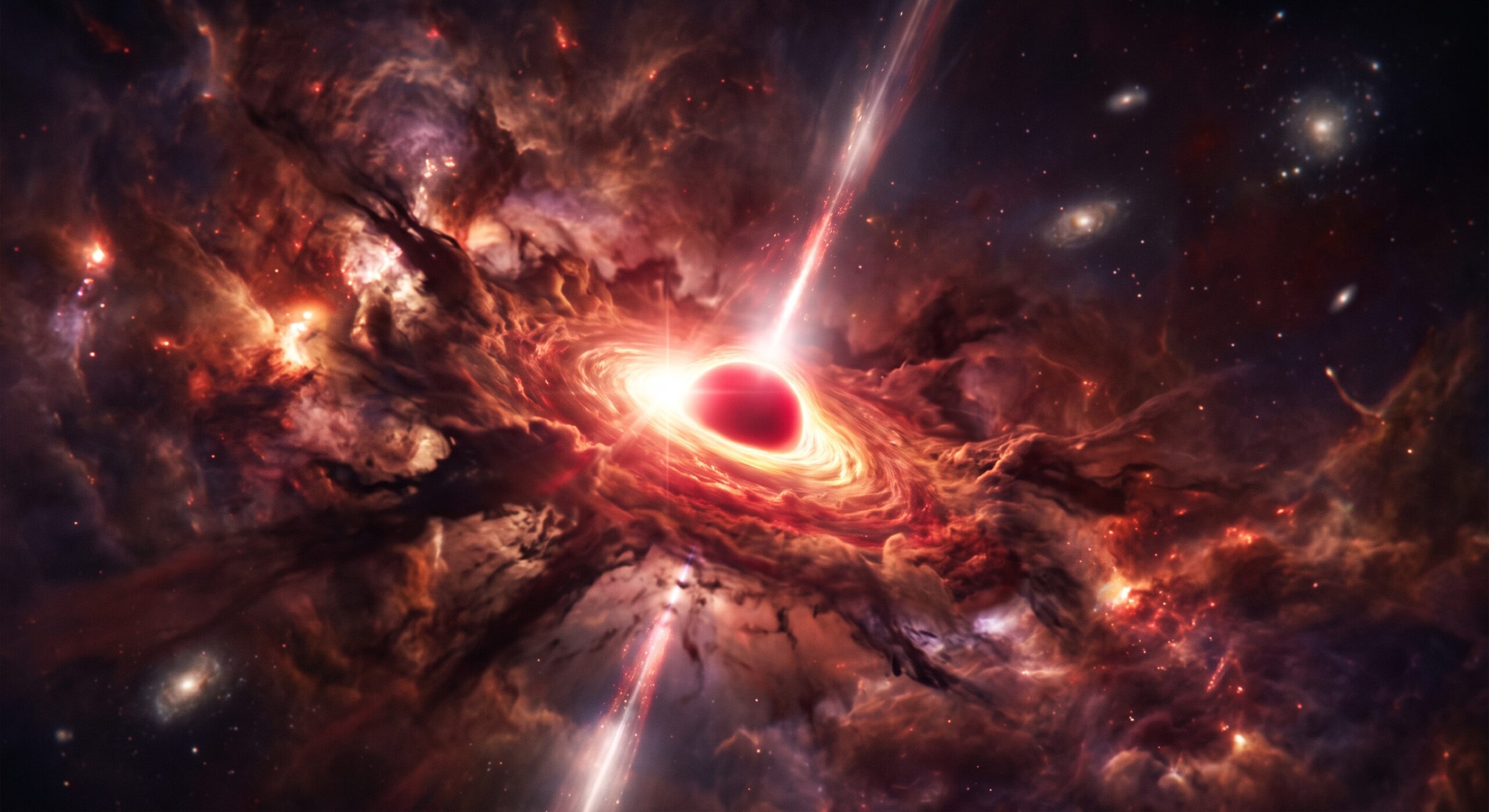
One of the most persistent enigmas uncovered by the James Webb Space Telescope (JWST) has been the ubiquity of compact “little red dots” in the high-redshift universe. A landmark study published in Nature Astronomy provides compelling observational evidence that these enigmatic objects represent the earliest nascent phases of supermassive black holes, actively growing within extremely dense, gas-rich cocoons just 600 to 800 million years after the Big Bang.
Using Webb’s Near-Infrared Spectrograph (NIRSpec), astronomers analyzed the broadened emission lines and distinct continuum slopes of these primordial sources. Rather than being ultra-compact stellar clusters as initially debated, the spectra reveal central accreting black holes that are rapidly accumulating mass at or near the Eddington limit. These findings offer crucial empirical constraints on cosmological seed models, demonstrating that supermassive black holes formed far earlier and grew significantly faster than classical galaxy evolution frameworks predicted.
Molecular Survival Near Sagittarius A*: Water and Silicate Dust Defy Extreme Radiation
In a complementary astrophysical breakthrough published in Astronomy & Astrophysics, mid-infrared observations from Webb’s MIRI instrument have detected water vapor and oxygen-rich silicate dust in the envelope of the dying giant star IRS 3. Remarkably, this star lies at a projected distance of only 0.55 light-years (0.17 parsecs) from Sagittarius A*, the supermassive black hole at the center of the Milky Way.
Conventional astrophysical models posited that the extreme ultraviolet and X-ray radiation environment within the crowded central parsec would disintegrate molecular bonds and vaporize circumstellar dust grains. Webb’s high-resolution spectroscopy demonstrates that dense, expanding stellar winds can provide sufficient self-shielding to permit complex chemistry and dust grain survival, fundamentally revising our understanding of the interstellar medium and stellar lifecycles in extreme galactic nuclei.
Spacewalk 98: Upgrading High-Speed Orbital Communications on the ISS
High above Earth in low Earth orbit, NASA astronaut Anil Menon and European Space Agency (ESA) astronaut Sophie Adenot conducted U.S. Spacewalk 98 outside the International Space Station. This critical extravehicular activity (EVA) successfully finalized the replacement and wiring of a degraded Space-to-Ground antenna assembly mounted on the station’s starboard truss.
The upgraded antenna system serves as the primary high-rate data link between the orbital complex and NASA’s Space Network, enabling real-time transmission of massive payload datasets, scientific telemetry, and high-definition video downlink to Mission Control in Houston. The completed EVA ensures robust communications bandwidth for upcoming international science complements and visiting commercial vehicle operations.