JWST Infrared Spectroscopy Demystifies Dyson Sphere Candidates
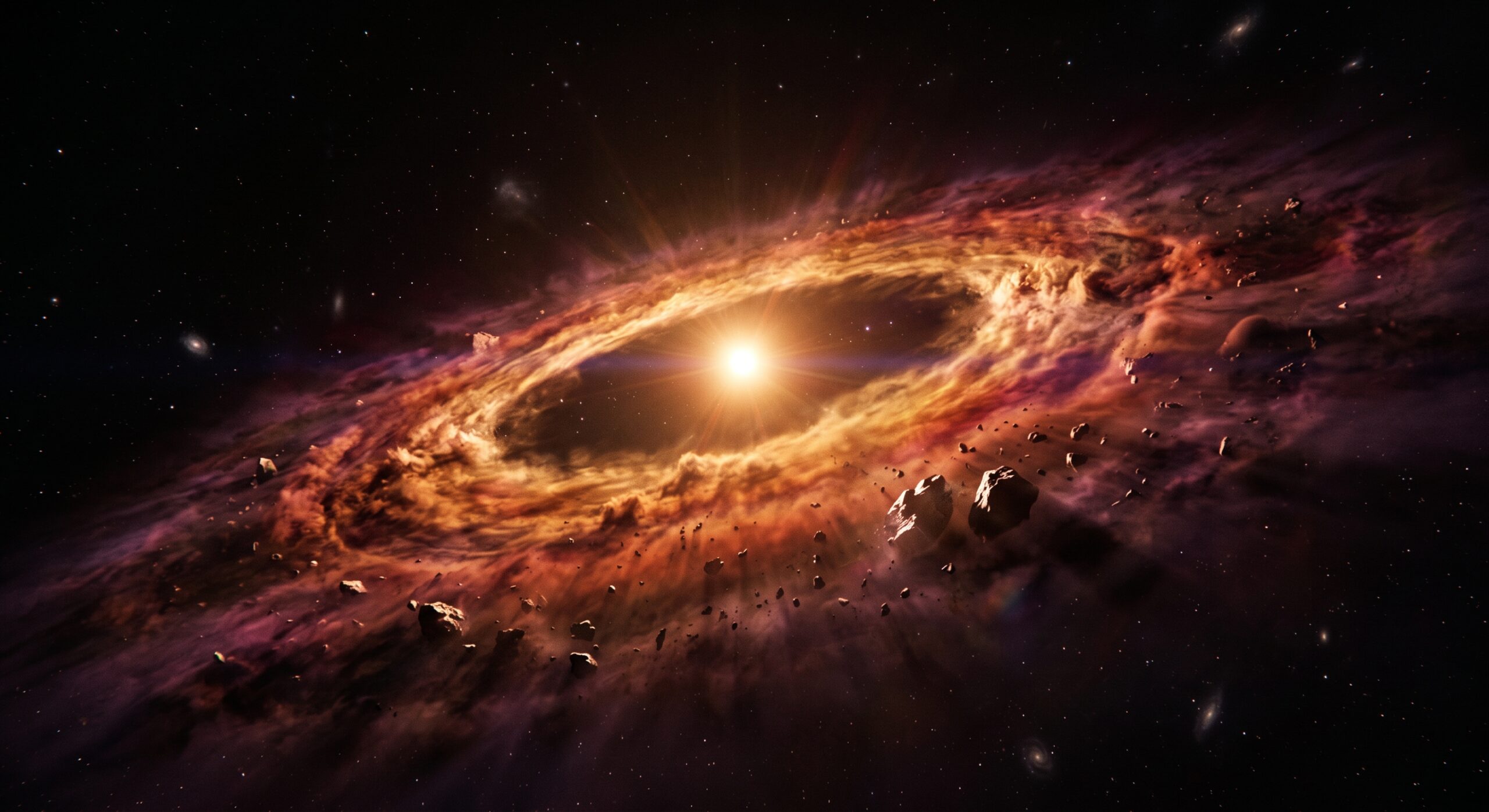
In a rigorous test of astronomical technosignature candidates, an international team under Project Hephaistos utilized the James Webb Space Telescope (JWST) to conduct high-resolution mid-infrared observations of stars previously flagged for anomalous infrared excesses. Initial wide-field surveys had suggested that these stellar systems might harbor alien megastructures, such as Dyson spheres or swarms intercepting stellar radiation.
Leveraging Webb’s Mid-Infrared Instrument (MIRI), researchers analyzed the precise spectral energy distributions across mid-infrared wavelengths. The high-fidelity data conclusively demonstrated that the observed excess emissions stem from natural astrophysical phenomena—primarily warm, collisionally active circumstellar debris disks and chance alignments with background dusty galaxies. While ruling out artificial constructs in these specific targets, the study establishes a new methodological benchmark for using next-generation infrared spectroscopy to filter false positives in the search for extraterrestrial technology.
Atmospheric Physics Behind the 96% Deep Partial Lunar Eclipse
On the night of August 27–28, 2026, Earth aligns between the Sun and the Moon, producing a deep partial lunar eclipse wherein approximately 96% of the lunar disk plunges into Earth’s central umbral shadow. Data from NASA’s Scientific Visualization Studio illustrates the complex atmospheric optics that transform the nearly fully obscured Moon into a vivid coppery-red sphere.
Although direct solar illumination is blocked across the umbra, sunlight passing through the perimeter of Earth’s atmosphere undergoes intense Rayleigh scattering, filtering out shorter blue wavelengths while refracting longer red and orange wavelengths into the shadow cone. Simultaneously, solar observatories are monitoring a moderate coronal mass ejection (CME) impacting Earth’s magnetosphere, potentially coupling high-latitude auroral displays with the coppery lunar silhouette for observers across North and South America.
Roman Space Telescope Arrives at Complex 39A for Final Launch Mating
Preparations for NASA’s next flagship astrophysics mission reached the launch pad as the encapsulated Nancy Grace Roman Space Telescope was transported to Launch Complex 39A at Kennedy Space Center in Florida. The observatory is undergoing final mechanical and electrical mating to its SpaceX Falcon Heavy launch vehicle ahead of its targeted August 30 liftoff.
Positioned inside the heavy-lift fairing, Roman is primed for an ascent that will place it on a direct trajectory toward the Sun-Earth Lagrange Point 2 (L2). Once operational, Roman will integrate wide-field infrared surveys with advanced coronagraphic imaging, embarking on a comprehensive decadal mission to map cosmic large-scale structure, measure dark energy cosmological expansion, and conduct statistical censuses of distant planetary systems.