Voyager 2: Humanity’s Robotic Envoy Across the Solar System
The Dawn of the Grand Tour
On August 20, 1977, Voyager 2 was launched from Cape Canaveral, embarking on one of the most ambitious space exploration missions ever conceived.
This launch was perfectly timed to take advantage of a rare planetary alignment that occurs only once every 175 years, an opportunity known as the Grand Tour.
The Grand Tour was a visionary plan to use the gravity of Jupiter, Saturn, Uranus, and Neptune to slingshot the spacecraft from one giant planet to the next.
Although Voyager 2 was launched before its twin, Voyager 1, it was placed on a slower, more comprehensive trajectory designed to visit all four outer planets.
The engineers of that era achieved a monumental feat by building a robust system capable of enduring decades in deep space, despite having incredibly limited computing power and memory.
Powered by radioisotope thermoelectric generators, the spacecraft was guaranteed a steady supply of electricity even in the darkest reaches of the solar system where sunlight cannot penetrate.
As Voyager 2 departed into the unknown void, it carried the boundless curiosity and unwavering faith in science of a small blue planet called Earth.
Miraculous Discoveries at Jupiter and Saturn
In July 1979, Voyager 2 arrived at the Jovian system, transmitting breathtaking data back to Earth and beautifully complementing the earlier observations made by Voyager 1.
Not only did it capture high-resolution images of the Great Red Spot’s complex atmospheric dynamics, but it also revealed the intricately cracked surface of Jupiter’s icy moon, Europa.
These incredibly detailed images of Europa planted the seed for a major astrobiological hypothesis, suggesting that a vast liquid ocean might exist beneath its frozen crust.
By August 1981, the spacecraft approached the majestic rings of Saturn, ready to uncover more secrets of the gas giant.
At Saturn, Voyager 2 discovered that the breathtaking main rings were actually composed of thousands of delicate ringlets, and it illuminated the diverse geological features of moons like Enceladus.
The discovery of shepherd moons embedded within the rings, which use their gravity to maintain the ring structures, sent shockwaves through the planetary physics community.
Furthermore, the probe conducted detailed measurements of Saturn’s powerful magnetic field and radiation belts, drastically deepening our understanding of gas giant environments.
The sheer volume and value of the data collected at Jupiter and Saturn fundamentally rewrote the planetary science textbooks of the time.
Encountering the Unknown Ice Giant Uranus
Following its highly successful gravity assist at Saturn, Voyager 2 ventured into truly uncharted territory by becoming the first human-made object to approach Uranus.
In January 1986, the spacecraft flew a mere 81,500 kilometers above the cloud tops of this bizarre ice giant, which is famous for its extreme axial tilt.
Due to the presence of methane in its upper atmosphere, Uranus presented a stunning pale blue-green face, appearing rather smooth and tranquil compared to the turbulent atmospheres of Jupiter and Saturn.
However, the planetary system was far from boring, as Voyager 2 successfully discovered ten new moons and detected previously unknown rings encircling the planet.
Among these discoveries, the incredibly bizarre terrain of the moon Miranda left scientists completely astounded.
Miranda’s surface appeared as a chaotic jigsaw puzzle of deep canyons and icy cliffs, looking as though the moon had been shattered into pieces and sloppily reassembled by gravity.
The mission also revealed that Uranus possesses a highly unusual magnetic field, which is not only severely tilted from its axis of rotation but also offset from the planet’s geometric center.
To this day, Voyager 2 remains the sole emissary from Earth to have visited Uranus, and virtually all of our detailed knowledge about this distant ice giant originates from this single, historic flyby.
The Final Planetary Chapter at Neptune
In August 1989, roughly three and a half years after leaving Uranus, Voyager 2 reached the final destination of its Grand Tour: the distant and freezing world of Neptune.
Despite being incredibly far from the Sun and shrouded in deep cold, Neptune was revealed to be a surprisingly dynamic and highly active planet.
Within its vivid blue atmosphere, the spacecraft photographed a massive storm system roughly the size of Earth, which was famously dubbed the Great Dark Spot.
It was also discovered that Neptune boasts the fastest winds in the entire solar system, with fierce gusts reaching mind-boggling speeds of up to 2,000 kilometers per hour.
How such energetic weather patterns can exist on a planet that receives so little solar energy remains one of the most captivating mysteries in modern planetary science.
During its close flyby of Neptune’s largest moon, Triton, Voyager 2 captured images of active geysers erupting dark plumes of dust and nitrogen gas from a frozen crust at temperatures near absolute zero.
This shocking discovery proved that Triton is a geologically active world with some form of internal heat source, completely defying expectations for such a frigid environment.
After skimming over Neptune’s north pole and observing Triton, Voyager 2 deflected downward, leaving the ecliptic plane of the solar system behind as it flew toward the southern stars.
This dramatic encounter marked the triumphant finale of Voyager 2’s primary planetary exploration mission.
Piercing the Heliosphere into Interstellar Space
The conclusion of the Grand Tour was by no means the end of Voyager 2’s extraordinary journey through the cosmos.
Its new, ongoing mission was to seek out the boundaries of the heliosphere, the massive protective bubble created by the solar wind as it pushes against the interstellar medium.
In November 2018, more than 40 years after its launch, scientists confirmed that Voyager 2 had finally crossed the heliopause, the boundary where the solar wind abruptly drops and galactic cosmic rays surge.
This historical milestone made it only the second human-made object in history, right after Voyager 1, to enter the uncharted waters of interstellar space.
Crucially, because Voyager 1’s plasma instrument had stopped working decades earlier, Voyager 2 was able to provide the first-ever direct measurements of the density and temperature of the interstellar plasma.
These unprecedented observations have allowed scientists to better understand the nature of the cosmic barrier that shields the planets of our solar system from high-energy stellar radiation.
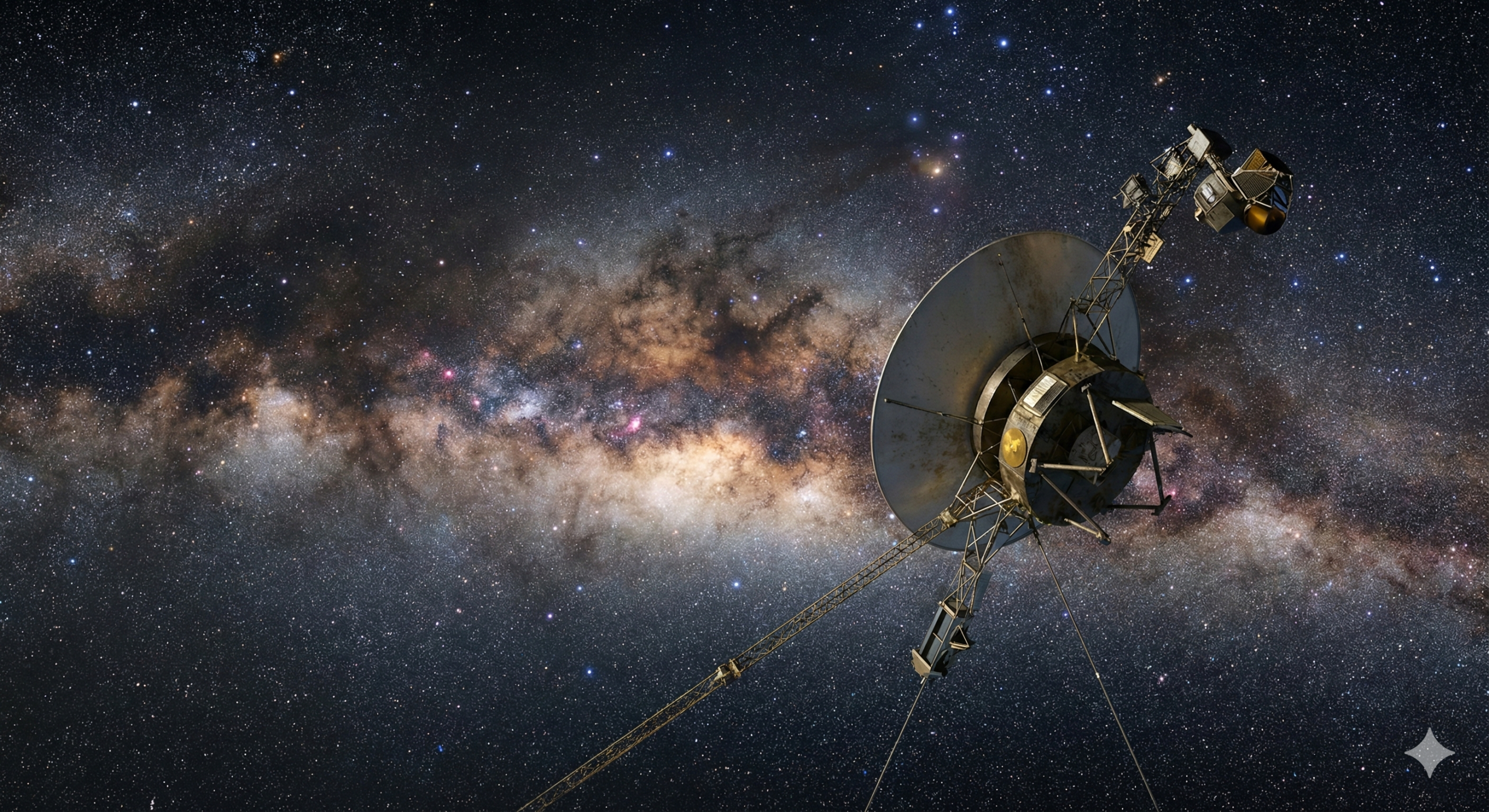
Today, the intrepid probe continues to fly outward at roughly 15 kilometers per second, billions of kilometers away from home, faithfully beaming faint signals back to Earth.
Although the power output of its nuclear battery decreases every year, brilliant engineering efforts ensure that it will continue to collect invaluable data from the space between the stars for as long as possible.
Humanity’s Memories Etched on the Golden Record
Alongside its suite of scientific instruments, Voyager 2 carries a profoundly romantic artifact: the Golden Record, a message designed for extraterrestrial intelligence or future humans.
This gold-plated copper disk contains a rich tapestry of Earth’s diversity, featuring the sounds of nature, greetings in numerous languages, global musical masterpieces, and a vast collection of images.
Curated by a team led by the legendary Carl Sagan, this interstellar message in a bottle is a beautiful testament to humanity’s desire to reach out and connect with the broader universe.
It will take tens of thousands of years before the spacecraft comes anywhere near another star system, but the record is engineered to survive in the harsh environment of deep space for hundreds of millions of years.
One day, long after Voyager’s power is completely exhausted and its communication with Earth is permanently silenced, the probe will drift alone through the Milky Way as a silent monument to our existence.
The Golden Record elevates the mission beyond pure science, adding a deeply emotional and philosophical dimension that forces us to reflect on our place within the cosmic ocean.
Plunging deeper into the immense darkness, Voyager 2 will forever remain a tiny, resilient time capsule guarding the hopes and memories of humanity.
Summary
Even now, nearly half a century after launch, Voyager 2’s journey through interstellar space remains a beautiful symbol of human curiosity.
Its legacy of revealing the giant planets will forever shine as a proud testament to what we can achieve when we reach for the stars.