Asteroid Impact Model Solves Dual Mysteries of Mars’ Moon Deimos
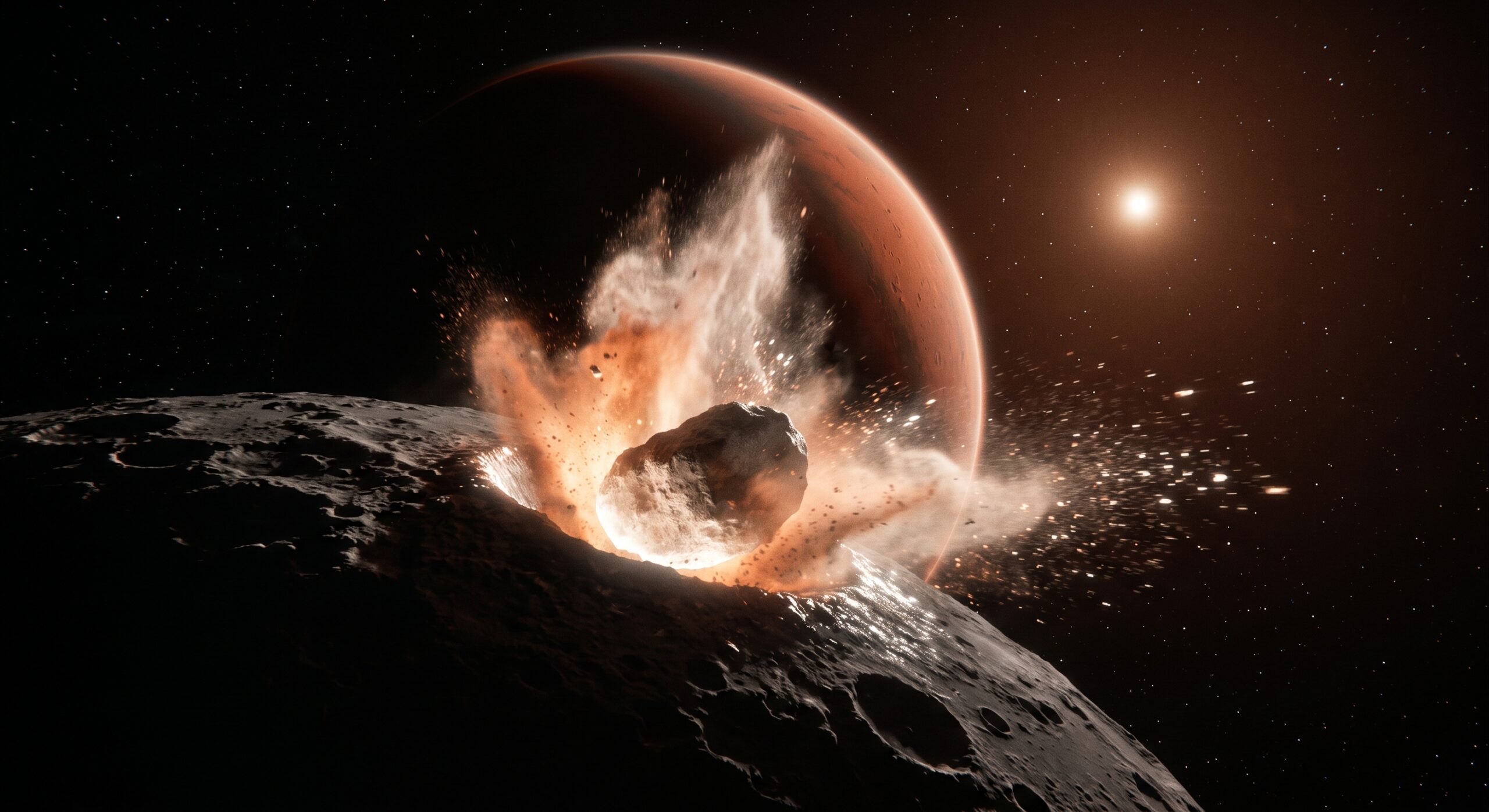
A groundbreaking study published in Nature Astronomy has resolved two long-standing planetary science puzzles regarding Deimos, the smaller and outermost of Mars’ two natural satellites. For decades, astronomers have debated why Deimos possesses an unusually smooth, dust-blanketed terrain alongside a subtle orbital inclination offset from the Martian equatorial plane.
Using high-resolution hydrodynamic impact simulations, planetary researchers demonstrated that a single, energetic asteroid collision during the late stages of solar system formation can account for both characteristics. The oblique impact ejected a localized debris disk that re-accreted onto Deimos, smoothing its cratered surface with a thick mantle of regolith while simultaneously imparting the gravitational torque required to tilt its orbital trajectory. These findings provide critical dynamical constraints for upcoming sample return missions targeting the Martian moons.
JWST Pierces the Complex Shroud of the Lion’s Head Nebula
Expanding our spectroscopic understanding of stellar death, new high-resolution infrared imagery from the James Webb Space Telescope (JWST) has captured unprecedented structural detail within NGC 2392, popularly known as the Lion’s Head Nebula. While optical images from the Hubble Space Telescope showcased its iconic outer filaments, Webb’s Near-Infrared Camera (NIRCam) and Mid-Infrared Instrument (MIRI) penetrated the dense gas shells to map the inner ejection dynamics.
The multi-wavelength infrared data reveals intricate concentric rings, shock fronts, and molecular hydrogen knots driven by the fast stellar winds of the central dying white dwarf. By resolving the elemental boundary layers between ionized gas and cold dust, Webb’s observations provide an essential empirical benchmark for modeling how planetary nebulae recycle heavy elements back into the interstellar medium to seed future generations of planetary systems.
Global Infrastructure Ready for Roman Space Telescope Operations
With the Nancy Grace Roman Space Telescope poised for launch atop a SpaceX Falcon Heavy from Kennedy Space Center, the European Space Agency (ESA) and international partners have completed operational readiness verifications across global tracking networks. ESA has finalized integration of its mission-critical contributions, including high-precision star trackers, batteries, coronagraph detectors, and ground station support.
A key component of this ground architecture is the newly upgraded 35-meter deep-space antenna located in New Norcia, Western Australia. Operating within the ESA Estrack network, this high-throughput station will support continuous high-rate data telemetry downlinks as Roman navigates to its operational orbit around the Sun-Earth Lagrange Point 2 (L2), ensuring seamless data ingestion for global astrophysical research.