Gemini North Captures the Starburst Embraces of NGC 7253
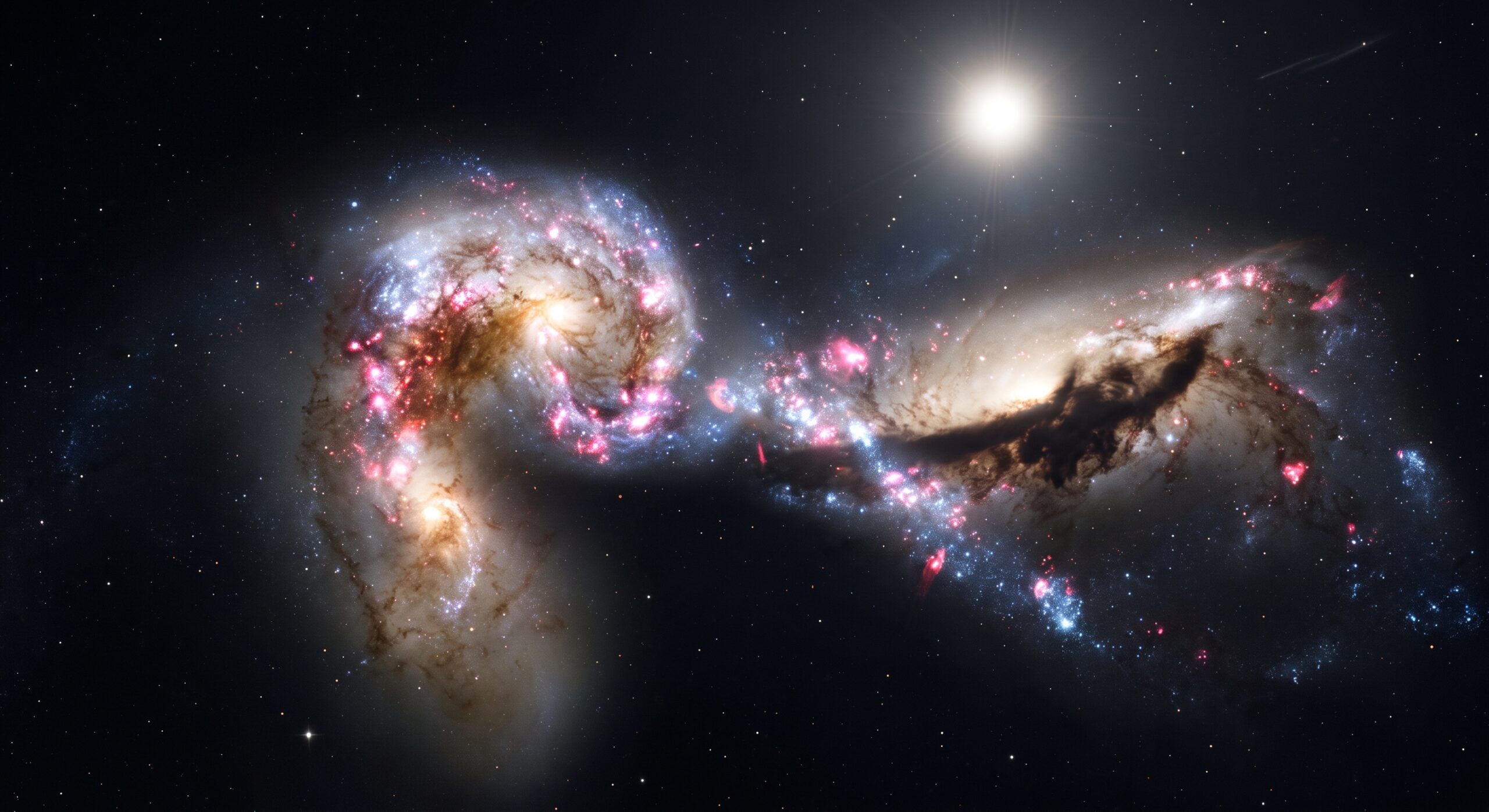
A breathtaking new deep-sky observation released by the International Gemini Observatory and featured on NASA’s Astronomy Picture of the Day captures the intricate gravitational dance of NGC 7253 (Arp 278). Located roughly 200 million light-years away in the constellation Pegasus, this pair of interacting spiral galaxies is locked in an intense collision that is fundamentally reshaping their interstellar architecture.
Captured using the 8.1-meter Gemini North telescope on the summit of Maunakea in Hawaiʻi, the image was chosen and named Nā ʻUhane Māhoe Huki Pū i ke Ola (“The Twin Spirits Pulling Together Creating Life”) through the University of Hawaiʻi’s Project Hōkūlani internship program. The high-resolution optical data reveals brilliant pink concentrations of ionized hydrogen (H II regions) strung along sweeping tidal tails. As the two galactic disks interpenetrate, shockwaves compress diffuse molecular clouds, igniting rapid starburst nurseries that demonstrate how cosmic collisions synthesize and disperse the elemental building blocks of future solar systems.
Caltech Geophysical Discovery: Massive Heat Divide Deep Inside Mars
In planetary science, a landmark geodynamical study from the California Institute of Technology (Caltech) has revealed an unexpected thermal asymmetry within the deep interior of Mars. Synthesizing orbital tidal dissipation measurements, gravimetric surveys, and seismic attenuation data gathered by NASA’s InSight lander, geophysicists discovered that Mars possesses a profound subterranean temperature divide, with its southern mantle potentially hundreds of degrees hotter than its northern counterpart.
For decades, planetary geologists have sought to explain the Martian crustal dichotomy—the stark geological contrast between the rugged, ancient southern highlands and the smooth, low-lying northern plains. The Caltech simulations demonstrate that this deep mantle thermal plume structure has persisted for billions of years, driving sluggish, asymmetric mantle convection. This sustained thermal anomaly provides strong physical evidence that localized magma chambers and geothermal activity could remain active deep beneath the Tharsis volcanic plateau.
Mapping 4 Billion Cosmic Objects: Expanding the Observational Frontier
Bridging local galactic dynamics with cosmic scales, NOIRLab has released the latest iteration of the DESI Legacy Imaging Surveys, marking the culmination of a 13-year observational campaign covering three-quarters of the visible sky. Cataloging nearly four billion astronomical objects, the comprehensive multi-band catalog provides unprecedented photometric depth across extragalactic space.
This massive census serves as the foundational target catalog for ongoing spectroscopic surveys measuring baryon acoustic oscillations and cosmic expansion rates. By pairing wide-area ground surveys from Maunakea and Kitt Peak with orbital observatories like Hubble and the newly launched Nancy Grace Roman Space Telescope, astrophysicists are assembling a continuous three-dimensional map of large-scale structure to probe the fundamental physics governing dark energy and the cosmic web.