The Winking Architecture of XZ Andromedae and Precision Differential Photometry
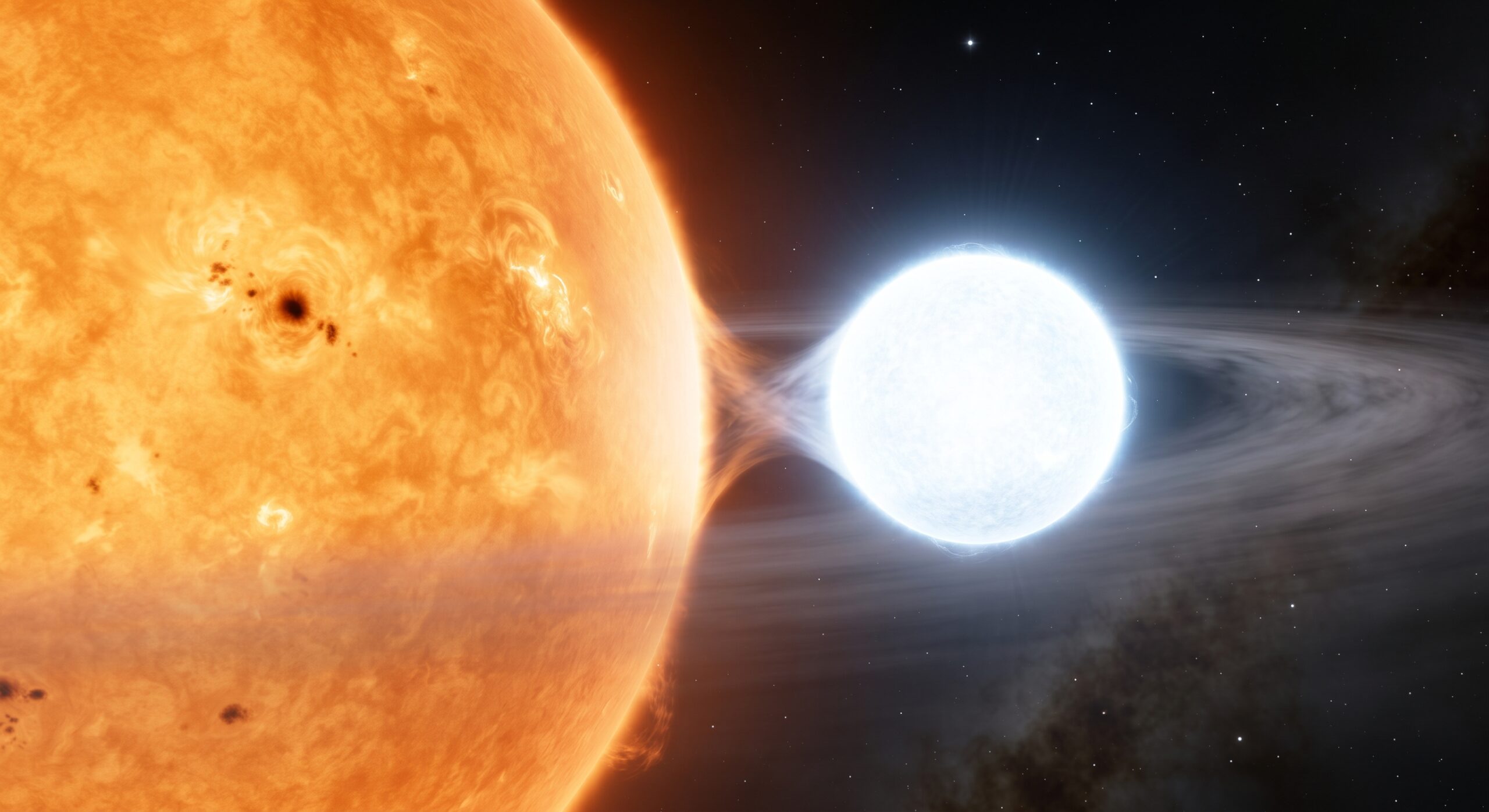
Featured on NASA’s Astronomy Picture of the Day, dynamic light curve animations capture the periodic “winking” of XZ Andromedae, an Algol-type eclipsing binary system oriented nearly edge-on toward Earth. Located in the constellation Andromeda, the system undergoes dramatic visual magnitude drops every 1.357 days as a cooler, evolved subgiant eclipses its hotter, more luminous companion star.
Beyond the primary eclipse geometry, long-term timing variations in XZ Andromedae’s orbital period reveal complex gravitational perturbations. Astrophysical models suggest the presence of two additional stellar companions in a 1:3 orbital resonance, transforming XZ Andromedae into a hierarchical four-body architecture. The data highlights the power of differential photometry—a technique comparing the flux between target and reference stars to cancel out atmospheric turbulence and detector noise. This fundamental photometric methodology is identical to the precision flux measurements used by space observatories to characterize transiting exoplanet atmospheres and accreting compact objects.
The September Epsilon Perseids: Tracing an Unknown Oort Cloud Cometary Stream
In solar system dynamics, meteor scientists and atmospheric observers are monitoring the peak of the September Epsilon Perseids (SEP) meteor shower on September 9–10. Unlike the prominent August Perseids, which originate from Comet 109P/Swift-Tuttle, the September shower represents a distinct debris trail shed by an uncataloged, long-period comet descending from the distant Oort Cloud on a high-inclination trajectory.
Entering Earth’s upper atmosphere at high velocities of approximately 64 kilometers per second, these millimeter-sized cometary meteoroids undergo intense frictional heating, generating luminous ablation trails between 80 and 110 kilometers in altitude. High-speed spectral cameras capture the chemical ionization lines of iron, sodium, and magnesium within the meteor plasma, providing direct physical samples of primitive, volatile-rich organics preserved since the formation of the outer solar system.
Surviving Stellar Death: Webb Probes Gas Giant Resilience Around White Dwarfs
Extending planetary astrophysics into the cosmic future, new transmission spectroscopy programs aboard the James Webb Space Telescope (JWST) are investigating exoplanetary survival around stellar remnants, exemplified by WD 1856+534 b. In roughly five billion years, the Sun will exhaust its core hydrogen, expanding into a red giant that engulfs Mercury, Venus, and potentially Earth, before collapsing into a dense, degenerate white dwarf.
Webb’s Near-Infrared Spectrograph (NIRSpec) observations demonstrate that Jovian-mass gas giants situated beyond several astronomical units can avoid envelope engulfment and tidal destruction. Driven by dynamical interactions with outer bodies, these surviving worlds migrate inward into stable, close-in orbits around the cooling white dwarf. Probing the atmospheric chemistry and molecular composition of these planetary survivors provides an empirical preview of the ultimate evolutionary fate awaiting the outer planets of our own solar system.