Daytime Celestial Mechanics: The Moon Occults Venus in Broad Daylight
Featured on NASA’s Astronomy Picture of the Day, an exceptional telescopic exposure captured from Cessy, France, documents a rare midday planetary occultation: the Moon passing directly in front of the planet Venus under bright daytime skies. While total solar eclipses captivate global audiences, lunar occultations of bright planets represent equally precise orbital alignments that offer valuable photometric insights.
Because the Moon and the inner planets travel along the narrow band of the ecliptic, their orbital planes intersect periodically. However, due to lunar orbital inclination and topocentric parallax, an occultation of Venus is typically visible across only about 10 percent of Earth’s surface during any single event. In this midday transit, high-resolution optics tracked the razor-thin lunar limb as it eclipsed and subsequently revealed the brilliant pinpoint disc of Venus against the blue atmospheric Rayleigh scattering of Earth’s daytime sky.
Albedo and Surface Physics: Why Venus Blazes Brighter Than the Moon
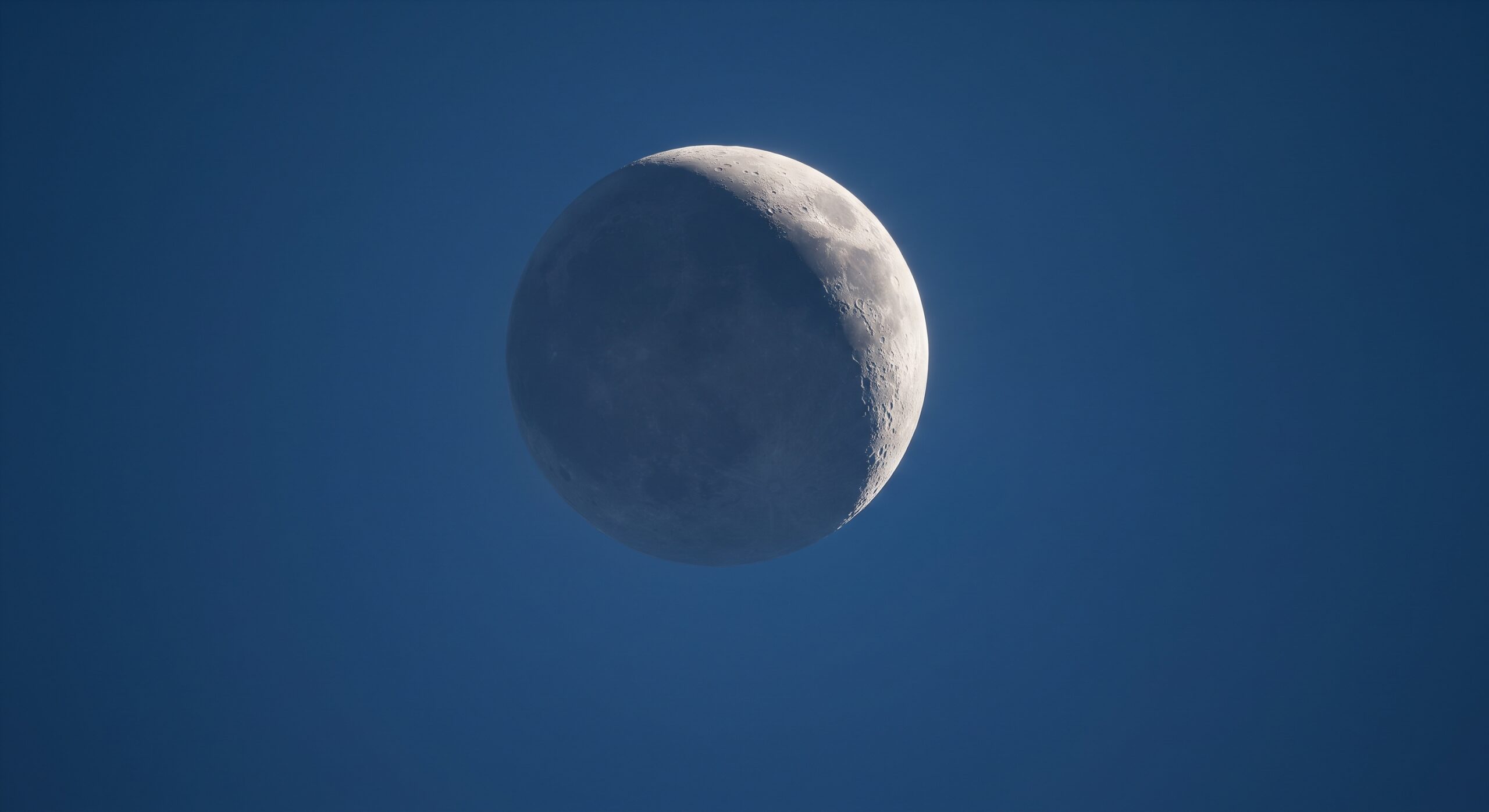
The single-frame exposure dramatically illustrates the contrasting surface reflectance and atmospheric physics governing our two nearest celestial neighbors. In the captured frame, both bodies displayed distinct crescent phases: the Moon exhibited a slender crescent with roughly 10 percent solar illumination, while Venus displayed a thicker crescent illuminated to approximately 25 percent.
Despite the Moon occupying an angular size vastly larger than distant Venus, Venus appeared noticeably more brilliant per unit surface area. This disparity is dictated by planetary albedo and solar irradiance. The Moon possesses a dark, heavily cratered anorthosite and basalt regolith with a low average Bond albedo of just 0.12, absorbing roughly 88 percent of incoming sunlight. Conversely, Venus is permanently enshrouded in dense, reflective clouds of sulfuric acid droplets that generate a Bond albedo of approximately 0.76. Combined with its closer orbit to the Sun, where solar flux is nearly double that received by the Earth-Moon system, Venus easily outshines the lunar terrain even in broad daylight.
Webb Investigates Alien Moon Nurseries in the Circumplanetary Disk of CT Cha b
Extending planetary architecture beyond our solar system, spectroscopic observations from the James Webb Space Telescope (JWST) are providing the first physical and chemical maps of an alien moon-forming factory. Utilizing the Mid-Infrared Instrument (MIRI), astronomers analyzed the circumplanetary disk encircling CT Cha b, a massive young exoplanet orbiting 625 light-years from Earth.
Circumplanetary disks are dense rings of gas and dust that coalesce around giant planets during their accretion phase, serving as the construction yards from which regular satellite systems emerge. Webb’s mid-infrared spectra detected strong molecular emission lines from warm, carbon-rich gas, specifically acetylene ($C_2H_2$), alongside crystalline silicate dust grains. This rich carbon chemistry indicates that exomoons forming around distant Jovian gas giants may inherit volatile inventories fundamentally distinct from the water-ice-dominated Galilean moons of Jupiter, reshaping theories of satellite habitability across our galaxy.
References & Data Sources
- NASA APOD (A Daytime Eclipse: Moon Occults Venus): https://science.nasa.gov/image-article/apod-2026-september-15-a-daytime-eclipse-moon-occults-venus/
- ESA/Webb Science Release (Moon-Forming Disc Around CT Cha b): https://esawebb.org/news/weic2521/
- NASA Science (Planetary Albedo & Atmospheric Dynamics): https://science.nasa.gov/solar-system/planets/venus/