Where Hubble Finds Darkness, Webb Sees Light: Revealing the Core of M64
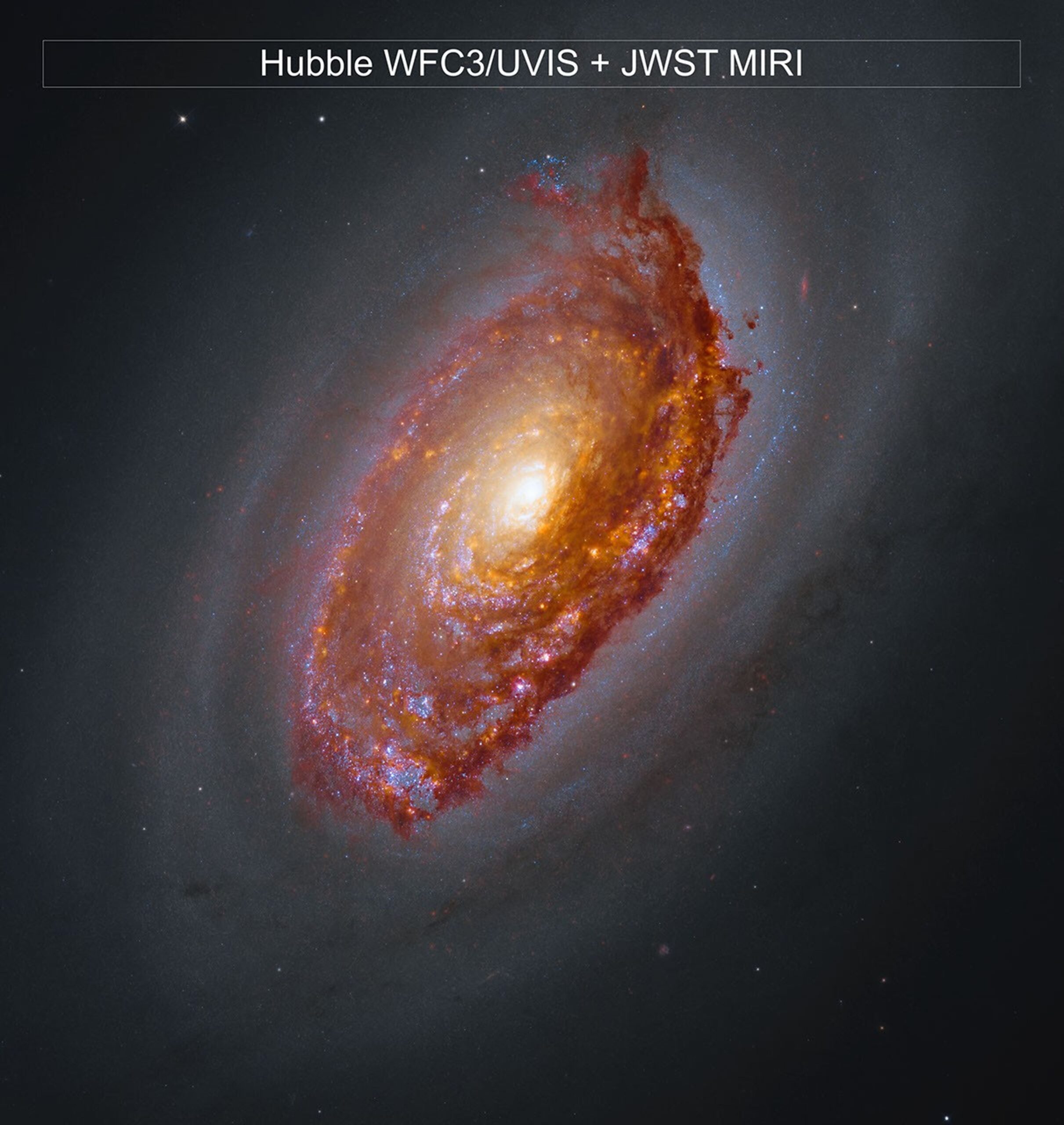
Featured on NASA’s Astronomy Picture of the Day, an exceptional cross-observatory composite pairs data from the Hubble Space Telescope and the James Webb Space Telescope (JWST) to examine Messier 64 (M64). Located approximately 17 million light-years away in the constellation Coma Berenices, this iconic spiral galaxy earned the popular moniker the “Black Eye Galaxy” due to a prominent, sweeping band of dark absorbing dust partially masking its brilliant nuclear core.
In visible light, Hubble captures this dense dust lane as an opaque silhouette that extinguishes background optical starlight while revealing bright pink knots of young stars along its outer periphery. However, observing at longer wavelengths with Webb’s Mid-InfraRed Instrument (MIRI) inverts the picture entirely: where Hubble finds darkness, Webb sees radiant light. MIRI’s detectors capture thermal emission directly from polycyclic aromatic hydrocarbon (PAH) molecules and warm silicate dust grains. As these dust grains absorb intense ultraviolet radiation from embedded newborn stars, they re-radiate that energy across the mid-infrared spectrum, tracing the hidden architectural skeleton of the galaxy’s starburst core.
Collision of Opposing Currents: The Counter-Rotating Gas Disks of the Black Eye Galaxy
Beyond its striking visual appearance, M64 harbors one of the most dynamic kinematic anomalies in extragalactic astrophysics: a massive counter-rotating gaseous architecture. Precision spectroscopic Doppler mapping reveals that the interstellar gas within M64’s inner core—spanning approximately 3,000 light-years in radius—rotates in one direction, while the gas across the expansive outer disk, reaching beyond 40,000 light-years, rotates in the exact opposite direction.
Where these two vast, counter-rotating fluid currents grind against each other along the shear boundary, immense hydrodynamic friction and shock compression occur. Cold molecular clouds are abruptly decelerated and compressed past their gravitational collapse thresholds, sparking an intense ring of rapid star formation. By mapping the kinematics, fine-scale clumpiness, and polycyclic dust composition within this collision zone, Webb’s high-resolution mid-infrared data provides observational benchmarks for how shearing gas flows regulate the efficiency of star formation.
Rewriting Spiral Galaxy Evolution Through Retrograde Mergers
The counter-rotating disks of M64 provide definitive empirical proof that spiral galaxies do not evolve in isolated tranquillity. Historically, classical models depicted spiral galaxies as static systems that formed their disks early and grew through slow, internal secular evolution. M64’s inverted kinematic structure demonstrates that dynamic mergers remain primary drivers of galactic morphology.
Astrophysicists deduce that roughly one billion years ago, M64 collided with and completely assimilated a gas-rich dwarf satellite galaxy whose orbital angular momentum was retrograde relative to M64’s primary rotation. While the stars of the swallowed dwarf dispersed into M64’s halo, its opposing interstellar gas survived, setting up the prolonged hydrodynamic battle observed today. Webb’s view of M64 illuminates how minor retrograde mergers replenish gas reservoirs, drive non-circular stellar orbits, and transform ordinary spiral galaxies into engines of violent starburst activity.
References & Data Sources
- NASA APOD (Webb’s View of M64): https://science.nasa.gov/image-article/apod-2026-september-16-webbs-view-of-m64/
- STScI / PHANGS-JWST Survey Collaboration: https://science.nasa.gov/mission/webb/
- NASA Science (Galaxy Mergers and Evolution): https://science.nasa.gov/astrophysics/