Opening the Treasure Chest: Webb Resolves Starbirth Inside the Carina Nebula
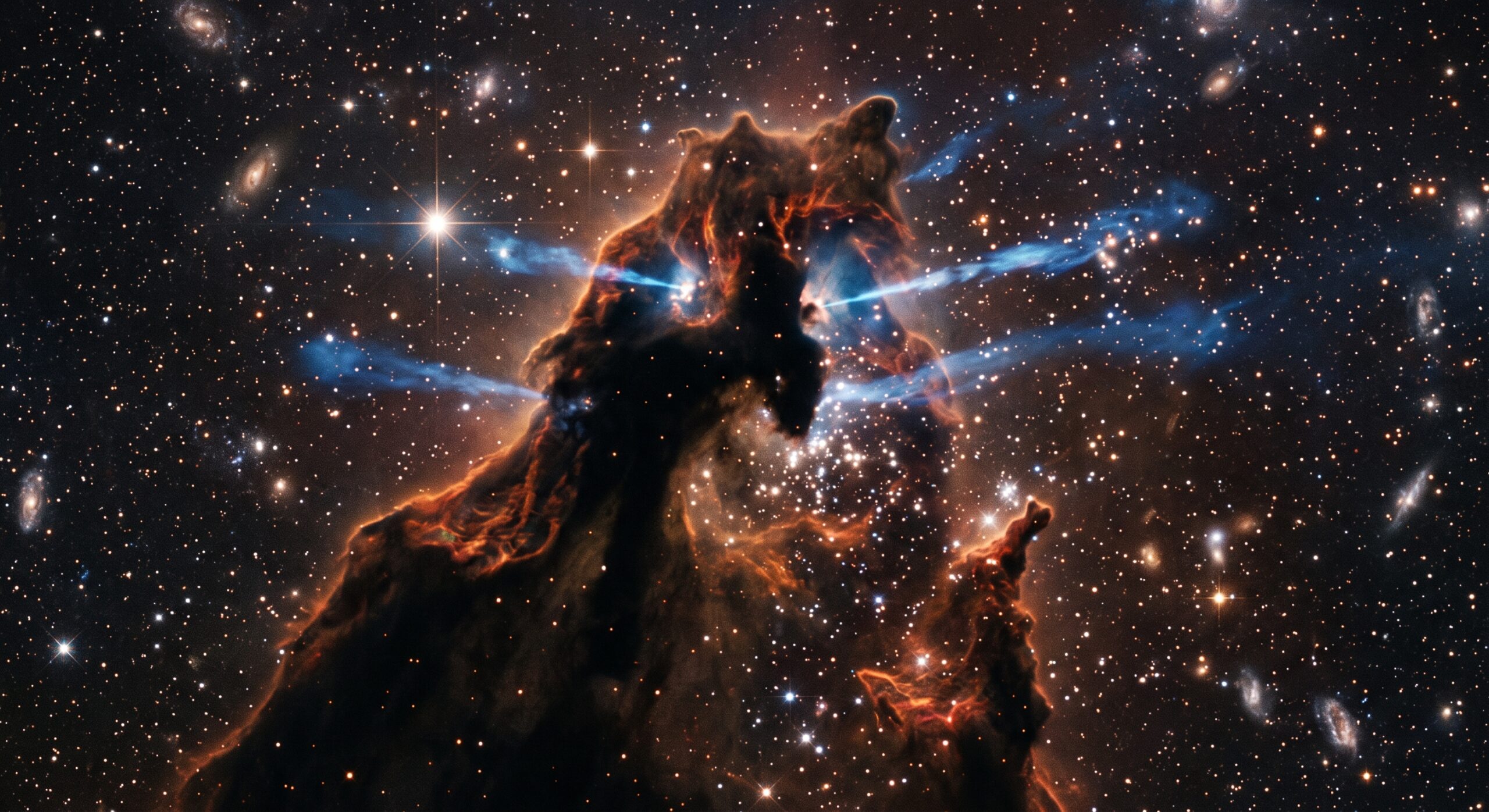
Featured on NASA’s Astronomy Picture of the Day, a breathtaking high-resolution observation from the James Webb Space Telescope (JWST) unveils the intricate inner anatomy of a cosmic “treasure chest” embedded within the Carina Nebula. Located roughly 7,500 light-years away in the southern constellation Carina, this dynamic star-forming complex contains some of the most luminous and massive stars in our galaxy.
Captured through a joint partnership of NASA, ESA, and CSA, Webb’s Near-Infrared Camera (NIRCam) and Mid-Infrared Instrument (MIRI) penetrated a towering pillar of interstellar dust that appears completely opaque to visible-light observatories. The high-resolution infrared mosaic reveals dozens of embedded protostars shining like brilliant jewels amidst dark, turbulent gas clouds. Blistering ultraviolet radiation and supersonic stellar winds from nearby massive O-type stars carve away the outer layers of the pillar through photoevaporative erosion, while triggering rapid gravitational collapse inside shielded gas pockets to initiate a new generation of star systems.
Interstellar Propulsion at 0.75c: Relativistic Aberration Challenges Laser Sails
Pushing the technological boundaries of interstellar exploration, a pioneering theoretical astrophysics study explores the hydrodynamic and optical physics of laser-driven lightsails accelerating toward relativistic velocities. Designed to reach nearby stellar systems like Alpha Centauri within two decades, concepts like Breakthrough Starshot plan to propel ultralight, gram-scale nanocrafts using gigawatt-scale phased laser arrays.
However, new simulations reveal a critical physical hurdle once a lightsail reaches 75 percent of the speed of light ($0.75c$). At such extreme velocities, relativistic aberration tilts the apparent direction of incoming laser photons forward, while relativistic Doppler shifts drastically compress the beam’s wavelength. This transformation alters the angle of incidence and photon momentum transfer across the sail, inducing destabilizing torques that can spin the craft out of the laser beam. Mitigating this effect requires developing dynamic metamaterials capable of modulating their refractive index in real time to maintain stable photon pressure during relativistic cruise phases.
Celestial Conjunction and Ocean Worlds: Saturn, Enceladus, and the Harvest Moon
In planetary astronomy, skywatchers worldwide are observing a stunning celestial conjunction on the night of September 17, 2026, as the luminous Harvest Moon rises alongside the golden ringed planet Saturn. While this pairing provides a breathtaking naked-eye spectacle, it highlights one of the most promising targets in astrobiology orbiting within Saturn’s system: the icy ocean moon Enceladus.
Despite its diminutive size—measuring just 500 kilometers in diameter—Enceladus harbors a global liquid water ocean insulated beneath a frozen crust up to 25 kilometers thick. Continuous orbital resonance with neighboring Dione induces intense tidal flexing that heats the moon’s silicate core, driving active hydrothermal vents at the ocean floor. Cryovolcanic geysers erupting from the south polar “tiger stripe” fractures vent water vapor, silica nanoparticles, hydrogen, and complex organic molecules directly into the vacuum of space, establishing Enceladus as a prime candidate for future robotic life-detection flyby missions.
References & Data Sources
- NASA APOD (A Treasure Chest in the Carina Nebula): https://science.nasa.gov/image-article/apod-2026-september-17-a-treasure-chest-in-the-carina-nebula/
- ScienceDaily (Interstellar Solar Sails & Relativistic Dynamics): https://www.sciencedaily.com/releases/2026/09/260902123000.htm
- NASA Science (Ocean Worlds & Enceladus Astrobiology): https://science.nasa.gov/solar-system/moons/enceladus/